

Why Rotary Apex Seals Fail
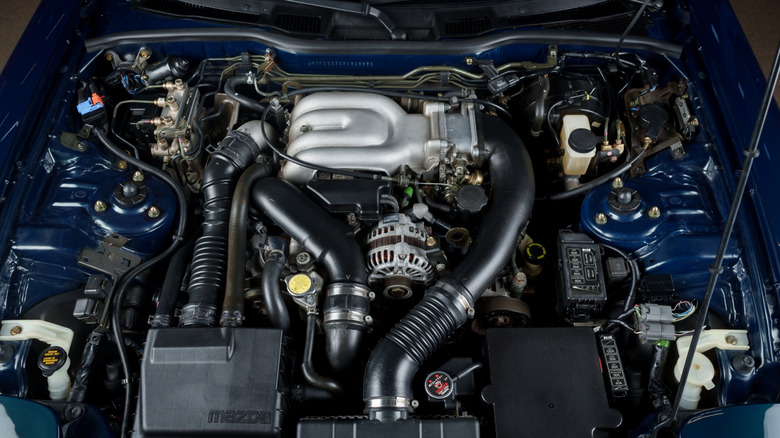
For better or worse, Mazda and the rotary engine are connected like vintage champagne and Gouda cheese. The rotary has since made a comeback in the Euro-only Mazda MX-30 Skyactiv R-EV, but it has transitioned into a range extender instead of a high-revving, oil-drinking yet silky-smooth powerhouse. However, nothing compares to the FD RX-7 and its twin rotor, twin sequential turbocharged engine, which we called the most intense bone stock car that you could get your hands on.
Mazda rotary engines are lighter, more compact, and have fewer moving parts than comparable piston engines, but they're not without downsides. Among other things, they're prone to developing sealing issues in the rotor housing, due to worn apex and other seals. Later Mazda rotaries (we're talking around 1985 to 2002) and their updated 2mm, three-piece cast-iron apex seals proved to be relatively durable in stock applications. Things change when adding some power-boosting engine upgrades, though, and you may need updated seals to cope with high-performance mods and nitrous oxide, à la Dominic Toretto from "The Fast and the Furious."
The reputation for premature failure of apex seals began with early Mazda rotaries, specifically those with 6mm cross-hollow and impregnated carbon apex seals, which were notorious for early wear and tear and for infusing the inner rotor housing with chatter marks — what Mazda engineers referred to as the "nail marks of the devil." Newer rotaries with 2mm cast-iron apex seals were not as bad. Then again, the apex seals have an important job, and they sacrifice themselves to get it done with every rotation. Those seals are like piston rings, but they live a harsher life inside the rotor housing and without adequate lubrication and frequent maintenance, they can succumb to detonation, wear, and high-rpm chatter.
Apex seals love oil (and oil changes)

And this, dear readers, is the truth behind rotary engines and apex seals. A rotary engine's design makes it drink oil like it's in an Irish pub, resulting in low efficiency and high emissions. It's for that reason that Mazda shelved the rotary in 2012. However, from a durability standpoint, rotary engines can hold their own with timely care.
Given more frequent oil changes (every 2,500 to 3,000 miles or every 3 months) and the necessary maintenance, turbo rotaries have been reported as lasting for 60,000 miles or more before needing a rebuild. Non-turbocharged rotaries can reportedly go 100,000 to 200,000 miles before the apex and other seals wear out to the point of significantly affecting compression, which is on par with standard piston engines.
Making the apex seals (and the engine itself) last longer has more to do with timely maintenance than anything else. Overheating is just as damaging to a rotary as it is to a piston engine, and so is running it with insuficient oil. That means that, although it's true that apex seals are frequently a sore spot for these engines, it often has more to do with insuficient lubrication than a flaw in the seals themselves. If your Mazda RX-7 or RX-8 has an illuminated oil warning light, stop driving immediately, and check the oil level to spare your apex seals from imminent death.
What are the signs of worn apex seals?

Given the precarious situations that apex seals have to endure inside the rotary housing, they will eventually wear out. Since the apex seals are some of the only parts that touch the rotor housing to create the necessary compression and produce power, the engine can produce a myriad of symptoms when the seals begin to fail.
Hard starting when the engine is cold is one of them, and the care will most likely idle erratically when it starts or emit a thicker plume of bluish smoke, which can be telltale signs the apex seals have gone kaput. Other symptoms include persistent misfires or drastic power loss, such as having difficulty accelerating or climbing steep gradients.
However, compression loss can be caused by other things inside a rotary besides the apex seals. Carbon buildup is one of them, and the only way to prevent it is to use high-quality oil (conventional oils work best) and occasionally rev the engine hard to hit the redline, allowing it to stretch its legs and burn off deposits. Moreover, deep scratches, flaking, and chatter marks on the rotor housing can also lead to compression loss.