

Mazda's Gram Strategy Is A Pursuit Of Lightness, But How Far Do They Take It?

It may not seem obvious just by looking at their cars, but Japanese automaker Mazda is obsessed with weight savings to make their cars and SUVs sportier and more fun to drive. Mazda's "Gram Strategy" is about shedding weight from every part of the car, right down to optimizing the bolts and nuts that hold everything together. It's why the iconic FD Mazda RX-7 weighed just 2,888 lbs, while competitors like the Mitsubishi 3000GT and A80 Toyota Supra paled in comparison with their 3,814 lbs and 3,560 lbs curb weights, respectively.
Toyota's two-door GR86 sports car has a curb weight between 2,811 and 2,833 lbs in manual guise. Meanwhile, the iconic Mazda Miata soft top tips the scales at 2,366 lbs. Sure, the Toyota is a bigger hardtop car and has what we call "occasional rear seats," but the decision to forego a metal roof and back seats is proof of Mazda's commitment to lightweight engineering, and it doesn't just apply to sports cars or coupes, either.
Mazda's "Gram Strategy" is about shedding weight from every part of the car, from the lug nuts in the wheels to the size of the seats. This strategy goes as far as redesigning or re-engineering parts to achieve the automaker's mission of lightweight simplicity. Mazda's passion for lightweight engineering and construction began way back in the 1960s with a tiny car known as the R360. That strategy continues today and shows up in all sorts of places throughout Mazda's history.
How the Mazda MX-5 remains the epitome of lightness
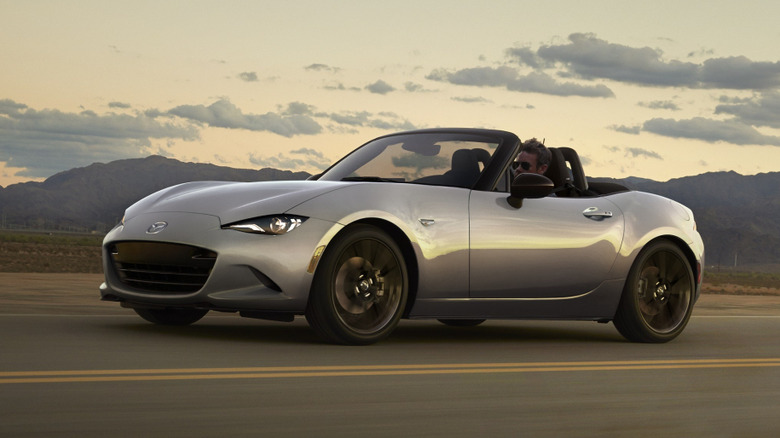
For the existing fourth-generation MX-5, Mazda went the extra mile to achieve lightness. The lightweight wheels have four lug nuts instead of five as part of the weight savings. Mazda redesigned the rearview mirror housing in an effort to shave off more grams, and the base of the windshield has drilled holes to do the same. Mazda even designed a slimmer seat-adjustment handle to shed weight. The Miata's tailpipes are polished and have no decorative exhaust tips, and Mazda ditched the battery cover to save more weight. Mazda became the first automaker to utilize ultra-high-strength steel for the body and floor assembly in the then-new CX-5 SUV in 2011, a strategy that carried over into the development of the ND Miata. It enabled Mazda to develop a stronger, stiffer architecture without adding weight.
More than just the body, the 2.0-liter engine got an aluminum block, lightweight plastic manifolds, and plastic cam covers to save weight. We're all ranting about the cacophony of plastics in the engine bay of a modern car, but in some cases, it's done to save weight. That's not all. That's not all. In an interview with Motor1, Chief Designer Masashi Nakayama noted that engineers were advised to create a new HVAC system, one that would be the lightest and most compact in its class. Whether that was actually achieved, though, remains unverified. Combined with the MX-5's exceptional balance and near-50:50 weight distribution, it's no wonder that it remains one of the most legendary and nifty handling roadsters of the modern era. Mazda's Gram Strategy laid the foundation for the automaker's existing Skyactiv technologies that focus on efficiency gains for the entire car.
Another Gram Strategy example: the Mazda 2

The Miata is well known for its lightweight performance enhancements, but another great example of the Gram Strategy is the Mazda 2 subcompact. Former Mazda Japan program manager Shigeo Mizuno had no specific weight targets when developing the then-new Mazda 2, but he envisioned a small car that weighed around 220 lbs less than initially planned. Others at Mazda thought it was an insane idea, but it was only ludicrous until they managed to pull it off. "If we could just make each part one gram lighter, it would add up to several kilos," said Mizuno.
At Mizuno's direction, the Mazda 2's engineering team was able to make the body lighter by 66 lbs, while the chassis and engine were 44 lbs and 22 lbs lighter, respectively. The weight savings fell short, though, so they went even deeper and re-engineered each part of the car to achieve its goal. They looked at every part, big or small, to meet the lightweight standards. Gram Strategy is still in full swing today, and it goes into every Mazda car on the road. It isn't just small cars like the Miata or Mazda 2; it even applies to its large SUVs, including the big and beautiful Mazda CX-9.