

Why European Traffic Lights Show Red And Yellow At The Same Time
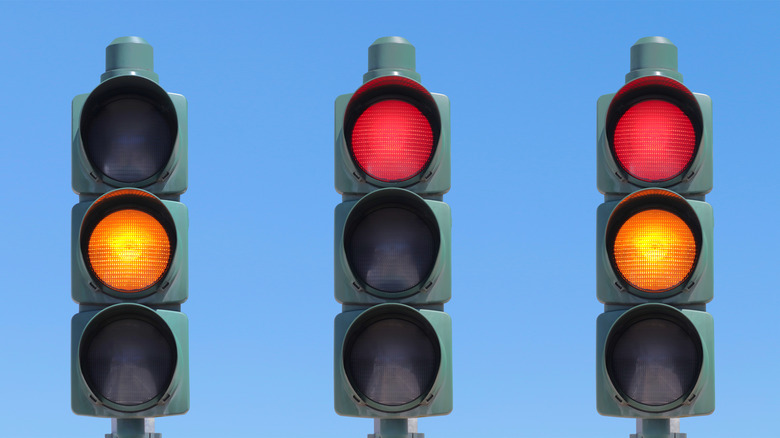
At first glance, European traffic lights look the same as the ones most American drivers are used to: red on top, amber in the middle, green on the bottom (unless you're in one of the few states where the signal is mounted horizontally). The difference is the order they appear in. When transitioning from red to green, in many European countries, including the U.K., Germany, and Poland, both the red and amber lights light up simultaneously for a brief moment.
That combination exists to signal the drivers that the red phase is ending and the green phase is about to start. It's a "get ready" alert for the drivers, so that they know in advance what decision to make. The sequence still uses a single amber light when transitioning from green to red, so drivers get a warning signal on both ends.
The key difference between U.S. and European states is that in the U.S., whether the signal is turning from red to green or green to red, only the yellow light comes up during the transition. With the European sequence, both transitions are clearly marked.
Some countries go even further with extra visual warnings
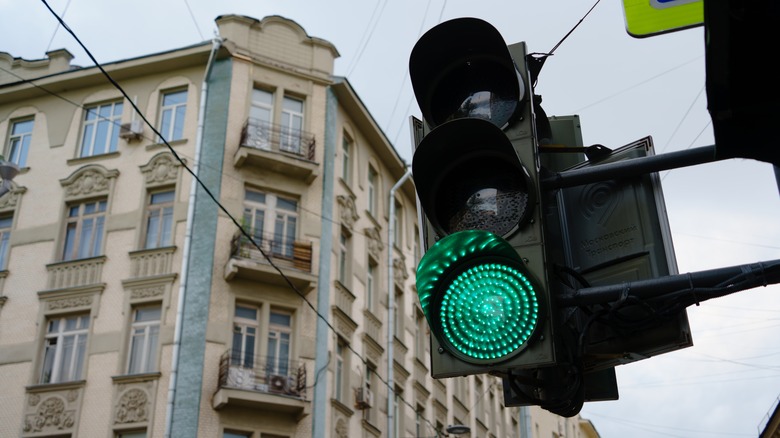
In parts of Europe and beyond, the red and amber pairing isn't the only extra cue drivers get. Some countries, such as Russia, Austria, Latvia, Israel, Estonia, Mexico, and Turkey, go a mile further and offer an additional signal. They have a system in which the green light blinks before turning to amber. In Tianjin, China, an unusual traffic light system appeared around 1999. It uses a horizontal colored bar that slowly shrinks to show how much time remains before the signal changes to a different color, with blinking phases warning drivers to slow or proceed cautiously.
All of these steps are to prevent drivers from facing what experts call the "dilemma zone." This is when drivers often face a dilemma about whether to proceed or stop when the signal turns yellow. The more early warning systems employed before that happens, the more time drivers will have to make up their minds.
We all know as drivers that we make our decisions mere seconds before reaching an intersection with a traffic light. This makes poorly timed transitions dangerous, and they can increase the likelihood of side-impact or rear-end accidents, especially at intersections known to be deadly. Blinking or simultaneous lights can be a great precaution to prevent these accidents from happening.
Why the U.S. doesn't use the same system
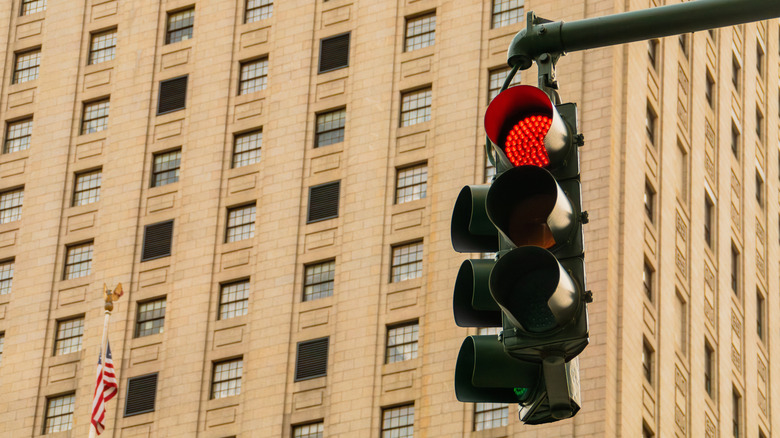
If these early warning indicators are so beneficial, the obvious question is, why doesn't the American traffic light system use them? The major reason is that almost all U.S. traffic signals are controlled by the Manual on Uniform Traffic Control Devices, which explicitly bans any kind of "pre-yellow warning" signals that would alert the driver that a change is imminent.
The reasoning the Federal Highway Administration gives for this is that such signals "have been found to lengthen the 'dilemma zone' and thereby result in increased crash rates." Others posit that advance warnings prompt unpredictable actions by drivers. Critics of the ban argue that these behaviors already happen a lot, and that the best way to tackle them is through clearer signs. But the U.S. seems to be going the opposite direction, with pedestrian traffic signals that are confusing drivers even more.
There's also historical inertia. The basic three-color system has remained largely unchanged for decades, even as vehicles and driver behavior have evolved. Some researchers and engineers are now exploring alternatives, including adaptive signals that work with each driver's ability to react, as well as vehicle-to-infrastructure communication that could provide personalized warnings inside the car.