

What Adding A Cold Air Intake Can Do For V8 Horsepower
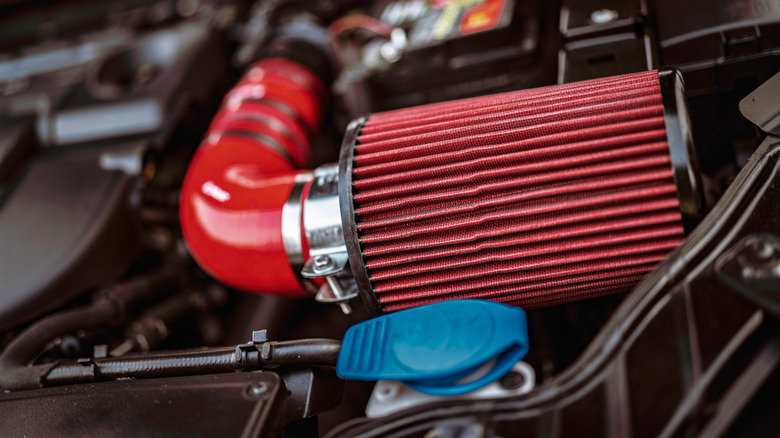
Having a V8 engine does not always guarantee big power. Some, like the early 350-horsepower LS1, are tuned for drivability and usable power delivery, not necessarily outright horsepower performance. As a result, in stock form, the LS1 can feel underpowered next to some V6 engines. The upside is that the LS1 responds well to bolt-on modifications. With the right upgrades, it can produce several times its factory output, with extreme builds exceeding 1,000 horsepower.
For many LS1 and other V8 owners, the first and simplest step in unlocking that potential is adding a cold air intake (CAI). On average, a CAI is likely to give an engine between 5 and 25 horsepower. Still, the exact amount depends on engine size, existing modifications, air quality, temperature, as well as your car and the specific intake system chosen. For example, for a GM 5.3L EcoTec3 V8, a K&N CAI can give it between 5 and 18 horsepower.
Similarly, a GM 6.2L V8 can gain about 21 horsepower, a Ford 5.0L Coyote V8 can gain 20 to 25 horsepower, and a RAM 5.7L HEMI can gain 18 to 23 horsepower. Besides numbers, a CAI upgrade improves throttle response, intake sound, and can help boost fuel efficiency. On the topic of CAI, MotorTrend explains: "It has been proven time and again here in our pages and elsewhere that properly designed cold air intakes do help improve power." Here's why it's worth considering for your V8.
What does a cold air intake do?
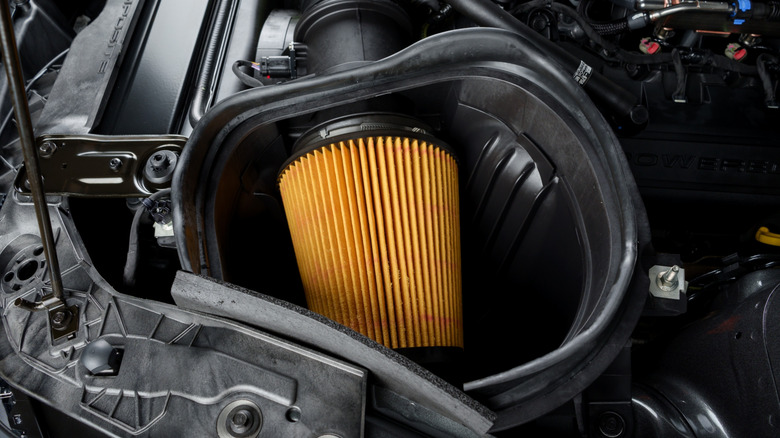
For a spark-ignition engine to make power, it needs three basic ingredients: air, fuel, and a spark. When the air reaches the engine, it enters the combustion chamber, gets mixed with fuel, and is then ignited with a spark. This controlled explosion pushes the piston up and down, and that's what rotates the crankshaft and makes power. Colder air is denser than warm air. This means it contains more oxygen molecules for the same volume. As a result, CAI upgrades can boost performance.
Therefore, if you add cooler air, the engine can burn fuel more efficiently, produce more power, breathe easier, and respond faster to throttle inputs. A CAI does this by moving stuff around. Specifically, it relocates the air filter and tubing away from hot engine compartments. This is one of a few benefits of a cold air intake. Moreover, many aftermarket CAI upgrades also include larger-diameter mandrel-bent tubing with less air resistance, meaning the air can enter more freely and at a higher volume.
With high-flow filters made out of oiled cotton or dry synthetics, CAI systems will also optimize airflow, either by making the air cleaner and more consistent or by increasing the volume. When paired with additional heat shields and enclosed airboxes, the air is even more shielded from hot engine compartments. CAI power gains are typically higher with forced induction since these engines are designed to push in more air and thus have a more meaningful impact on overall boost pressure.
Maximizing V8 horsepower with a cold air intake
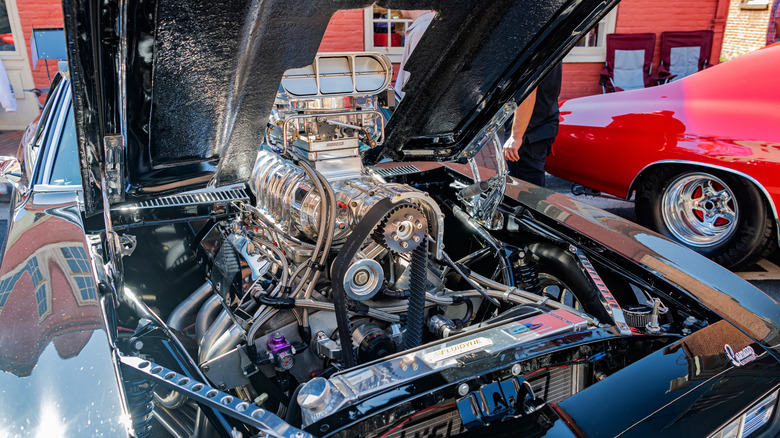
A V8 engine is larger compared to a V6 or a V4. This means that V8s can burn more fuel and air, and have higher gain potential. A CAI can help boost that power, but it only represents a part of the overall equation. For a traditional four-stroke engine, a CAI improves the intake stroke, but if you pair it with exhaust modifications — one of a few car mods that actually make your car faster — you are also improving the exhaust stroke by reducing exhaust backpressure.
Since a cold air intake has a meaningful effect on throttle response, it also makes sense to pair it with a high-flow throttle body or an intake manifold upgrade. Both of these complement a CAI upgrade by allowing the additional cold air to flow more freely into the engine. This further reduces restrictions and improves volumetric efficiency, especially at higher RPMs. Consequently, the engine can take in more oxygen-rich air per intake stroke, which maximizes combustion and power output.
Another modification that works well with a CAI is a performance header system because it expels exhaust gases more effectively. This also improves the "breathing" aspect of an engine because the overall airflow choke points are reduced. When paired, these modifications deliver greater performance than they could individually. Therefore, if you want to maximize potential and squeeze out all the power, consider doing them together.