

Will Scratch Remover Ruin Your Paint Over Time?
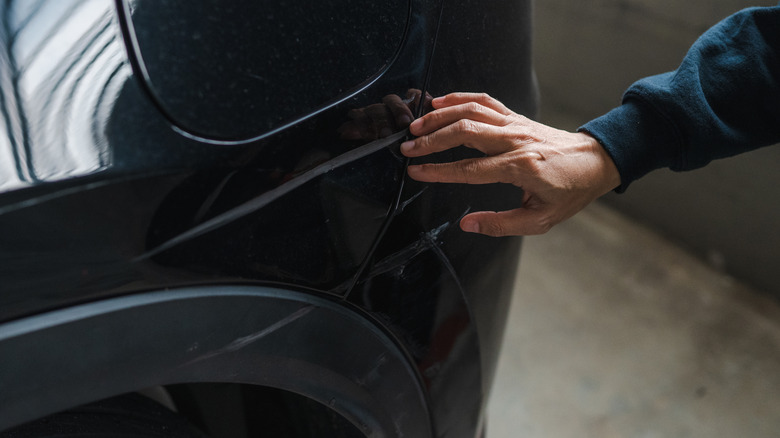
Seeing scratches on your car can feel incredibly frustrating, but it's one of those inevitables, shall we say. No matter how much you baby your prized possession, a scratch or blemish may eventually find its way onto your vehicle's paint. There are, of course, several DIY scratch removal methods that you can resort to, like maybe using WD-40 on your car's paint. However, it's important to assess the scratch itself before deciding on the next course of action.
For instance, minor blemishes (like those scratches inside your door handles) can be dealt with using scratch removers, while deeper ones often require a professional touch. A rule of thumb is to run your finger along the scratch and see if your fingernail catches. If yes, then you're beyond DIY repairs. If it's not as obvious to the touch, scratch removers may work. But will they ruin the paint? The short answer is no. The long answer is that it depends. That said, as long as you use the product properly, the car's paint should be fine.
Here's the thing: There are different types of scratch removers available. Some of these are pretty straightforward and require about as much time and effort as washing your car. Others can be a bit tedious and involved, especially those that require sanding. The latter type, if not used correctly, can lead to long-term paint damage.
It's all about the clear coat
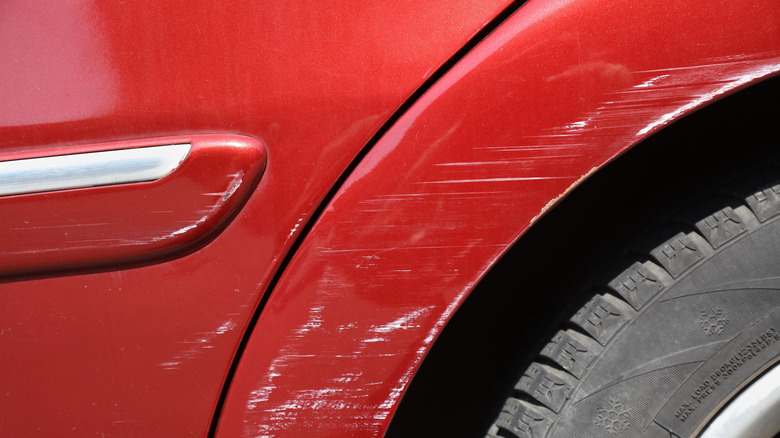
Understand that a scratch remover is not necessarily removing anything, it's merely blending the lightly scratched surface to the car's finish by making it smooth and even. The scratch, therefore, is no longer as apparent as it used to be. Polish-based and pen-type scratch removers are often the easiest to use, while compound scratch removers generally require sanding and a bit more manual labor.
Scratch removers shouldn't be of concern as long as your car's clear coat is intact. It's worth pointing out that scratch removers are mild abrasives that typically work by removing a thin layer of the paint's clear coat. Scratch repair pens, on the other hand, use a clear coat resin to mask the blemish, although their effectiveness is somewhat questionable.
Automotive clear coat thickness typically ranges between 38 and 50 microns, which is about 40% of the paint thickness itself. Depending on the product used, polishing can take away anywhere from 2 to 5 microns of clear coat, which is par for the course. Keep in mind that aggressive polishing or sanding can cause the clear coat to thin out more. If too much clear coat is removed, you're looking at future paint damage in the form of fade, oxidation, peeling, and so on. Make sure you use scratch removers properly, otherwise, things can go from looking bad to worse fairly quickly.