

11 Cars With Remarkably Short Production Runs
Do you remember that one restaurant in your town that serendipitously sprung out of nowhere and knocked your socks off, only to disappear a few years later? Well, we do — it was called Richie's Burger Urge (sounds appetizing, no?). Richie's was so good that it transcended our perception of how long it had been in business. Our rose-tinted memories tell us the joint had been there forever, but, in reality, it enjoyed a fairly unremarkable and short tenure at the local strip mall, where it served greasy burgers for a while before evaporating into thin air.
In a roundabout way, this is exactly our automotive topic of the day — cars that, for one reason or another, existed on showroom floors for an incredibly brief period of time. There are countless vehicles from past years that could qualify for this concept, whether they be million-dollar specials that were purposefully 1-year-only products or boring economy cars that were sales flops for a reason. We've chosen to meet somewhere in the middle.
This group of 11 cars was neither boring nor worth a million dollars when new. However, they all had production runs that you forgot were so short because of how impactful they've become over time, hence the stupid Richie's Burger Urge analogy. Indulge us, won't you?
Mazdaspeed Protege (2003 only)
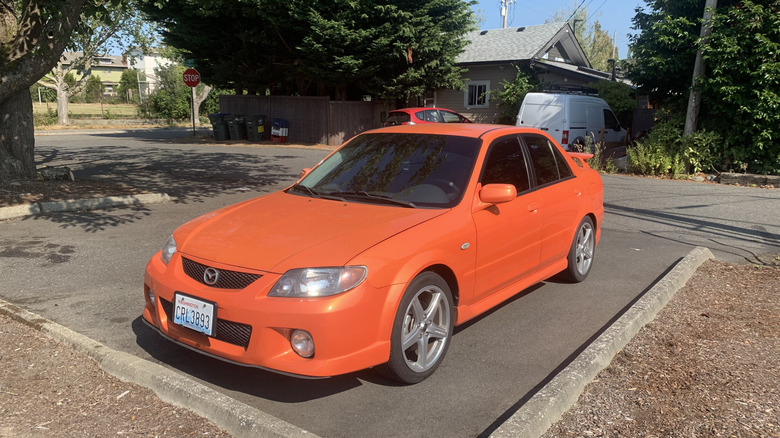
We've received several go-fast Mazdaspeed products over the years, but the Mazdaspeed Protege was the first and rarest of them all. Debuting for the 2003 model year only, the MSP, as it's colloquially known, was a major player in the hot compact segment of the early 2000s, competing against such formidable foes as the Honda Civic Si, Nissan Sentra SE-R Spec V, and Dodge Neon SRT-4. Though, despite its extremely brief production, the MSP was a project of huge scale involving five different companies.
RacingHart was in charge of the special five-spoke alloy wheels, Racing Beat handled the MSP's sport-tuned suspension, Kenwood headed up the sound system (which was really nice for 2003, by the way), and Callaway Cars had the most important job of all — turbocharging the 2.0-liter, dual-cam inline-four. Oh, and Mazda was involved.
The result was 170 horsepower and 155 pound-feet of torque (courtesy of a Garret T25 ball-bearing turbo), a five-speed manual transmission, and a knife-edge feel unbeaten by its competitors. Everything, from the Sparco pedals and shifter to the white Mazdaspeed gauges and some of the coolest factory exterior colors ever painted on a production car, combined to create the automotive equivalent of a sugary soda — densely packed fun, all the time. Over the course of 2003, Mazda built just 4,500. The first batch, produced in the first half of the year were either orange or black, and the second batch (known as the 2003.5) was available in yellow, blue, silver, and gray.
Buick GNX (1987 only)
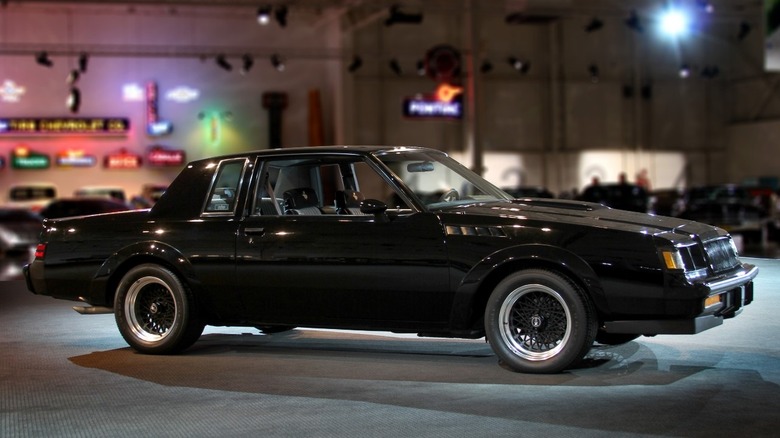
Either you only recently found out about the GNX because of Kendrick Lamar, or you have lusted after this piece of American muscle history for years. Regardless, all you need to know is that for one year only in 1987, Buick gave us the ultimate Grand National.
To sum up the story painfully briefly, the turbocharged V6 for which the GNX is legendary first popped up in 1973 with a small GM side-project and was later stuffed into a Buick Century for use as an official NASCAR pace car. That idea soon sprang into a production engine, and by 1982, Buick decided to make a commemorative edition of the Regal for its 1981 winning car in the Winston Cup Series, which was previously called the Grand National Series. See where this is going?
The Regal Grand National was special in its own right, but by the mid-1980s, its engineers knew that higher-ups were plotting its discontinuation. To send it off with honor, the team was allowed to set up a separate project with ASC/McLaren (based in the U.S.) to build the most sinister Grand National possible. This was the GNX. Standing for Grand National Experimental, it featured an even meaner tune for the turbocharged 3.8-liter V6 and produced 276 horsepower and 360 pound-feet of torque. At 4.7 seconds to 60 mph, it was the second-fastest production vehicle Car and Driver tested in 1987, second only to the Porsche 911 Turbo (it was only 1/10 of a second behind).
Ford Edsel (1958-1960)
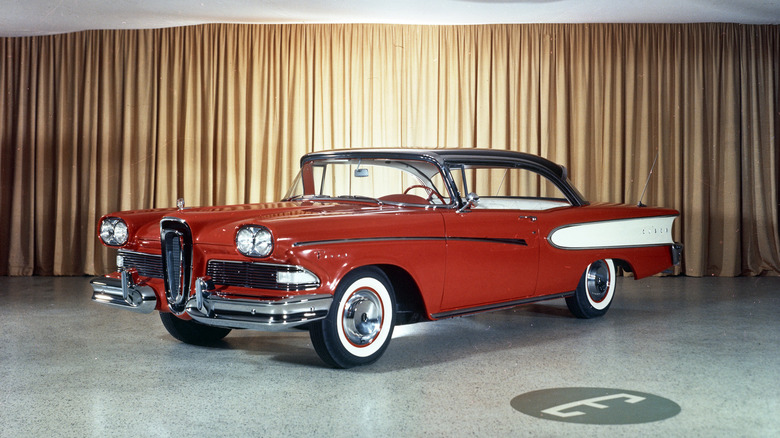
If there's one car on this list you definitely knew had a short run, it was the Ford Edsel. This poor car is consistently lauded as one of Ford's biggest sales flops, and while we love it, one can't deny how hot of a mess the Edsel project truly was.
Launched in 1958, the Edsel was a big, full-size vehicle that Ford positioned as a car of the future. In many ways, it was, with such innovations as self-adjusting brakes, an electronic hood release, a floating and glowing speedometer, and even a transmission lockout system that kept it in park until the ignition was turned over. It was also offered with a range of engines over its 3 years of production, all the way from the small 223-cubic-inch straight six to the massive 410-cubic-inch MEL V8.
But when the Edsel hit the showroom floor, it fell on its face. A combination of its polarizing styling cues, early technical issues, insufficient market research, flaky dealers, and bad economic timing failed to uphold the story Ford had sold to the public. After all was said and done, Ford lost around $350 million on the project, and its poor sales drove the final nail into the coffin after just 3 years.
GMC Syclone (1991 only)
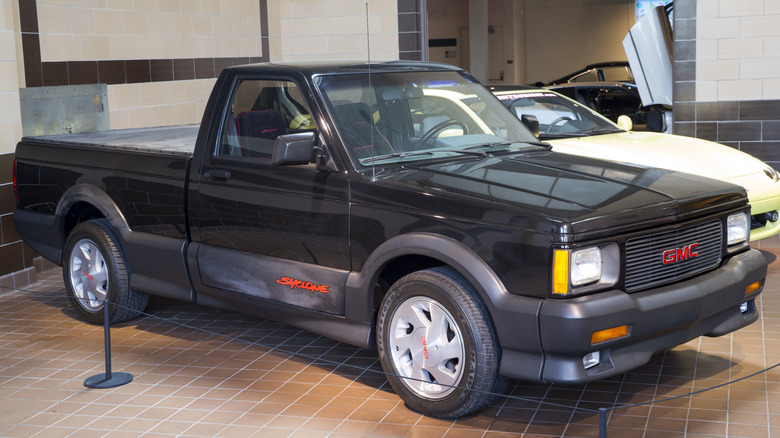
After the Buick Grand National and GNX were killed off, GM employee Kim Nielsen got worried. He recognized that once those hot Regals were gone, GM would be lacking in the fun department and would quickly need a supplement. This is when he birthed the idea of the Syclone. It was to be a compact pickup truck, stuffed with the guts of the outgoing Grand National, that could outrun sports cars worth several times more. GM wouldn't allow the 3.8-liter turbocharged V6 idea, so, instead, they set their sights on Chevy's 4.3-liter V6 and went about turbocharging it.
Two third-party companies competed for the right to build the Syclone — ASC/McLaren (which helped with the GNX) and Production Automotive Services (PAS). Both turbocharged the V6 with ease, but while ASC/McLaren left it as is, PAS went a step further with an all-wheel drive system.
This quickly won over Nielsen, and after some additional development on the V6 and its all-wheel drive system, the GMC Syclone went on sale. Its 280 horsepower and 350 pound-feet of torque shoved the expertly styled black and red truckling to 60 mph in under 5 seconds in early models. It was everything GM advertised, but it was not a great seller. Truck buyers wanted more space and towing capacity than passenger cars, and GM's other products could cover all those bases for less money. Thus, after just one year of production, the Syclone was swiftly killed off.
Lincoln Blackwood (2002 Only)
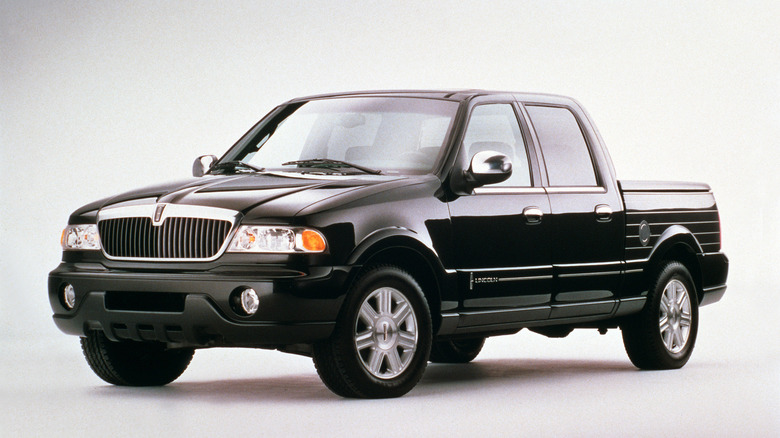
In the early 2000s, luxury SUVs were cropping up everywhere. The BMW X5 was pioneering utility design, the Escalade was illustrating big-body style, and Acura was gearing up to release what would become a segment-defining small SUV, the RDX. But Lincoln was arguably the only brand brave enough to take the concept one step further. In 2002, they released the Blackwood — a mid-size truck that would combine the rising demand for luxury with an elevated utility experience.
Based on the then-current F-150, the Blackwood also borrowed the front fascia and interior from its Lincoln brethren, the Navigator. Under the hood, though, is where the F-150 DNA fully faded away. It got the 300-horsepower 5.4-liter DOHC V8 — something the F-150 never did. Out back, the bed was a complete departure from the typical design. Polished aluminum lined the edges of the bed, and instead of plastic or metal, the bed floor was carpeted and lit with LEDs. The whole deal was covered with an automatic tonneau cover, á la Cybertruck, to keep your precious cargo dry at all times.
The concept of a luxury truck, at least in the way that Lincoln executed it, wasn't all that attractive to utility buyers at the time (and it was cancelled after one year). However, we have to say, it's a shame that the Blackwood never got its flowers for how it accurately predicted the wave of luxury pickups that would follow over the next 20 years.
Fisker Karma (2011-2012)
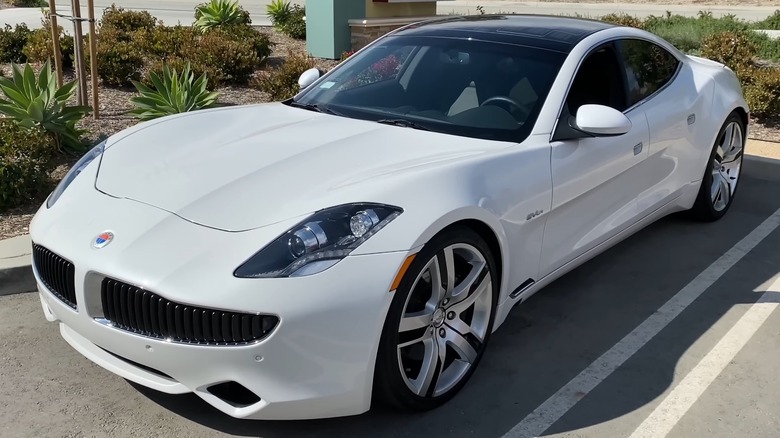
The person behind the then-promising start-up, Fisker, was Henrik Fisker himself, a man of Danish descent who had previously designed some of the most beautiful cars of the late 1990s and 2000s, including the Aston Martin DB9 and V8 Vantage, as well as the BMW Z8. However, Fisker Automotive's own initial entry into the industry instead came in 2011 by the way of the Karma, a futuristically designed plug-in hybrid luxury sedan.
It used a 2.0-liter turbocharged engine, sourced from the already dead Pontiac, as a generator for two AC electric motors, which sent 402 horsepower to the rear wheels. Its sleek, alien character was eye-catching, no doubt, but with a price of around $100,000, the Karma was a hard sell.
It seemed that misery was the only fate for the Karma, and really for Fisker as a whole. Right around the time when the Karma had made its concept debut in 2008, the company was slapped with a lawsuit from Tesla, alleging stolen designs. And after its release, the Karma was marred with reports of poor build quality and even battery fires. In the end, only around 2,500 total units were produced, and a year later in 2013, Fisker Automotive filed for bankruptcy.
Pontiac G8 (2008-2009)
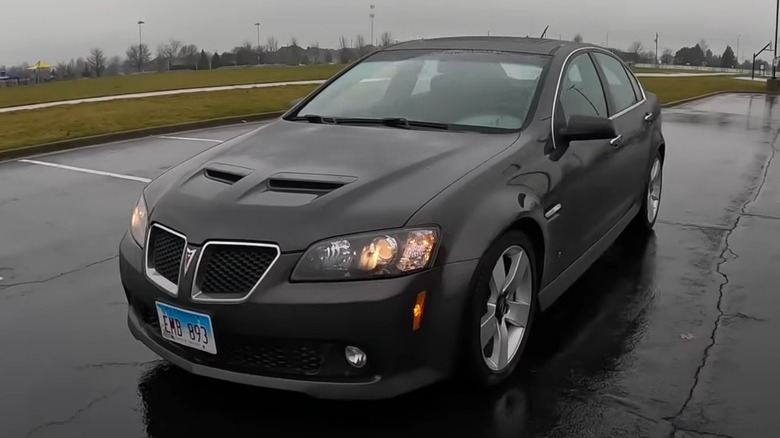
The aughts were anything but kind to Pontiac. Slow sales and dwindling interest cast the writing on the wall years before it ultimately died off in 2010, but the historic American manufacturer didn't go down quietly in its final years of operation. We'd go as far as to say that some of its last products are the ones enthusiasts, especially those who grew up in the 2000s, may remember most fondly.
One of them was the Pontiac G8, an Australian Holden Commodore-based sport sedan that featured a new platform (GM Zeta) and a trio of engines during its 2-year-long stay on the factory line. The base engine was a 256-horsepower V6, though the GT trim was the true crowd pleaser, utilizing a 6.0-liter V8 capable of 361 horsepower. Later, we also got the GXP variant, which boasted the Corvette's 6.2-liter, 415-horsepower V8 and a six-speed manual (the GT was auto-only).
The G8 had many things going for it to genuinely compete with big hitters like the BMW M5 — agility, raw power, and an affordable price (about $30,000 for the GT, and $40,000 for the GXP). GM was even planning a hot wagon body style, too. But timing's a cruel devil. The '08 and '09 cars were the only model years we got, and more than 15 years departed in 2025, we miss it dearly.
AMC AMX (1968-1970)
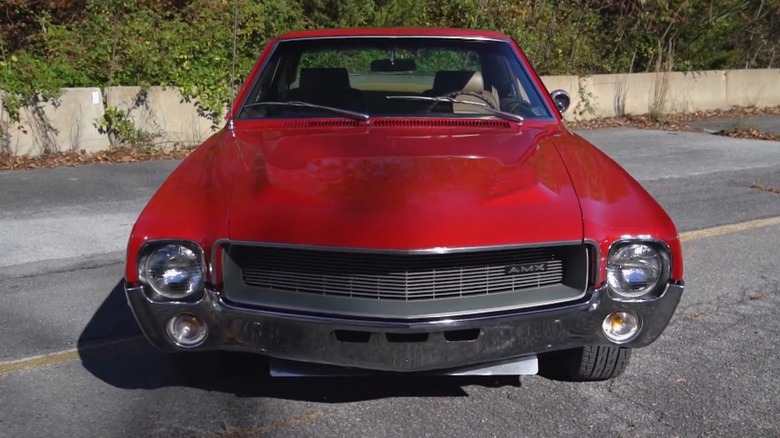
AMC stood proudly as the sole independent soldier in the 1960s horsepower wars that focused so heavily on the Big Three. The manufacturer would debut potent versions of models like the Ambassador, Rambler, Rebel, and even the Hornet, but none took the fight to the automotive giants as ferociously as the AMX.
This thing was stocky, like body-building pit bull stocky. It was 12 inches shorter than the Javelin it was based on, and it didn't even have rear seats, making it one of the only true two-door sports cars you could buy at the time, other than the Corvette. However, its petite stature didn't translate to anything else on the car. AMC only allowed V8s under the hood of the AMX, ranging from the 290-cubic-inch V8 up to the big daddy 390.
AMC owners back in the day made up just a tiny fraction of the market share that Chrysler, Ford, and GM dominated during the peak of the muscle car era, but the existence of the AMX gave AMC the new buyers it desperately needed (for the time being). By 1970, though, it was too late. Sales were only okay (19,134 units were built over 3 years), and they couldn't keep up as the underdog number-four brand in America. It spelled the end for the quirky coupe as a model, and the AMX moniker would only show up once or twice more in the late 1970s as a trim package for other AMC models like the Spirit.
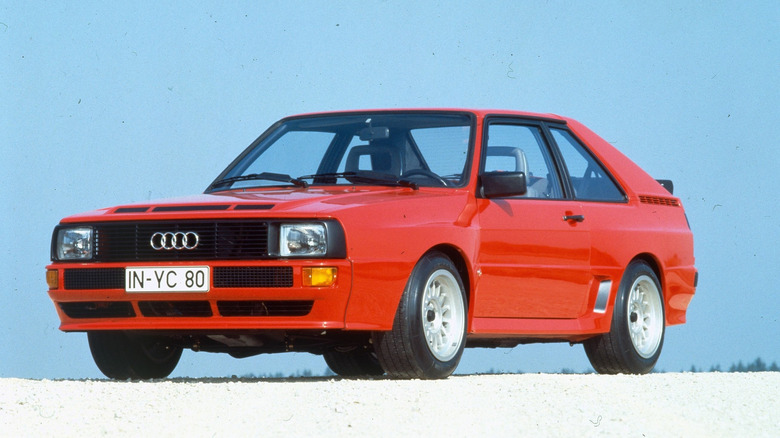
Audi Sport Quattro (1984-1985)
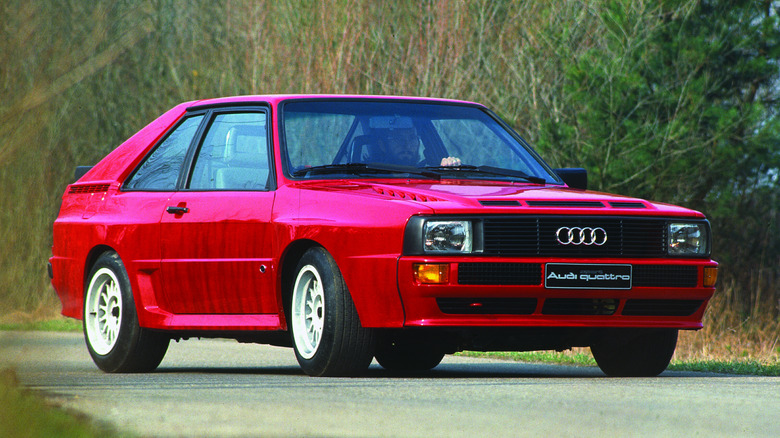
Homologation cars are a bit of a cheap shot within the confines of the rubric we've set up for this list, because, after all, their shelf-lives are designed to be short — qualifying them for a racing series that may only last a few years. That's exactly what happened to the Audi Sport Quattro, but this car is so influential in the rally zeitgeist that we bet you didn't know it was built for just 2 years in 1984 and 1985. Talk about a good impression.
Audi was the unequivocal king of 1980s rally racing. Simply nothing was more adept at handling all kinds of surfaces and weather than the Quattro's all-wheel drive system. But when the Group B rally competition ramped up in the middle of the decade, Audi designed one of the most iconic motorsports machines of all time to assert its dominance, the Audi Sport Quattro S1.
To compete, however, homologation rules stated they had to sell a few for the road. This is how we got the Audi Sport Quattro. It sported a 2.1-liter turbocharged five-cylinder, throwing down 306 horsepower to all four wheels. It had box flares, extra vents, a new interior, and a shortened wheelbase, just like the rally car. Due to the fleeting and dangerous existence of Group B that ended in 1986, Audi didn't need to build any more after '84 and '85, and of the 214 examples built, only 160 were designated for the road.
BMW 1-Series M Coupe (2011-2012)
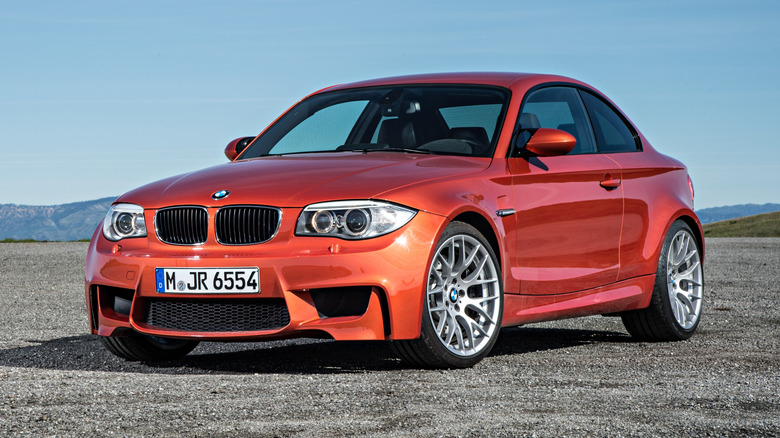
BMW's 1-Series M Coupe shouldn't have been so good. It was conceived as what we in the industry call a "parts bin special," a vehicle that is not itself a homegrown, ground-up sports car, which borrows its most crucial parts from those that are. But who better to borrow from than one of the world's greatest performance divisions — BMW M?
Purists were enraged, as they often are, mostly because the 1M Coupe didn't use a proper M-Division engine, instead opting for the powerplant from the Z4 sDrive 35is. It was certainly no S65, with its naturally aspirated screaming V8 symphony, but it was plenty. Specifically, the 1M got the Z4's twin-turbocharged 3.0-liter straight six, making 335 horsepower and 370 pound-feet of torque. But those angry sticklers should have known BMW wasn't messing around when the only transmission available was a six-speed manual.
The 1M coupe used the then-current E90/E92 M3's rear suspension and subframe, dampers, brakes, and limited-slip differential, all inside the adorable body of the little 1-Series Coupe, transforming this platform into one of BMW's best drivers of the last 20 years. From the beginning, the 1M was supposed to have a limited and brief production cycle. So, even after the outpouring of love for the car forced BMW to increase production from 2,700 to 6,331 units, its fate was sealed, being built for only a short time in 2011 and 2012.
Ford RS200 (1984-1986)
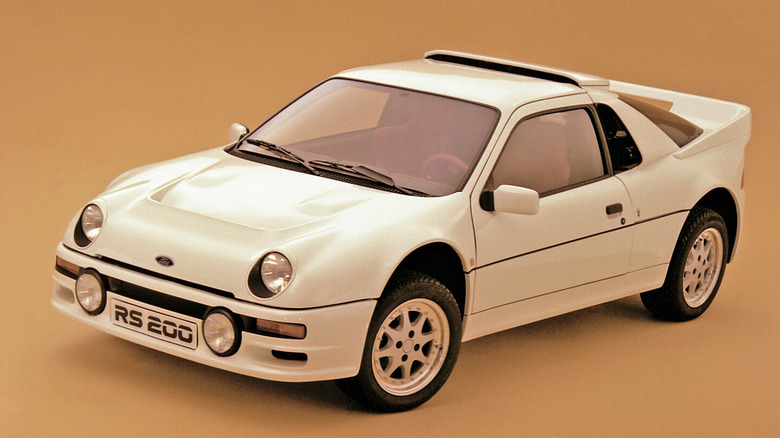
For traitors of the heartland (us included), the RS200 is easily the coolest Ford ever built. Why are we enemies of the state? Well, funnily enough, the RS200, despite proudly wearing its gleaming blue oval, was designed and produced almost entirely by Ford's British division. But if you're a true American Ford person, you can take some solace in the fact that this wickedly slick-looking rally car was, by most metrics, a failure in the World Rally Championship.
Like the Audi Sport Quattro from above, the RS200 was designed to compete in Group B rally, and, as such, a small number (est. 200 units) of road-going examples were sold to the public between 1984 and 1986. It used a 250-horsepower Cosworth-built turbocharged 1.8-liter inline-four, though it was reportedly capable of a terrifying 800 horsepower in full race spec.
Underneath, this thing was odd. Its transmission was situated in the front of the car, meaning that the middle-mounted engine had to send its power to the front, and then to a complicated center differential that distributed the power to all four wheels. This back-and-forth circus allowed for a perfect 50/50 weight distribution, as well as several optional front-to-rear torque-split ratios, including 50/50 and even 100/0. To engineers, it's probably sexy as hell, but to a driver, that was just extra weight. As a result, the RS200's best finish was third-place during its one and only season in 1986, where a crash involving an RS200 contributed to the permanent cancellation of Group B.