

9 Causes Of Engine Vibrations (And What To Do About It)

Engines vibrate. Honestly, considering the unending series of high-frequency explosions happening under your car's hood, it's kind of shocking that they don't vibrate more than they do.
Still, a tremendous amount of engineering goes into minimizing the phenomenon, but even a car working perfectly as intended is going to have a little bit of it, with about half of business-as-usual vibration coming from the inherent imbalance between spinny engine components and back-and-forthy ones. Managing the motion of pistons, connecting rods, the flywheel, and other bits makes up most of the rest of the equation. Those subtle "everything is fine" vibrations are actually so much a part of the driving experience for some, that we've even shared how Hyundai sets up EVs to vibrate so they feel more like gas cars. Humans are weird.
Then what's left, once you've learned to accept the mechanical realities of your motor vibrating at least a little bit? Problems, of course. Big ones, little ones. Minor ones that are actually symptoms of more serious ones. You name it. Figuring out what's going on is largely a game of pattern recognition. A shake that appears only at idle is going to likely point to a different issue than one that manifests only at high RPMs. One that pops up when your AC clicks on is going to be a different thing than one that only shows up when your wheel is cranked all the way to starboard. So let's talk about it.
Misfires

A misfire means that at least one of your pistons is struggling with the delicate fuel-spark-explosion-repeat that makes the world (or at least your crankshaft) go round. This isn't the kind of thing that is likely to leave you on the side of the road and it's generally going to be more analogous to walking with one foot asleep than to walking with an actual injury. Still, in addition to running a little rough, a misfire can take the edge off of your vehicle's acceleration, lower fuel economy, and even damage your pricy catalytic converter by making it process more unspent fuel than it bargained for.
The cause will likely have to do with your fuel mixture or the timing and delivery of the ignition spark, with either one being a little bit off sufficient to introduce a little weirdness to the combustion cycle. On modern vehicles, this is one of those issues where electronics can be your friend, as doing a quick code read can often reveal exactly what's going on. Misfires often tempt people to guess, but starting with codes and basic inspections helps avoid unnecessary component swaps.
Addressed early, many misfire-related vibrations are relatively straightforward to fix, especially if you're wise to the reasons why engine cylinders misfire.
Vacuum leaks
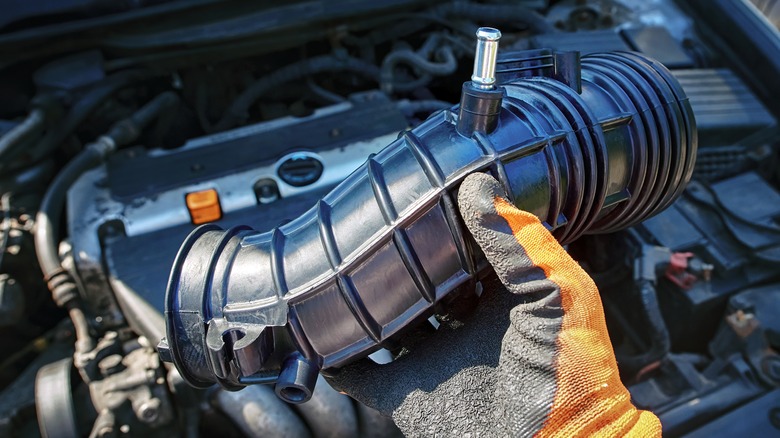
Modern engines rely on a pretty precise ratio of air to fuel in order to operate at peak performance, with the ideal mixture being somewhere around the oddly specific 14.7 to 1, meaning 14.7 units of air for every one unit of fuel. You can call this "the stoichiometric ratio" if you want to sound smart.
Your car's computer is actually pretty good at keeping this number right where it's supposed to be, but there's one thing that can really throw it for a loop. That's when there's air entering the equation that the ECU isn't expecting, namely by having it sneak in somewhere that's after the engine reads the airflow but before it reaches the pistons — think intake manifold, throttle body, or any of the myriad vacuum hoses that are moving air around.
However the air is getting in there, it's likely to cause a misfire and there's a good chance that it's going to lead to a check engine light, which will give you at least a starting point for narrowing down the issue even further. In any case, you're going to need to find the culprit, which is going to be something like loose or damaged hose, or a cracked throttle body or carburetor. If you can't find it with your eyes, you might be able to find it with your ears. Spraying a fine mist of water can help point you in the right direction, as it'll get audibly sucked in by the leak.
Fuel injector issues
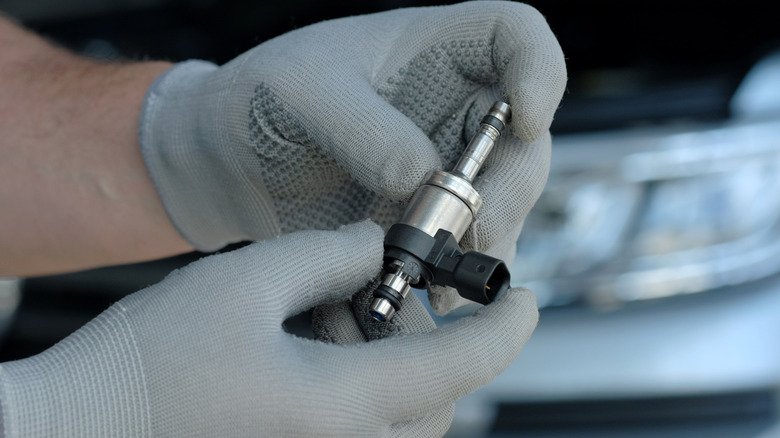
Fuel injectors are responsible for delivering precise amounts of fuel to each cylinder, a whole bunch of times per second. A problem with one is usually going to mean that the affected cylinder isn't getting as much fuel as it should, which as far as vibrations go will translate to either a roughness at idle or a bit of stumbling hesitation as RPMs climb.
The root cause here can come from a couple of different directions. The most common is a clogged injector, which is most likely going to be the result of poor-quality fuel, dirt, carbon, or other ick getting in the way of proper flow. Electrical weirdness or damage to the injector itself could also be the culprit.
Unless you're especially handy, chances are that you only have one realistic, fingers-crossed DIY fix on the table for this one, and that's going to be fuel injector cleaner. It's a small bottle of stuff that you dump into your empty gas tank, fill up, and then drive as normal. It can help clear out any deposits and keep new ones from forming, but if you have something deeper going on it's probably not going to do much. It's worth a shot, but if you don't see improvement it's likely going to mean a trip to the shop from there, where you can rethink your life choices and ask yourself for next time if regular fuel injection service is worth it.
Broken or collapsed engine mounts
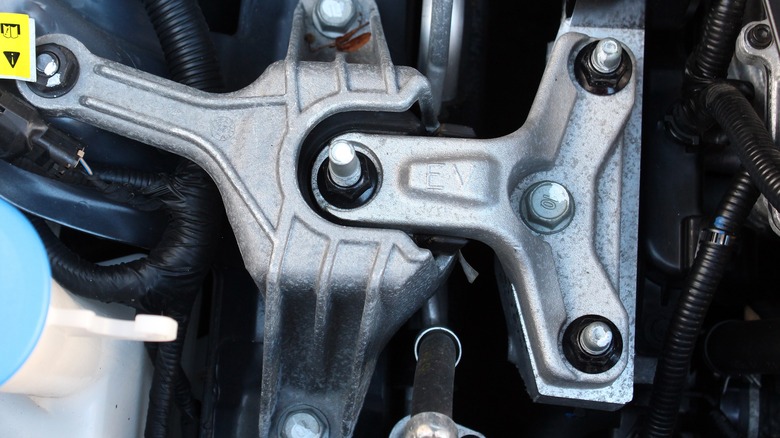
Unless you sit around daydreaming about the potential of various baffling and wonderful engine swaps, you probably don't give a whole lot of thought to your engine mounts. It's easy enough to think of them as simply the place where the motor bolts into the engine bay, but there's (slightly) more to it than that. An engine mount also plays a role in reducing how much vibration is transmitted from the motor to the rest of the car, to you, and to your passengers. The way this is done can be as simple as a little rubber bit set between metal or as complex as an electronically managed vacuum cushion that adjusts on the fly.
Whatever the case, something being awry can lead to noticeable vibrations. The way you can differentiate between an engine mount vibration as opposed to any of the others on this list is that it's often paired with some weirdness in how your engine is behaving in the bay. This could literally mean that it moves around in there when you give it a shove or that you can feel it shifting as you accelerate quickly, decelerate sharply, or turn hard.
Assuming your mounts are of the relatively simple variety, the complexity of the fix pretty much comes down to whether the mount is load-bearing and whether you can actually reach it. Replacement can be pretty straightforward, assuming that you can get to it, though if it's a load-bearing mount you'll need to jack up or otherwise support the engine as you go. In any case, it isn't usually a huge deal for a shop.
Throttle body buildup and airflow control problems
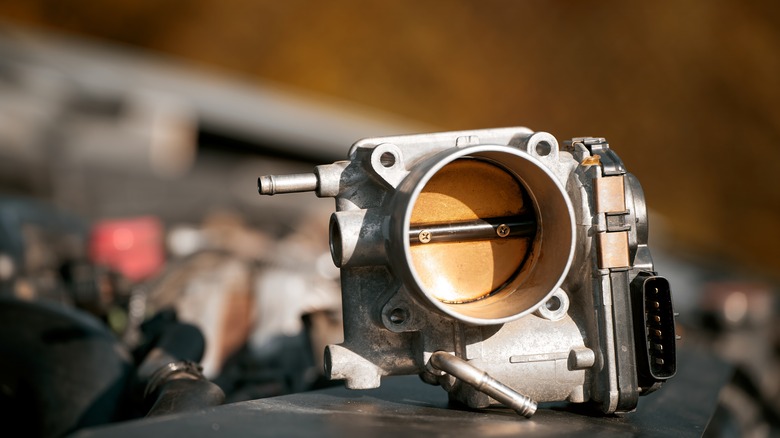
A rough idle or choppy performance under acceleration (that shows up, again, in the form of annoying vibration) will often come down to airflow. Like the vacuum leak issues we discussed before, there are a few other components that can lead to a weird amount of airflow and an ill-performing engine.
Before we go there, however, let's clear up some confusion about what a throttle body even is. Regulating the fuel going into your engine is part of it, but the throttle body itself is primarily regulating air, with the additional air bringing more fuel along for the ride when you put the pedal on the floor. So a throttle body issue is usually a problem of air as much as anything else, and you can have similar vibrational symptoms from other airflow-related components, like your idle control valve.
In this case the fix can be anywhere from addressing signs that your throttle body needs cleaning or a replacement of either the throttle body itself or the idle air control valve. Signs that point to an idle control issue are, predictably, various bits of weirdness at idle. That's because this is the component responsible for adjusting power at idle to accommodate the fluctuations caused by things like your AC compressor clicking on or your power steering pump activating.
Timing belt or timing chain
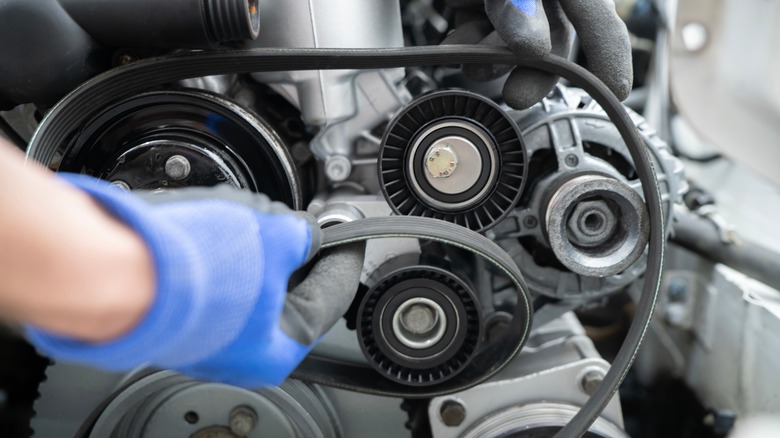
As if you needed another reason to care if your engine uses a timing belt or a timing chain, it turns out that among many other commonalities between the two, they can each cause vibration if something is amiss.
Whether you have a belt or a chain, the principle is the same. Either one essentially connects your crankshaft pulley at the bottom of the engine to ensure that the camshafts are turning at exactly the right speed to align the timing of intake valves, exhaust valves, and sparks in that cool way that makes an engine go round. If that belt or chain (or the pulleys they spin) are misaligned, tensioned improperly, or just plain worn out and maybe slipping a bit, that mechanical choreography can be compromised and you can feel it in the form of a shake, shimmy, or vibration.
A timing chain can last more or less forever under proper maintenance, but a timing belt is more of a wear item, so you'll want to adjust your expectations accordingly. In either case, just remember that the consequences of falling seriously out of spec of breaking entirely can be severe, up to and including an engine timing failure that could be potentially catastrophic. Those vibrations are a warning sign, though, so you'd be well advised to get the message. A small adjustment or even a more involved replacement can save you significant trouble down the road.
Harmonic balancer failure
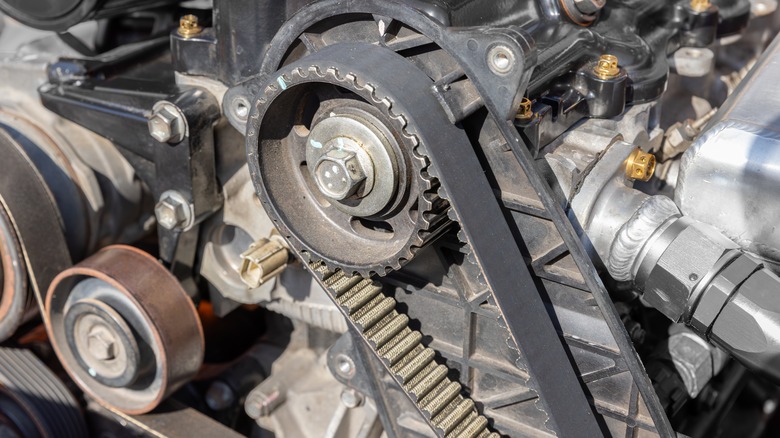
A harmonic balancer is one of those parts which exist explicitly to cut down on engine vibration, so yeah — if it breaks you'll have vibrations. Without getting too much into it, it's a piece of hardware that sits on your crankshaft at the front of the engine and exists specifically to control engine vibration, which it does by creating a squishy buffer that absorbs the natural vibrations of the motor. When it's working, you'll never think about it. When it breaks, things shake.
This is one of those rare examples where the symptom and the problem are one and the same — vibration (and sometimes some obnoxious noise to go with it). Downstream of your balancer problem you might have some additional mechanical consequences like misaligned belts or spotty engine performance.
Generally speaking, the fix here is to replace the balancer, which is made up of an inner hub and an outer ring with the rubber insulator in between. Even getting these bits apart requires both specialized expertise and specialized tools, so if that doesn't sound like you, you've got a shop visit in your future.
Accessory drive belt, idler pulley, and tensioner problems
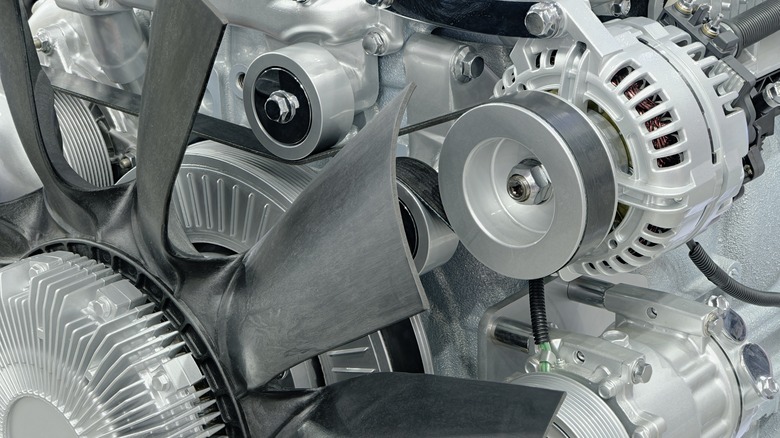
Your accessory drive system is made up of things like the serpentine belt, idler pulleys, and belt tensioner, which all work together to steal a small bit of power from your engine and use it for things like running your air conditioner. Any one of these items can lead to noise and vibration, from a worn belt to a misaligned pulley. Even the belt tensioner, which a lot of people don't realize is essentially a wear item, can deteriorate and lead to problems elsewhere in the system, many of which can manifest as vibration.
While there are plenty of horrible things you should never use to quiet a noisy engine belt or reduce vibration, it's pretty often going to be a matter of swapping out that tensioner, replacing the serpentine belt, or simply adjusting a pulley. If you do need to change a belt, it isn't necessarily complicated, but you'll definitely want to do your homework and make sure you're keeping track of exactly how to route the thing properly when it goes back on.
Stop driving red flags

Some engine vibrations are simply annoying and others are helpful warnings that can help you avoid trouble ahead. Others, however, aren't telling you to keep an eye on something, but rather that you need to drop whatever you thought you had planned for today and deal with something immediately.
So while the check engine light icon is terrible and due for an update, that glowing little indicator can be a lifesaver. Many in the enthusiast community take a certain pride in their uncanny ability to ignore it, but if your check engine light is flashing, it's time to stop screwing around. A flashing check engine light means that you have a serious problem that needs to be addressed immediately.
Aside from a literal flashing warning light demanding that you start taking things seriously, there are a couple of other stop driving red flags that should give you more immediate pause than the others discussed so far today. Specifically, if your car is shaking not because of an engine issue, but due to suspension or tires at speed, it's time to prioritize not just mechanical protection, but the safety of you, your passengers, and anybody sharing the road.