

Ford Made Tractors For Decades. Here's When It Stopped
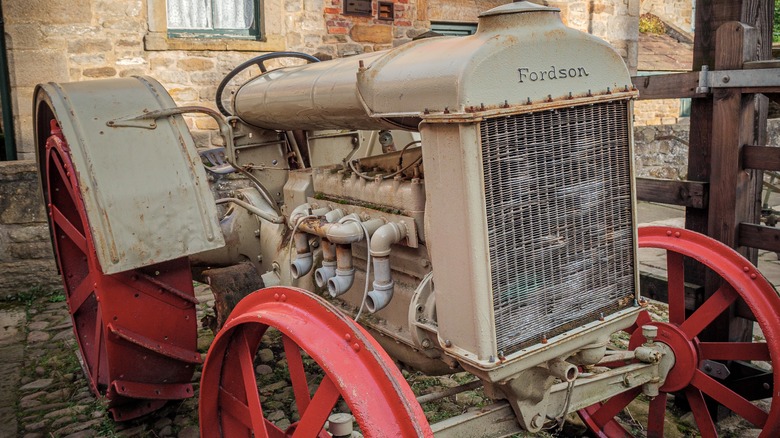
Henry Ford's mechanical interests went much further than automobiles. Ford also built America's foundational airliner, the Ford Trimotor, and kick-started the production of modern tractors, too. In fact, Ford remained a major player in the tractor business until 1990, when it agreed to sell a controlling interest in its farm division to Fiat — although the Ford name still adorned the tractors until 1999.
It all started with Ford's 1907 "automobile plow," backed by a 24-horsepower four-cylinder engine, leftover parts from Ford Model B and Model K cars, and a grain binder's rear wheels. But the Model T's impressive success meant Ford didn't have time to focus on a production tractor until 1917, when Henry and his son Edsel partnered on the Fordson Model F tractor. At the time, tractors were assembled by hand with custom parts and relied on steam power, making them expensive to buy, hard to repair, and difficult to keep running. But the Fordson tractor naturally adopted the same mass-market approach to production, with interchangeable parts, as Henry's famous cars.
Rather than steam, the original Fordson Model F tractors ran on kerosene (but could be modified to use gasoline). They quickly gained a following in Europe since many farmers there had gone off to fight in World War I, and those who remained needed an affordable way to pick up the workload.
Tracing the early history of Ford tractors
Despite this early success, Ford found itself in and out of the tractor market over the next few decades. Fordson tractors had moved from their original production location at the Henry Ford & Son facility in Dearborn, Michigan to Ford's River Rouge, then the world's largest factory, in 1921, and the brand built 75% of all U.S.-made tractors during the 1920s. However, with the competition catching up, and Ford preparing to launch the Model A car, the tractors went out of production in 1928 — in the United States, anyway. Fordson tractors would continue to be built in Ireland, and then England, up until the 1950s.
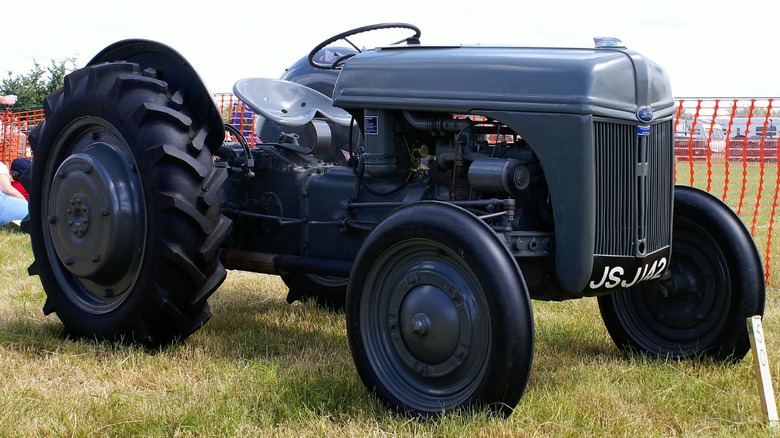
Ford was soon ready to introduce its next-gen tractor back in the United States, and the Ford-Ferguson 9N became another game-changer. The Ferguson part of that equation was Harry Ferguson, an Irish engineer who invented an integral three-point rear hydraulic hitch capable of lifting heavy rear attachments — like mowers and tillers — off the ground using engine power instead of human effort. That was in 1936, and soon he and Henry Ford agreed to make the Ferguson hitch standard on a new line of Ford tractors that went on sale in the U.S. in 1939.
No doubt helping the 9N's success was a price tag of $585; at that point, typical Ford-Ferguson rivals cost about 33% more. Production of N series tractors continued until 1952 and tallied close to 800,000 sales.
Blue Oval tractors from the Ford 6000 to a Fiat subsidiary
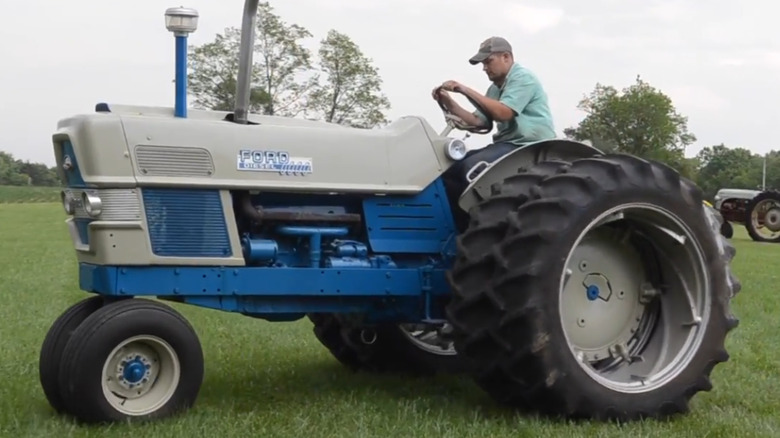
After going their separate ways during the Fordson years, Ford's U.S. and U.K. farm divisions were unified in 1961 as the Ford Tractor Division. The same year saw the premiere of the cutting-edge Ford 6000 that marked the beginning of the automaker's fresh push toward tractor dominance. But what happened next may not surprise modern Ford watchers, who've seen the company endure a record-setting year of recalls in 2025: All of the original Ford 6000 tractors ended up being recalled for issues including power train troubles and problems with hydraulics.
Ford got the 6000 sorted out eventually, leading to a major product offensive that peaked with the Ford 9000 series. After debuting in 1969 with Ford's first turbocharged tractor engine, a 401-cubic-inch diesel six-cylinder making 131 horsepower and paired to either an 8-speed manual or 16-speed power-shift automatic, a Ford 9000 at the company's plant in Highland Park, Michigan became its 4-millionth tractor manufactured.
Ford's modern tractor era continued in the 1970s and early 1980s, setting the stage for the final phase of its tractor business. In 1985, Ford bought Sperry's New Holland agricultural equipment arm with a lineage going back to 1895. Yet only a few years later, in 1990, Ford agreed to basically sell off its tractor business to Fiat as part of a change in corporate direction to focus on the automotive sector.