

How Does The 12V Cummins Diesel Compare To The 24V Version?
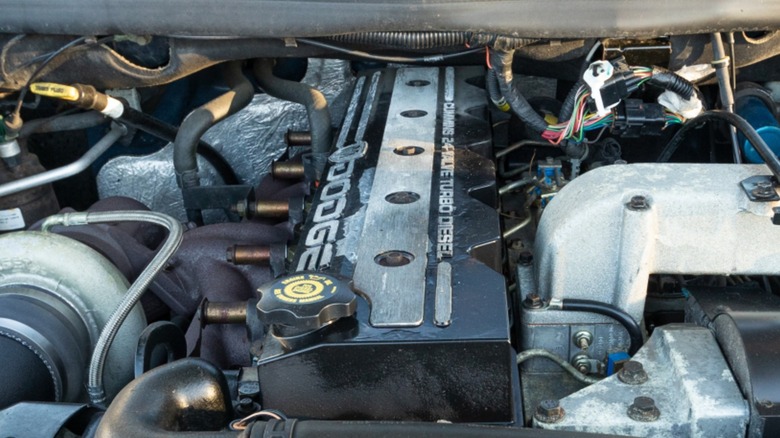
While Dodge diesel trucks didn't always have Cummins engines, their shared history dates all the way back to 1989. That's when the inline six-cylinder 5.9-liter Cummins diesel first appeared in Dodge trucks. The 5.9-liter Cummins diesel engine family is often broken into four distinct generations, although Cummins only separates it into two: the 12-valve 6BT with two valves per cylinder and 24-valve ISB with four valves for each of the six cylinders. Following its 1989 debut, the 12-valve 6BT Cummins powered Dodge pickups through to mid-1998, which was when it was replaced by the 24-valve ISB Cummins — with that version lasting until 2007.
The 12-valve Cummins is commonly considered to have two generations, with the second generation coming in 1994. While the second-gen 12-valve used many of the same core parts as the first, it featured a number of improvements to its fuel delivery and combustion system. These changes were largely due to tightening diesel emission standards implemented in 1994.
Midway through 1998 brought the introduction of the first 24-valve ISB generation (or third-Gen 5.9 Cummins). It featured the manufacturer's first fuel system with electronic controls, as well as a Bosch-branded VP44 injector pump designed to meet standards that had grown even more restrictive. The final 5.9 Cummins iteration came in 2003 with a new Bosch CP3 injection pump driving the common-rail fuel injection system. More changes occurred mid-2004, including new injectors and a turbocharger with an electronically-controlled wastegate — all to once again keep up with emissions standards.
Which 5.9 Cummins had the most power?

The 12-valve 5.9 Cummins used in the 1989 Dodge Ram produced around 160 horsepower and 400 pound-feet of torque. In 1994, it gained upgrades to its injector pump, pistons, intercooler, and turbocharger. Power output available for manual transmission trucks increased to 175 horsepower and 420 lb-ft of torque. By the end of the 12-valve era, power had increased to 180 horsepower and 420 lb-ft of torque in models with automatic transmissions and 215 horsepower and 440 lb-ft of torque when paired with a manual.
While the 12-valve Cummins is one of the greatest truck engines of all time, the 24-valve Cummins was destined to outperform it. When the 24-valve Cummins debuted in mid-1998, it had 215 horsepower and 420 lb-ft of torque for automatics and 235 horsepower and 460 lb-ft of torque for manual-equipped models. The most powerful 5.9L Cummins engines are the last 24-valve 5.9s produced from mid-2004 to 2007, boasting 325 horsepower and 610 lb-ft of torque.
Which 5.9 Cummins is the most reliable?
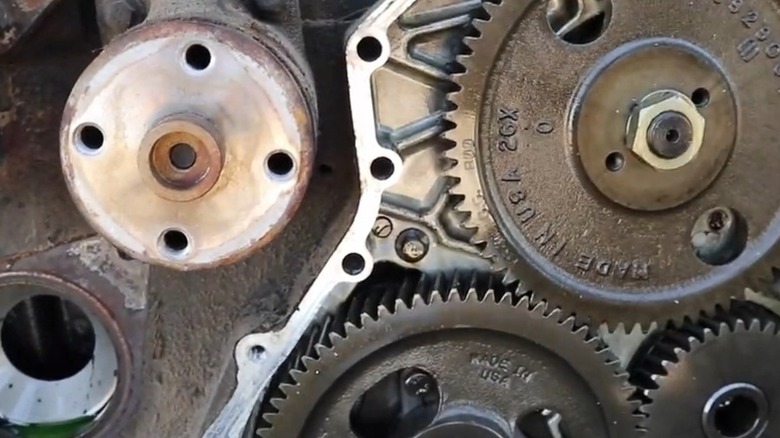
Like any engine, there are some 5.9 Cummins years that are best avoided. One of the most notorious issues to plague a wide range of 5.9 Cummins diesel engines is the killer dowel pin. At its root lies a steel 5/16-inch dowel pin that aligns the aluminum front cover on all 12-valve 5.9 cast-iron engine blocks and 24-valve Cummins up until 2002. Unlike other dowel pins used for alignment, the "killer" pin lives in an open hole that allows it to eventually come loose and fall into the gear drives on the front of the engine. If luck prevails, the dowel pin could fall into the oil pan. Otherwise, it could lodge itself between the engine housing and gears, causing immense damage and ruining the engine entirely.
Another well-known 5.9 Cummins issue centers around engine block castings known as the "53 blocks" used for 1999-2002 24-valve engines. These engine blocks, identified by the number 53 cast into the front driver side, are more prone to cracking than other 5.9 Cummins blocks. Once cracked, they'll leak coolant, eventually requiring a welded repair or a new block. By process of elimination, that leaves the 2003 to 2007 24-valve 5.9 Cummins on top, although the 2003 5.9 is known to suffer some issues inherent to its newness. It doesn't hurt that the common rail engines offer decent reliability on top of their status as the most powerful 5.9 models.