

Vegetable Oil As A Motor Oil Substitute? It's Been Tested, Here's How Well It Worked
A quart of fully synthetic motor oil is typically under $10, yet it can be all that stands between you and having to pay thousands for a new engine. To help prevent this, of course, oil companies spend significant amounts of time and money fine-tuning their products for optimum performance, and automakers design their engines just as carefully to run on one specific grade of the slippery stuff. None of which has stopped people from trying to replace motor oil with vegetable oil — and then helpfully posting their results online.
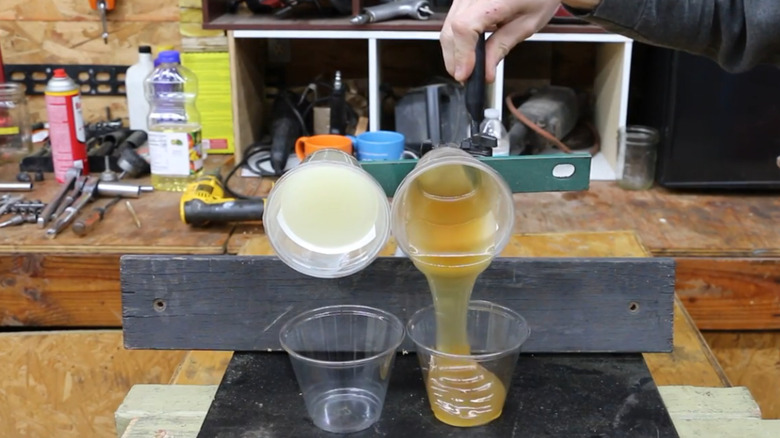
The real-world outcome has been surprisingly positive, too. Now, if you start doing research yourself, you'll notice that the experts explicitly say that putting vegetable oil in a car engine is a terrible idea and should never be done. Yet when the team at Project Farm tried running a lawn mower engine after filling it with vegetable oil instead of motor oil, there was really no immediate issue. The only serious problem noted was that vegetable oil froze nearly solid in extreme cold temperatures, but the motor oil retained its viscosity. That said, when you watch the video yourself, you may notice the cylinder and piston head do seem noticeably dirtier after using vegetable oil than before.
YouTubers have also successfully run engines in power washers and motorcycles with vegetable oil, at least for the duration of the videos. However, when one guy tried it with an actual car, a beat-up Hyundai Tiburon — one of those cars you probably forgot existed — the poor thing threw a rod, as The Drive reported.
So why are the experts against it?

The previously mentioned difference in viscosity between motor oil and vegetable oil is part of what makes the latter a poor choice for lubricating any part of a car's powertrain. The chemical makeup of vegetable oil means that it's less viscous — thinner — than motor oil at higher temperatures. So when things heat up in the engine, the vegetable oil breaks down quicker and can't create enough of a barrier between engine components to keep the parts properly lubricated. At the other temperature extreme, as Project Farm found out, veggie oil is more viscous than motor oil — it turned into a lump of fatty liquid in the video. Try starting a cold engine with that stuff inside and the oil won't be able to flow where it needs to go.
Moreover, motor oil isn't pure oil. It also includes additives that not only help to optimize viscosity, but also detergents and dispersants to keep the engine clean and anti-wear agents and friction modifiers to help prevent metal-on-metal contact. Separate additives can protect against rust and corrosion and maintain healthy engine seals. Foam, or air bubbles, can also cause problems if they develop within your oil, so most motor oils come with an additive for that as well. The effects of going without additives like these aren't likely to show up on a short YouTube video, though. And just to be clear, we're talking about additives already included in the motor oil, not aftermarket additives like Seafoam and Lucas.
Vegetable oil as a fuel substitute

Now, one of the reasons so many motorists seem interested in using vegetable oil in their engines might be because they've heard it can be used as a fuel — and for diesel-powered cars, that can be true. The secret here is that diesel engines operate on slightly different principles than their gas-powered counterparts: a gasoline engine requires a spark to ignite, while a diesel unit relies on compression ignition. The very act of squeezing the diesel fuel and air together in the cylinder is enough to raise the temperature to the ignition point. And the same thing can happen with vegetable oil, which is also a main source for biodiesel.
But to make vegetable oil/biodiesel compatible with a car's engine for everyday use, both the liquid and the hardware do need some modifications, especially to get to the right viscosity for proper lubrication and atomization — that refers to how the fuel is broken up into tiny droplets to mix with the air for better combustion. It's popular enough now that even Cummins engines can run on biodiesel.
Returning to the real world, Consumer Reports evaluated a 2002 Volkswagen Jetta TDI running on diesel fuel, biodiesel, a popular diesel blend with 5% biodiesel, and pure vegetable oil. The Jetta ran well on vegetable oil but with the lowest highway fuel-economy rating and highest amount of unburned hydrocarbon emissions (compared to the Jetta running on other fuels).