

What Makes BMW's S58 Straight-6 Powertrain So Popular?
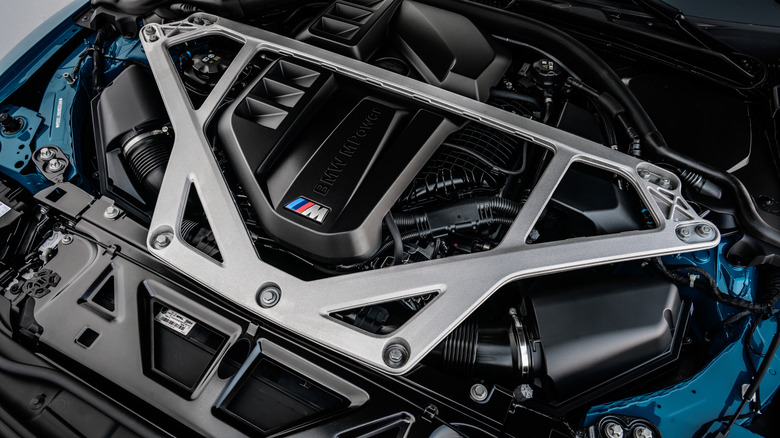
BMW and inline engines, specifically, its six-cylinder straights, have quite a reputation within the automotive sphere. While BMW didn't invent the first straight-six engine, its take on the inline-six configuration has certainly helped cement the brand's identity. There are, of course, non-BMWs with the inline-six shoehorned inside them. However, engines like the S54 from the iconic M3 CSL, the N55 from the first-gen F87 M2, and its twin-turbo S55 cousin found in the track-ready F8X M3s and M4s have all played a part in popularizing BMW's straight-six identity among the millennial crowd.
Part of this storied lineage is BMW's latest S58 3.0-liter twin-turbo inline-six, powering the G8X-generation of M3/M4s alongside their SUV counterparts, namely the X3 M and X4 M. In a very short span of time, the S58 climbed the popularity ranks, courtesy of its out-of-the-box performance, impressive reliability, and outstanding tuning potential.
It's worth pointing out that the S58 is the performance variant of BMW's B58 single-turbo 3.0-liter straight-six, which itself is quite revered. The S58, in its regular guise, puts out 473 horsepower and 406 pound-feet of torque. However, the same engine is tuned to pump an extra 30 horsepower and 73 pound-feet in Competition models, with the latest M3 CS and M4 CSL eking out 550 horsepower from the straight-six lump.
The S58 holds an edge over its predecessor
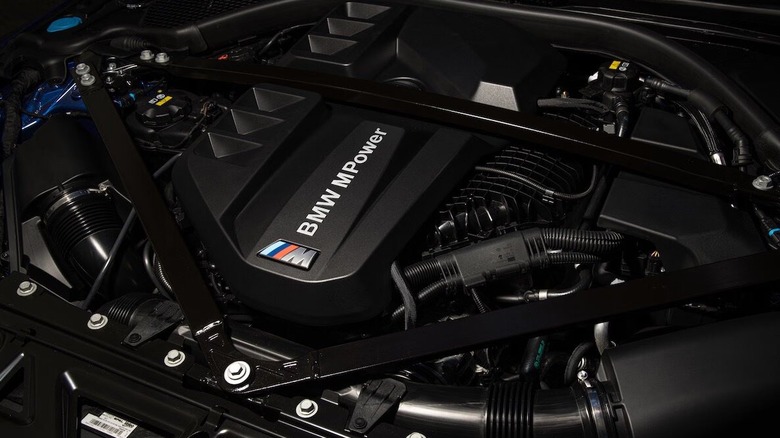
As a direct replacement of the S55 – a popular choice among high-performance, straight-six, aftermarket builds — the S58 brought along several improvements, such as stronger, lighter, and more advanced internals, in addition to several reliability upgrades. For instance, BMW claims the S58's crankshaft is 2 kilograms (around 4.4 pounds) lighter than the already lightweight S55 crank, while being able to handle more power. Something else the S58's crankshaft has that the S55's doesn't are forged pinions for the oil pump and camshaft drive chain.
Pistons inside the S58 use more advanced coatings for better heat dissipation, reduced friction, and improved engine performance. Even though both the S55 and S58 feature forged connecting rods, the ones inside the S58 are lighter and can withstand high-output motorsport-level builds. Most of the S58's internals are top-quality forged items, and stuff like the bearings are essentially designed to last the engine's lifetime.
You may have doubts about what exactly BMW means by the engine's lifespan, so here's some perspective. Red Bull Driftbrothers, after thrashing their 1,000-horsepower tuned S58s for 2 years, disassembled the engines with help from BMW to assess the damage. To their surprise, despite the S58s being under constant stress, BMW engineers found the engines to be in excellent condition, with critical components such as the crankshaft, pistons, connecting rods, and main bearings witnessing little to no wear. This should paint a decent picture of the S58's robustness and absurd tuning potential.