

Why Are Car Makers Removing The Transmission Dipstick?
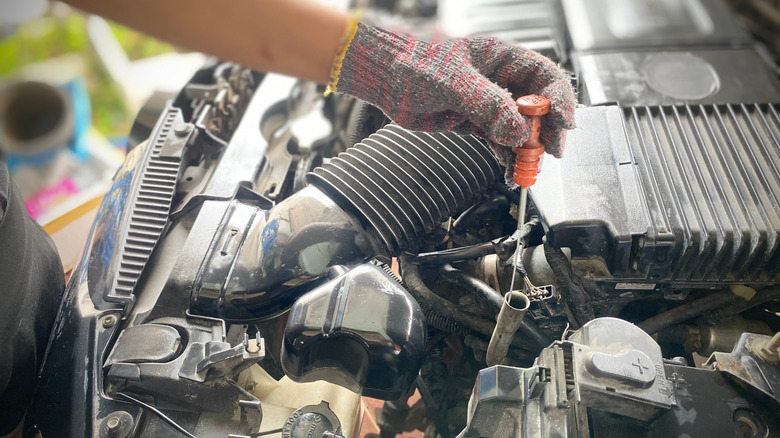
There are two schools of thought behind cars no longer including a dipstick. Removing it helps to deter less mechanically-inclined owners from using the wrong transmission fluid and ruining their entire transmission. Plus, by not having to incorporate a dipstick, manufacturers can create transmissions with tighter tolerances, significantly reducing the chances of a leak — which is a big reason as to why new cars don't come with dipsticks. That's not to say those transmissions are fully immune to leaks, but they're less likely to be a common occurrence.
Proponents of the idea also argue that by removing the transmission dipstick, you're preventing the transmission from accumulating dust and moisture during overly-frequent checks. Granted, this argument could just as easily apply to an unkempt service center as it does to a modest driveway. Something that seems more convincing is how manufacturers, by removing the dipstick, save a few pennies on the production line. It might seem like corporate greed, but for mass-market items, those pennies add up to a lot of extra cash in the bank.
The omission of dipsticks might not sit well with folks who enjoy working on their cars. Although it can mean more dealer visits, the sealed transmission (as it's commonly called) is not necessarily anti-DIY – provided you have the right diagnostic equipment and the knowledge to use it correctly.
No transmission dipstick doesn't mean maintenance-free

If there's no traditional dipstick, service technicians use an OBD scanner to diagnose the car's fluid levels. This occurs after running the engine and transmission to make the fluid reach a specific temperature range. At that point, the check plug is taken out to inspect the fluid for viscosity, contamination, and discoloration. A slight drip is ideal, but anything that involves the fluid overflowing — or not flowing at all — warrants corrective action. The latter case warrants a refill via the filler plug, which is often done with the help of a specialized pump.
The advancements of modern transmissions have helped eliminate the need for dipsticks, with sensors and software constantly communicating with the vehicle's ECU to keep everything under check. The fluids themselves have also come a long way, as advanced synthetic fluids can tolerate higher temperatures while offering improved oxidation and wear resistance. This translates to better longevity, which is evidenced by fluids in most modern transmissions lasting over 100,000 miles without any problems.
Of course, automakers take this as an excuse to market them as lasting for the lifetime of the transmission. In corporate speak, that's until the vehicle's warranty is invalid. There is no such thing as a lifetime transmission fluid, as these will deteriorate and break down just like any automatic transmission fluid. No matter what the automakers might say, transmission manufacturers will often recommend changing the fluid regularly — though you could still go thousands of miles without needing to.