

Is It Legal For A Car To Have Two Different Color Headlights?
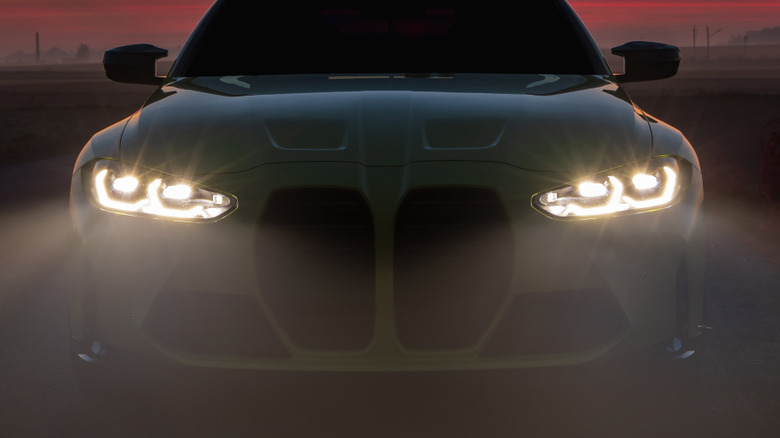
Headlights appear to be pretty straightforward. If you have a car — and not a motorcycle – you have to have two headlights. Those headlights also have to work, of course, but you'll have to watch out for additional regulations surrounding them, including basic rules surrounding their color. You might be tempted to replace your headlight bulbs with a different color, or even to have one headlight in one hue, and the other headlight in a different color. If that's what you were hoping to do on your ride, you're going to be disappointed.
It is absolutely illegal to have different color headlights on a car in the United States. Not only that, but there are restrictions on what the colors can actually be, how bright lights can be, or even the use of auxiliary lighting like light bars. While it might seem like a no-brainer to some, the rules and regulations around vehicle lighting can be quite complex, and in some cases, even confusing.
Make them match
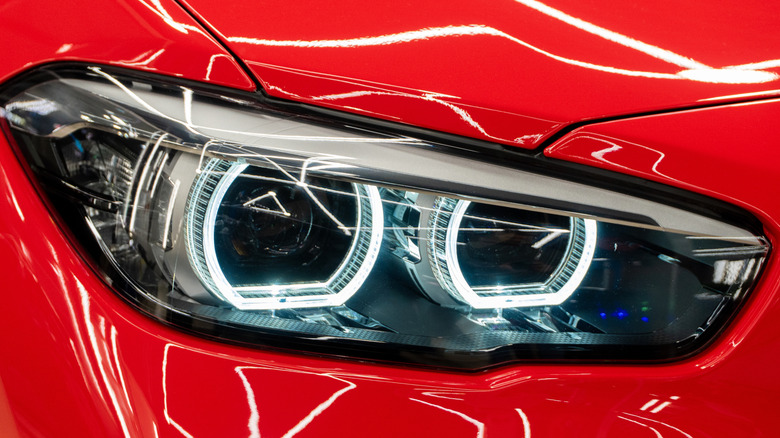
Vehicles sold in the United States are regulated by the National Highway Traffic Safety Administration, and the rules are codified in the Federal Motor Vehicle Safety Standards (FMVSS). FMVSS 108 clearly states that the lower and upper beams need to be white, and that the shade of white must fall within certain boundaries of color in order to officially match the specifications. Other countries haven't always followed these guidelines; there was a time in France when cars had yellow headlights.
For required lights, the rules are quite strict. For example, front turn signal indicators must be amber. Rear signal indicators can be red or amber, but brake lights have to be red. If your vehicle has adaptive front lights – the type that swivel when you turn – they should only work if other manually-selected lights, such as fog lights, aren't on.
Speaking of fog lights, it's not a legal requirement to have them equipped on a new car in the United States, so there is no rule specifically around their color at the federal level. Automakers are even getting rid of fog lights. There are, however, rules at the state level. For example, in Washington, you can use either amber or white fog lights. Federal rules only require that these auxiliary lights not interfere with the operation of the required lights.
Light my candle
Brightness isn't limited by lumens, but by candela output at specific testing angles. That's why BMW's Laser Lights aren't available anymore here. As for off-road lights, they are a no-go on the street. As previously mentioned, there's a clause in the FMVSS that states, "No additional lamp, reflective device, or other motor vehicle equipment shall be installed that impairs the effectiveness of lighting equipment required by this standard." Regardless of if they're mounted cleanly, pointed low, or even emitting the appropriate white, fog lights and off-road lights can exceed the candela limit, produce uncontrolled beam patterns, or cause glare for oncoming drivers.
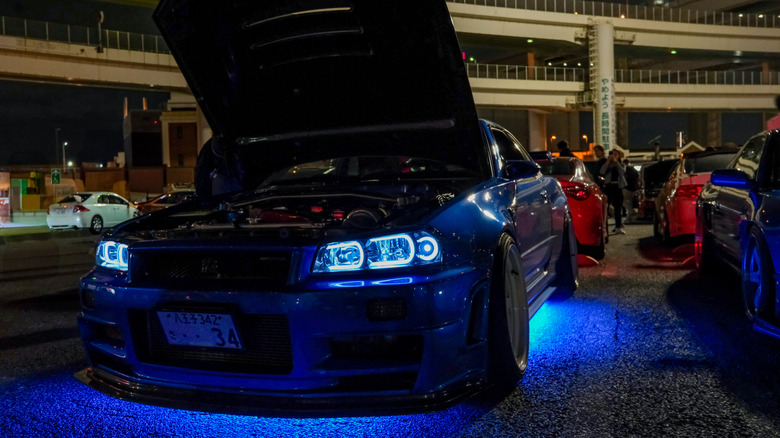
It's also worth noting that you should definitely not use blue unless you like the attention of law enforcement, as that color is meant only for emergency vehicles. Also, while these federal rules are the law of the land, state and local regulations might also impact lightning, so it's best to investigate that before changing something up. Headlights are designed so that you can see and drive safely at night. Stick with lights that were designed and engineered to perform that very function, and leave the vehicle modifications to components that aren't about driving safely.