

Why Some Semi Trucks Need 18 Speed Transmissions
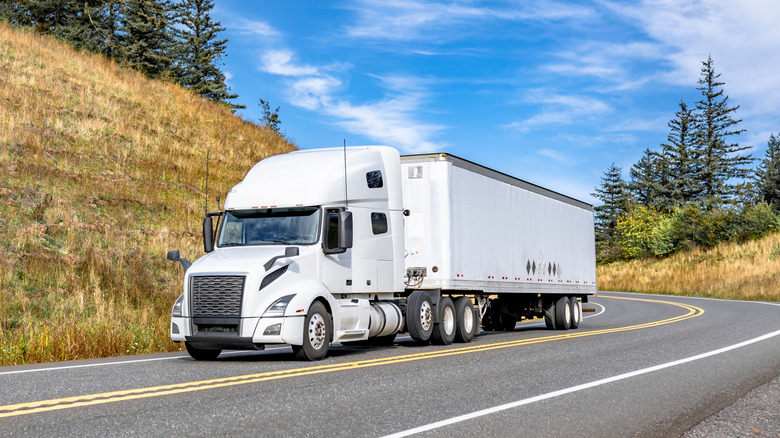
At first glance, an 18-speed transmission sounds like overkill. After all, most cars get by with five or six gears. But semi trucks are built for an entirely different purpose, and that is moving large loads safely and efficiently over long distances and steep grades. Those freights can include anything from hazardous materials to electronic products, and any mishap could have disastrous effects. Just like semis have their own engines and don't use V8s, they need to have specialized transmissions, too.
Getting a fully loaded tractor trailer (which can weigh anywhere from 80,000 pounds up to 100,000 pounds) to budge from a dead stop, managing it on a long downhill grade, or navigating it through a mountain pass requires precise power delivery. To get the ball rolling, the lower gears come in. They provide the initial torque and also help out when climbing hills. They do this by sacrificing wheel speed to multiply the engine's RPM. Once you get up to highway speeds, though, the higher gears are necessary for the engine to settle into an efficient RPM range.
The extra gears aren't there to force drivers to use all of them. In fact, most drivers won't. Many day-to-day routes only require about half the available gears.
Keeping the engine in its sweet spot

One of the biggest jobs of a multi-gear transmission is protecting the engine while scaling its power to the current driving situation. An 18-gear transmission does that by giving the drivers enough gears to keep the engine in its ideal RPM range in a wide variety of conditions. Semi truck engines are capable of churning out anywhere from 400 to 600 horsepower, along with massive amounts of torque. Without the gears to spread that power out, the existing gears would require higher RPMs. This increases fuel consumption and also speeds up wear. That's why transmissions that can handle such high horsepower are required. Some transmissions can even handle 1,000 horsepower or more.
Split gears go a long way toward facilitating this spread of power by creating high and low ranges within the same gear. This way, the driver can fine tune engine speed without dramatic jumps in RPM.
Despite the number, 18-speed transmissions are built around a familiar H pattern. Once drivers learn the rhythm, shifting becomes methodical and smooth. Most drivers focus on listening to the engine, feeling the truck, and choosing the gear that keeps everything steady. That's why many experienced drivers describe the 18-speed as strong and versatile rather than complicated. It gives them the right gear for almost any situation, without forcing them to use every option.