

What's The Difference Between A Pushrod And A Modular Ford V8?
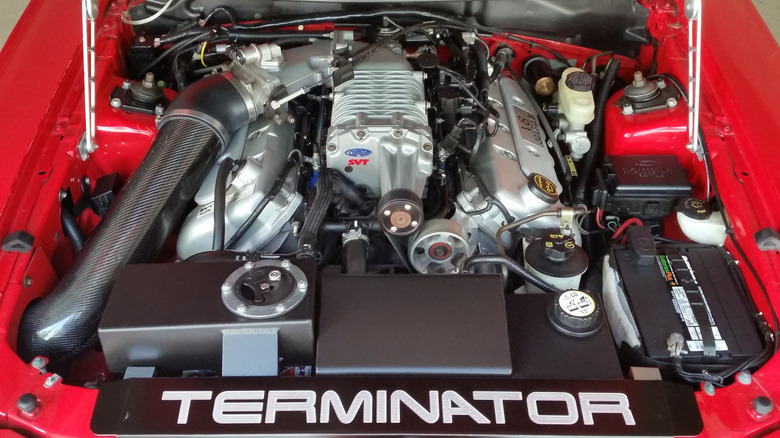
Ford pushrod V8s served many a driver for decades in a veritable buffet of displacements from 1952 through 2001 (until Ford brought them back for the 7.3-liter Godzilla in 2020). In the early 1990s, Ford started phasing out its overhead-valve (OHV) pushrod Windsor 4.9-liter 302 and 5.8-liter 351 in favor of the new single overhead-cam (SOHC) and double overhead-cam (DOHC) Modular V8 that debuted in the 1991 Lincoln Town Car. By the way, for this conversation, we're going to consider the Coyote as part of the Modular lineage, sort of like how GM considers LS/LT V8s to be "small-blocks."
Also, despite its "Modular" name, that label isn't because of the engine itself. Rather, the tooling to make it was modular, and it could be set up to produce a variety of other engines quickly. That said, though Modulars aren't really modular, Ford sort of acts like they are. Displacements vary between 4.6-5.8 liters in two deck heights with two-valve, three-valve, or four-valve heads. In modern Shelby GT350s, the 526 horsepower Voodoo 5.2-liter from the Modular family thoroughly eclipses the 306 gross-horsepower pushrod 289 from the GT350s of the 1960s.
Supercharging proliferated, too, bringing F-150 SVT Lightnings and "Terminator" Mustang SVT Cobras within spitting distance of 400 horsepower. Then, the blown 5.4-liter DOHC V8 could make 500 horsepower in Shelby GT500s and Ford GTs, and the Trinity 5.8 offered 662 horsepower. The ultimate evolution of the Modular V8 is the GT500's 760 horsepower Predator 5.2 and F-150 Raptor R's 720 horsepower Carnivore 5.2. Ford also added cylinders to create the 6.8-liter V10s that powered Excursions and RVs, laying the foundation for Build It Yourself guys on YouTube to craft a DOHC V10 Lincoln Continental super sedan in their garage.
Cams in blocks vs. cams in heads
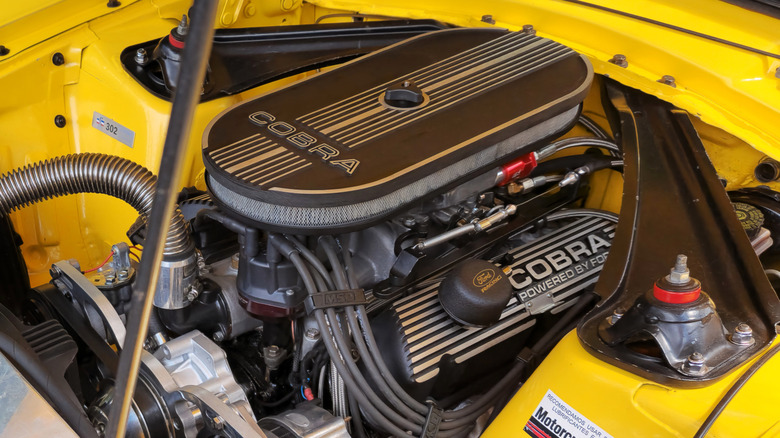
Another nickname for OHV V8s is "cam-in-block," accentuating how physically compact pushrod V8s can be compared to them. With camshafts on the heads, there's a lot more hardware to accommodate, and that manifests in width. If you're considering a Coyote swap, a pushrod Windsor 302 has a bore center spacing of 4.38 inches and is 27.5 inches long, while a 5-liter DOHC Coyote V8 has a shrimpy 3.937-inch bore center spacing and is 26 inches long. But, the Windsor is 18.75 inches wide, and the Coyote is nearly a foot girthier at 28 inches wide.
As you may imagine, increasing the number of camshafts can also increase gravity's effects. Remove the accessories and flywheel, and a Fox-body Mustang's 4.9-liter 302 (those 5.0 badges are liars) weighs 411 pounds, while a Coyote weighs 421 pounds. And the 302's heads and block are cast iron while the Coyote's are aluminum!
Ford went OHC because the benefits outweigh the, uh, weight. Modular V8 heads with four valves per cylinder enjoy Big Bad Wolf levels of breathing capacity, and by getting rid of long pushrods and rocker arms, camshafts act directly on the valves for serious high revving. This is mostly why pushrod V8s often have better down-low torque while OHC V8s are screamers. Try to rev a Fox-body 302 to Coyote rpm, and you're asking for valve float.
Using overhead cams also made it easier to add variable valve timing for even more efficiency and horsepower, though Ford called it variable camshaft timing in its 2004 North American debut. It's not like pushrods can't use it, too — as Chrysler's Gen-III Hemis and Chevrolet's LT V8s prove — but it requires more engineering cleverness.
OHC future builds upon OHV past
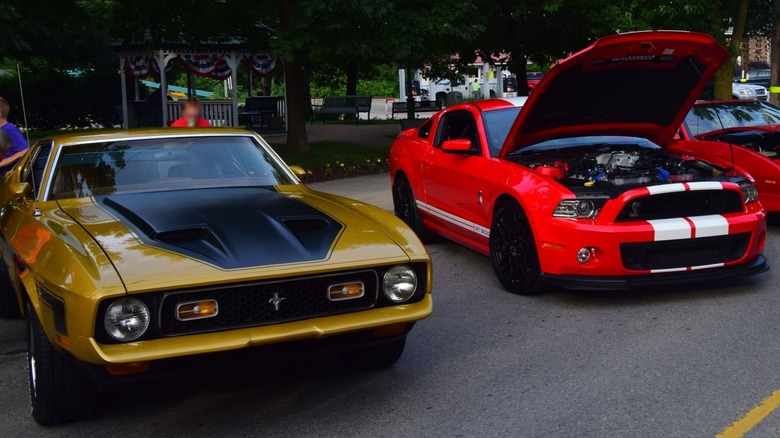
The December 1992 issue of Car and Driver highlighted the 1993 Lincoln Mark VIII and its Modular engine. That InTech DOHC 4.6 V8 seemed like it was from the future, pushing out 280 horsepower at 5,500 rpm and 285 pound-feet of torque at 4,500 rpm. For comparison, the 1993 Mustang Cobra's pushrod Windsor 302 made 235 horsepower at around 5,000 rpm and over 280 pound-feet of torque at 4,000 rpm.
The Mustang was quicker to 60 mph (5.6 seconds vs. 6.8), but it got worse mileage (22 vs. 25 mpg highway and 15 vs. 18 mpg city) despite having a five-speed manual instead of the Mark VIII's four-speed slushbox. Plus, the Mustang weighed only 3,248 pounds while the Mark VIII weighed 3,811. If you want an even more direct comparison, the 1995 Mustang Cobra R's 5.8-liter 351 Windsor made 300 horsepower, and the regular 1996 Cobra made 305 horsepower with 4.6 liters and DOHC heads. Both ran the quarter mile in about 14 seconds, except one did it with a displacement penalty of more than one whole liter.
None of this is to say pushrod engines can't rev or make serious power. The Ilmor/Mercedes-Benz V8 that won the Indianapolis 500 in 1994 had pushrods, and it made 1,024 horsepower at 9,800 rpm. Meanwhile, Ford's one-off 598 cubic-inch Boss Mustang made 855 horsepower and pulled a 1.9-second 0-60 time in 2000. V8s have used OHV technology since at least 1915, when the Ferro/Scripps V8 was helping the Scripps-Booth Vitesse reach a heady 75 mph. It's capable technology, and manufacturers continue to explore its limits. But overhead-cam engines in general (and Modular V8s specifically) have the edge in spinning and aspirating.