

5 Toyotas With The Longest Production Runs
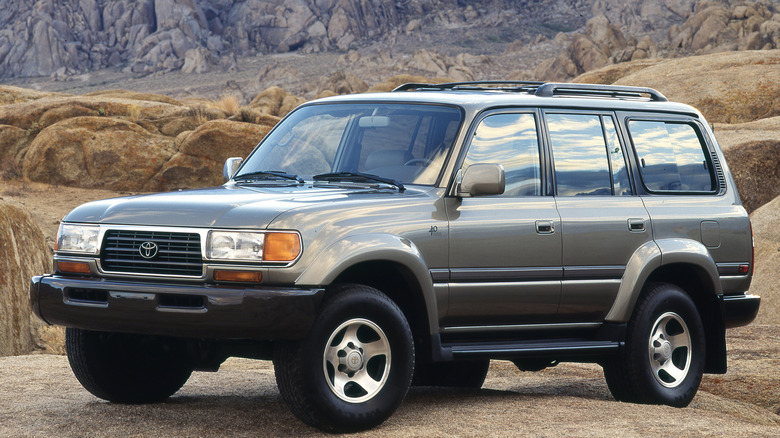
The Toyota lineup has many familiar names like Highlander and Prius, but some models have been around longer than others. In fact, two have been in production and sold in the U.S. for over half a century (that's the Land Cruiser and Corolla, if you're curious). Meanwhile, the Camry and 4Runner have been on the market since the 1980s. Even the Tacoma gets called out for its longevity, having been in Toyota showrooms for over three decades.
The breakdown of these models appears below, with the qualifier that this article covers models sold in the U.S. (the same nameplates available elsewhere may have different production runs). In addition, we didn't look at continuous production cycles, just the total number of model years for each vehicle (including 2026). This distinction matters only for the Land Cruiser, which left Toyota's lineup after 2022 and returned for 2024. Production of the other models hasn't been interrupted.
It's worth highlighting (let's call it an honorable mention) that the RAV4, Toyota's perennial best-seller, didn't make the top-five cutoff. While this model helped launch the compact SUV craze when it debuted for the 1996 model year, its 31-year manufacturing run isn't enough to earn senior status. The same can be said for the Sienna (29 years), Avalon (28 years), and Tundra (27 years).
Toyota Tacoma (1995-2026: 32 model years)
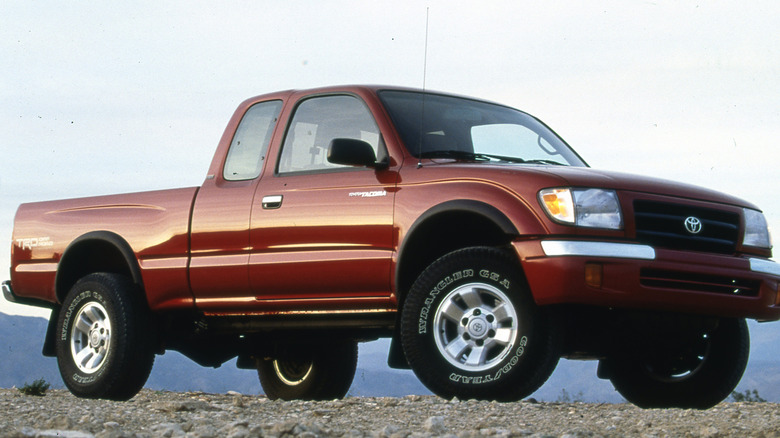
Strictly looking at the Tacoma nameplate, this truck's story starts in 1995, when Toyota first added the label to its line of pickups. However, the company's history with trucks in the U.S. dates back to the 1960s. The first generation launched with a pair of four-cylinder engines that never exceeded 150 horsepower, but a 3.4-liter V6 powerplant later became available, increasing output to 190 ponies. The second-gen Tacoma, which debuted for 2005, morphed into a larger, more powerful machine. V6 power, via a 4.0-liter unit, was rated at 245 horsepower.
Following an "if it ain't broke, don't fix it" philosophy, the Tacoma soldiered on until it was redesigned for the 2016 model year. The changeover brought a new V6 engine making 278 horsepower, while still offering an inline-four powerplant for buyers looking for efficiency over brawn. Along the way, the Tacoma earned a reputation for solid reliability, which has translated into strong resale value. The truck consistently ranks among the top vehicles for lowest depreciation.
The current Tacoma, the fourth generation, hit showrooms for 2024, ditching six cylinders for a standard turbocharged inline-four engine. In its continued drive toward electrification, Toyota added a hybrid option, cranking output to a robust 326 horsepower. Mercifully, the Tacoma is still available with a six-speed manual gearbox, albeit with only a few configurations.
Toyota 4Runner (1984-2026: 43 model years)
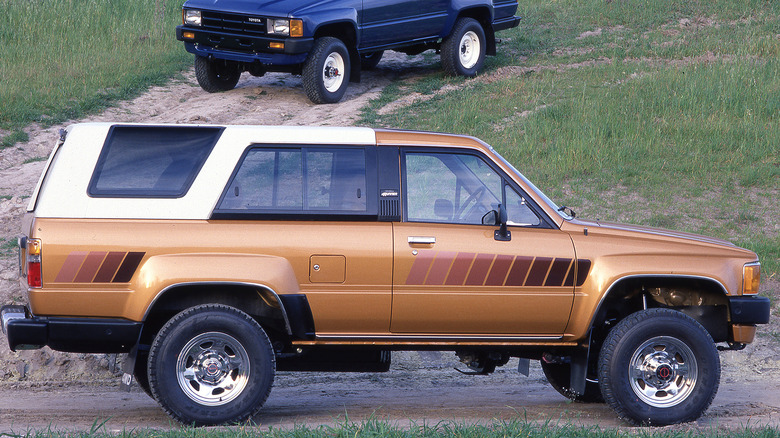
The 4Runner traces its roots to the Toyota Hilux pickup, which dates back over half a century in the U.S. Yet, it took over two decades for Toyota to adapt the truck into an SUV that's been part of the company's model range for over 40 years. The first generation showed its pickup roots with the absence of a second row and a removable fiberglass top. In 1990, the second-generation 4Runner debuted with a more refined presence and a solid roof across the entire top. The base 2.4-liter four-cylinder engine offered a modest 116 horsepower, while the optional 3.0-liter V6 increased output to 150 horsepower.
A 1996 redesign introduced the third-generation 4Runner with a new 3.4-liter V6 that produced 183 horsepower. At the same time, Toyota added more trims, including the upscale Limited with leather upholstery. While the automaker softened the exterior of the fourth-generation 4Runner, it didn't shortchange the engine bay. The 2003 launch featured a standard 4.0-liter V6 engine and an optional 4.7-liter V8 powerplant.
The fifth-generation 4Runner was produced from 2010 through 2024, without a V8 under the hood. The body-on-frame architecture remained, while a 2020 update added standard driver-assist technologies, including automatic emergency braking. The sixth generation launched for 2025, sharing a platform with the Tacoma, Land Cruiser, and other Toyota products. As with the Tacoma, power comes from the same turbocharged four-cylinder and optional hybrid units.
Toyota Camry (1983-2026: 44 model years)

The Toyota Camry is like ants at a summer picnic — they're everywhere. Even in today's SUV- and truck-heavy marketplace, this stalwart sedan continues to rank high in sales. In 2024, it was the best-selling passenger car (non-SUV or truck) in the U.S., with Toyota moving over 300,000 units. The Camry launched for 1983, when popular vehicles of the era included the Oldsmobile Cutlass, Ford Escort, and Chevrolet Cavalier. More than 40 years later, only the Camry is still being produced.
The first Toyota Camry featured a squared-off exterior — very typical of '80s design — and sold 50,000 examples in its initial year. Back when automakers had shorter product life cycles, the next version rolled out for 1987 with somewhat softer lines, while the third-generation Camry (1992-1996) adopted a more bulbous look. While the sedan has been the traditional body style for the Camry, Toyota did offer coupe and station wagon variants during these earlier years. 1997 marked another redesign. This first year of the fourth generation helped push total Camry production total in the U.S. to two million units. By 2000, another one million Camrys were built.
2007 marked the release of the sixth generation, which broke new ground with the first Camry Hybrid. This version featured a continuously variable transmission (CVT) and an EPA fuel economy rating of 40 mpg in the city, a 65% improvement over the base four cylinder's city rating. The launch of the ninth-generation Camry for 2025 marked the model becoming a hybrid-only offering.
Toyota Corolla (1969-2026: 58 model years)
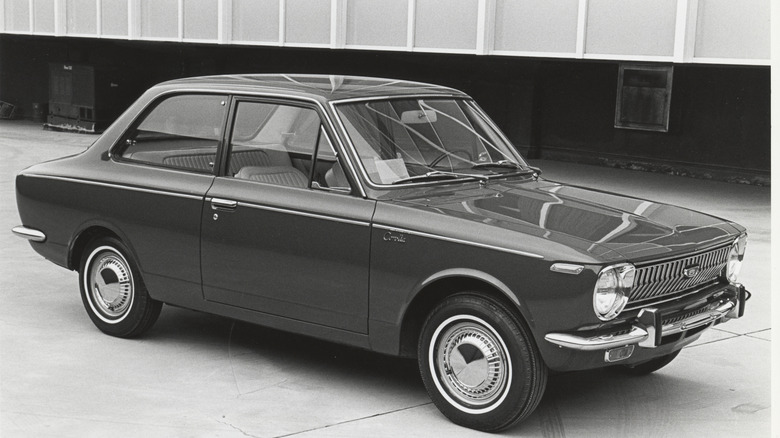
Unsurprisingly, the world's most popular car has been in production for well over half a century. The Toyota Corolla debuted in the U.S. for the 1969 model year, a well-timed entrance before the first energy crisis in 1973. By today's standards, the first Corolla was modest, offering a 1.1-liter four-cylinder engine making 60 horsepower. In comparison, the base six-cylinder engine in a 1969 Chevrolet Corvair produced 95 horsepower. The Corolla helped spur competition from Detroit, including the Ford Pinto and Chevrolet Vega.
Each successive generation brought refinements, especially under the hood, with increased displacements and a switch to overhead cam architecture in the 1980s. In addition, Toyota introduced more variants beyond the bread-and-butter sedan, with performance versions like the mid-1980s AE86 popularized by the "Initial D" anime series. This period also saw another significant change: the transition to a front-wheel-drive layout.
After 12 generations, today's Corolla has come a long way, but it still anchors the automaker's U.S. passenger car lineup. Buyers can opt for a hybrid edition that can be outfitted with all-wheel drive. Toyota has also kept the five-door body style alive with the Corolla Hatchback and the 300-horsepower GR Corolla.
Land Cruiser (1958-2021, 2024-2026: 67 model years)

The Land Cruiser has been available in the U.S. since 1958, starting as the 20 Series, a small SUV more akin to a Jeep CJ. Another 2 years later, Toyota rolled out the 40 Series (FJ40) with a 125-horsepower inline-six-cylinder engine. In 1967, the automaker added the larger Land Cruiser 55 Series to the lineup with wagon-like styling that more closely resembled modern SUVs.
The 1980s were transformative for the Land Cruiser. The 55 Series was replaced with the more refined 60 Series, and the smaller FJ40 was dropped. This would lead to the Land Cruiser 80 Series for the 1991 model year. In addition to an upgraded suspension and a more versatile four-wheel-drive system, leather upholstery was available, giving the Land Cruiser an upscale touch. The 80 Series underpinned the first Lexus LX 450.
The Land Cruiser graduated to V8 power with the introduction of the 100 Series for 1998, helping cement the SUV's flagship status in the Toyota lineup. A decade later, the more upscale 200 Series debuted with a 381-horsepower V8 under the hood. This generation would continue through 2021, the final year of this behemoth utility in the U.S. An all-new five-seat Land Cruiser appeared for 2024 with a turbocharged 2.4-liter four-cylinder hybrid engine and styling cues from the original 60 Series. The new version slots between the 4Runner and the Sequoia.