

These Are The Fastest Jets A Civilian Can Own
Owning an aircraft of any sort is a luxury reserved for a very small club. Owning one of the fastest machines on the market, however, is a flex on an entirely different level. Ever since Chuck Yeager's Bell X-1 first broke the sound barrier on October 14, 1947, the world of aviation has learned to respect speed — perhaps more than anything else, other than range. It goes without saying that such speed also carries bragging rights.
Today, the quickest aircraft on earth are almost exclusively military. Many were engineered to dodge missiles and deliver ordnance within minutes of urgency. Modern civilian aviation post-Concorde (which was retired in 1989) isn't as lucky. Bound by fuel efficiency, noise regulations, and cost, passenger planes struggle to go supersonic.
However, that doesn't mean you have to enroll in the air force to taste true speed. A surprising number of ex-military icons have appeared on the private market, and modern business jets from Gulfstream and Bombardier skim just shy of sonic flight. Here are some of the fastest aircraft within reach of private owners, including Cold War interceptors and corporate flagships.
Douglas A-4 Skyhawk

The owner of an A-4 Skyhawk doesn't just own a beast that scrapes near the speed of sound. They possess an aluminum piece of U.S. Navy and Marine Corps history. When it debuted in 1954, this ultra-light attack aircraft amazed the Navy by weighing just under 10,000 pounds when flying clean; other competitors were much heavier. Driving that light‑but‑powerful frame was a single Pratt & Whitney J52-P-6-A engine that coughed 8,500 pounds of thrust. This resulted in a top speed of Mach 0.91.
Only the Argentine Air Force and the Brazilian Navy currently operate this 70-year-old bird. Yet many of the 2,960 produced airframes remain in private hands, functioning as warbirds or demonstration jets. As recently as 2011, the New Zealand Air Force sold the last of its eight grounded Skyhawks to a U.S. firm for $7.9 million. Even today, examples from the early 1990s occasionally surface for sale. A 1992 model is currently listed by Platinum Fighter Sales for $3.2 million.
Dassault Falcon 8X
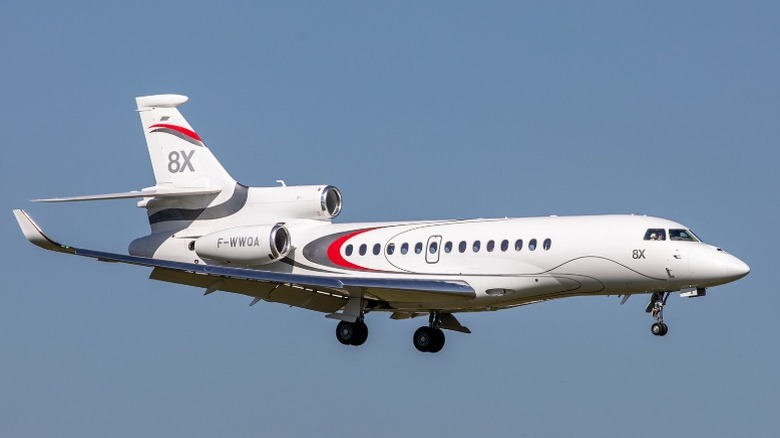
Until the Falcon 10X officially hits the market, the Dassault Falcon 8X remains as the pinnacle of the French manufacturer's civilian aircraft engineering. It's also one of the few trijets around alongside its predecessor, the 7X. Three Pratt & Whitney Canada PW307D engines produce a combined 20,166 pounds of thrust, propelling the aircraft to top speeds of Mach 0.90. All that speed is thankfully backed by fuel efficiency and a range of 6,450 nautical-miles, sufficient for a London-to-Singapore trip without stopping.
The Falcon 8X benefits from Dassault's expertise in military aviation. Its Digital Flight Control System draws on technology developed for the Rafale fighter jet, while the FalconEye Combined Vision merges synthetic and enhanced vision to satisfy every pilot's dream — as far as situational awareness is concerned. True to the Falcon family, the 8X has a very comfortable cabin. Dimensions measure 42 feet, 8 inches long, 7 feet, 8 inches wide, and 6 feet, 2 inches tall. This is roomy enough to sit up to 16 passengers, although it is typically configured for a dozen. It also passes the aesthetic test; there's a reason Max Verstappen owns one.
Cessna Citation X+
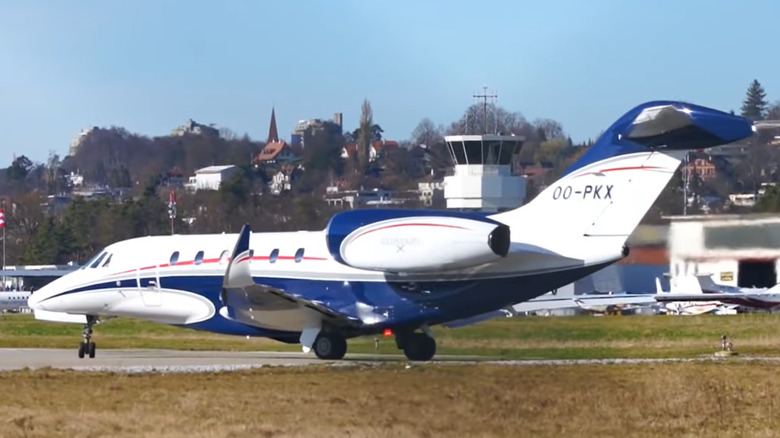
When Cessna unveiled the first Citation X+ in 2013 as an upgrade to the Citation X, it made one of the fastest business jets in the world even faster. Upgrades that birthed the Citation X+ include two Rolls-Royce AE3007C2 turbofan engines with improved fans mounted at the rear fuselage, giving it a Mach 0.935 top speed, and a new aviation suite in the Garmin G5000. It is also remarkably efficient. Gobbling a measly 5.6 gallons per minute, it has a decent range of 3,200 miles as well, while hauling 12 passengers and many more cabin amenities to accompany them.
While it has since lost the title of "fastest business jet" to the Bombardier Global G8000, the upgraded Citation X+ continues to rank among the fastest civilian aircraft and certainly Cessna's quickest. Sadly for Citation X+ enthusiasts, the program drew to a close in 2018. But even its successor, the Longitude, with its improved range still lags behind in raw dash power (644 mph). Since no new airframes are produced, getting one means parting with as "little" as $3 million, or as high as $10 million.
Gulfstream G800
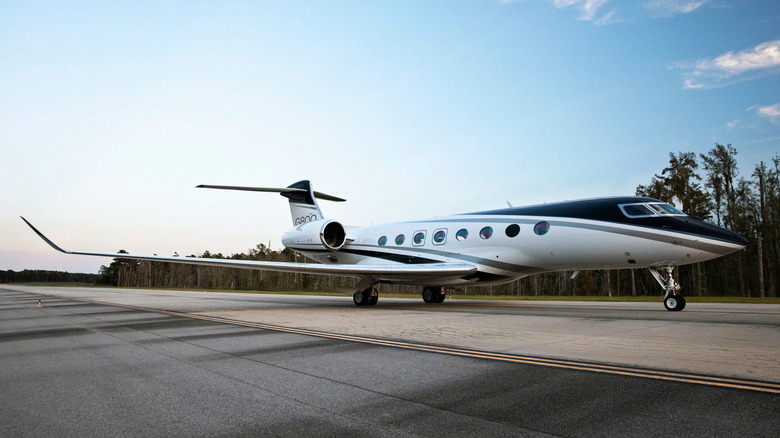
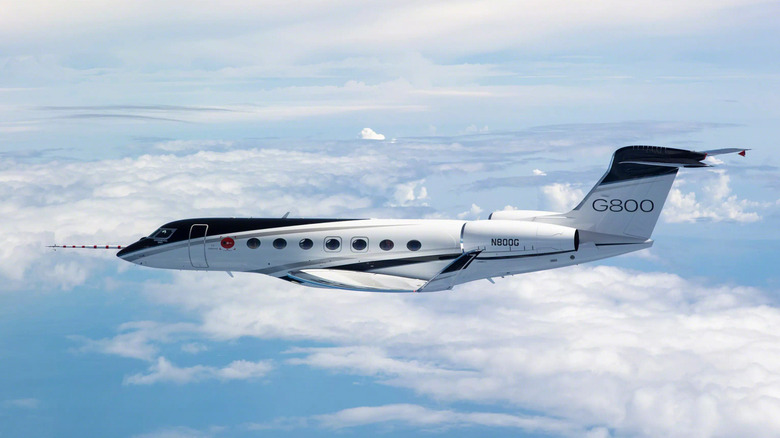
11 mph. That's the margin holding back the Gulfstream G800's top speed from becoming the outright fastest amongst private jets. Even so, the G800 still sports an enviable top speed of Mach 0.935 and has the farthest reach of any bird in its class at 8,200 nautical miles. Its performance credentials were already clear in December 2023 when its G700 derivative completed a 6,365-nautical-mile journey from Tokyo to Savannah in a record 10 hours and 53 minutes, setting a new city-pair record.
As the newest product from Gulfstream Aerospace Company's already storied "G-series" lineage, the G800 aces all metrics: cabin size, avionics, engines, range, and definitely speed. Gone are the Rolls-Royce BR725 units that powered the G650. In their place are the more advanced Pearl 700s, churning 1,350 pounds more thrust (18,250 versus 16,900) and achieving a 5% reduction in specific fuel consumption. To get the most out of the G800's maximum range, crews typically dial back to Mach 0.85; high-speed cruise only breeds 7,000 nautical miles of unrefueled coverage.
Once aboard, it's easy to see why the G800 costs $70 million-plus on order. A spacious cabin — configurable for up to 19 passengers — bears all the hallmarks of Gulfstream's design elements with its expansive living zones, refined materials, and the company's signature panoramic oval windows. Plus, there's no need to worry about jet lag. The record-low 2,840-foot cabin altitude capability makes sure of that.
Bombardier Global 8000
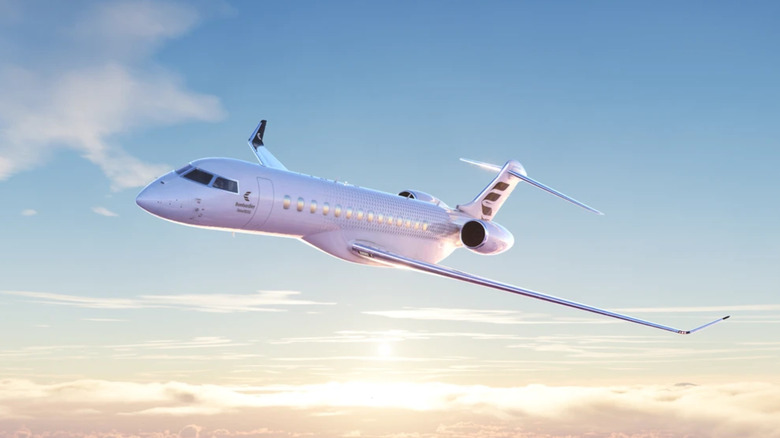
As far as private air travel is concerned, the title of "fastest" belongs to the Bombardier Global 8000. Since the iconic Concorde retired, no passenger aircraft has flown faster. Even the Global 8000's cruise speeds, set at around Mach 0.92, is enough to outclass nearly every other competitor. It's been this way since May 16, 2025, which is when the jet made its maiden flight and established itself as the speediest mode of business transport. Thanks to twin General Electric Passport engines that spit 18,000 pounds of thrust apiece, the Bombardier Global 8000 flies at an enviable top speed of Mach 0.95.
Range is this jet's friend, as well. Its fuel efficiency and near-sonic cruising allows it a global reach of 8,000 nautical miles, just 200 miles short of the Gulfstream G800's record. For reference, departing from New York places almost every major global city within nonstop distance; only pockets of Southeast Asia and Australia would be left out. That perfect balance of speed, range, space, and luxury doesn't come cheap, translating to a $78 million price tag.
Northrop T-38 Talon
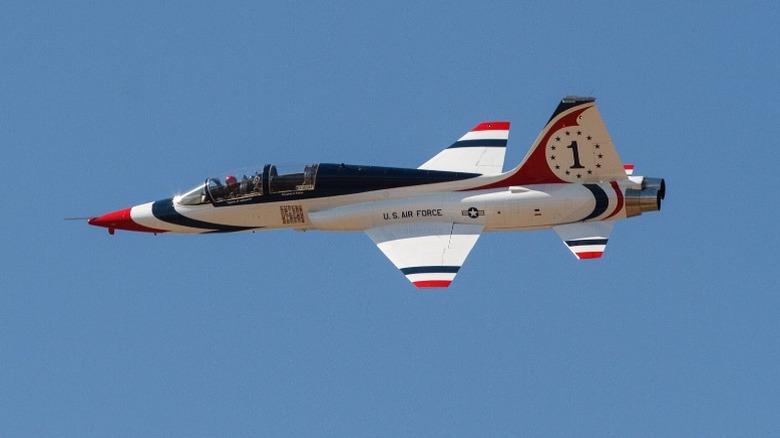
Mach 0.95 might be good for some, but that's not the case for anyone craving true supersonic flight. For that, there's a cheaper, nimbler, and far less spacious set of wings: the Northrop T-38 Talon. As the world's first supersonic jet trainer, capable of Mach 1.08 at sea level and around Mach 1.3 at above 30,000 feet, the 46-foot T-38 has spent most of its life on and over U.S. Air Force ramps.
Its two General Electric J85-GE-5 turbojet engines are so good at their job that, 64 years after its introduction, the T-38 is still training generations of U.S. Air Force pilots. NASA even continues to use it for astronaut proficiency flying. But the Talon's claws will soon run blunt, as the T-7A Red Hawk is being eyed as its successor. But the Air Force's loss becomes the private flyer's gain as a small number of these models inevitably find their way into civilian hands.
Just don't expect any version except the T-38A, the most basic variant, and the only one that has appeared on the civilian market. Even then, they're extraordinarily scarce. Chuck Thornton was the first private individual to acquire a T-38, and another example reportedly surfaced with an asking price of around $800,000.
Saab J35 Draken
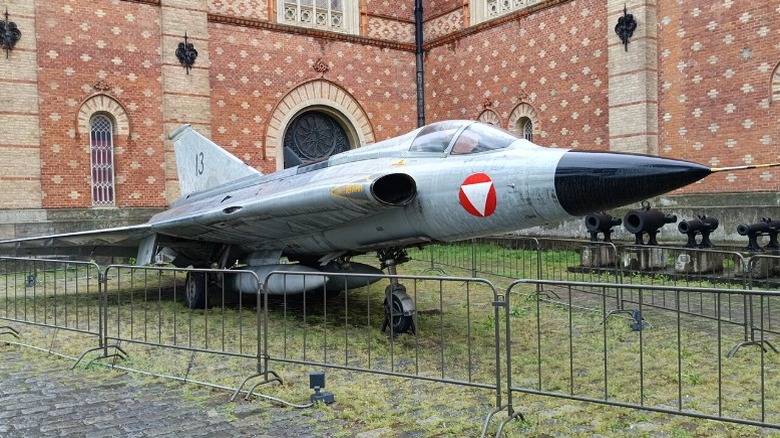
When talking bizarrely genius and fast Cold War aircraft designs, the J35 Draken ("Dragon" in English) from legendary Swedish auto and aircraft manufacturer, Saab, deserves a spotlight. This is an aircraft of many groundbreaking achievements: it was the first Western European fighter capable of true sustained supersonic flight, the first in the region to crack Mach 2, and the first to cheat the laws of aerodynamics by adopting the tricky double delta wing design. It pairs one sharply swept inner wing section with a wider outer span. The genius is that it lets one airframe behave like two different aircraft depending on how fast it's flying.
Ironically, the instability created by this cutting-edge wing helped give birth to one of aviation's most dramatic maneuvers: the Cobra, where the aircraft pitches its nose in an almost vertical angle before sharply dropping. It's a staple move at airshows worldwide. There's another feature of the Draken that makes it civilian-friendly.
With its rugged landing gear and powerful Svenska Flygmotor RM6B/C engine (a Swedish take on the Rolls-Royce Avon), the jet could operate from short debris-ridden stretches of highway that would scare most fighters. The Draken is a more difficult military aircraft to obtain as a civilian, but it's not impossible. An airframe with the FAA civil registration as N35350 currently exists somewhere in the U.S., and another was once listed for $249,000.
Mikoyan-Gurevich MiG-21
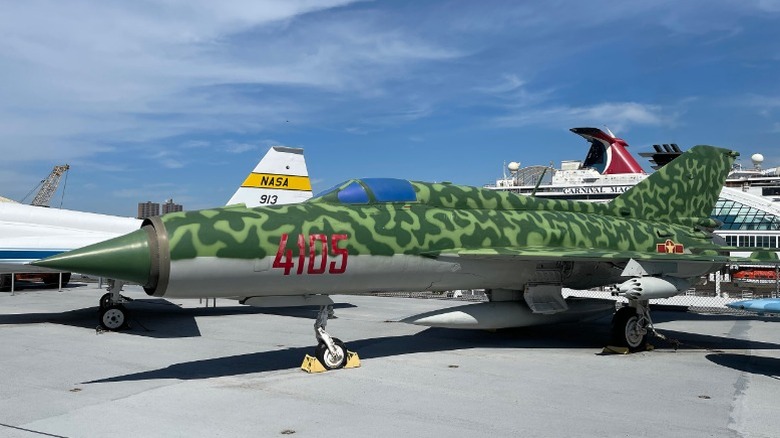
Like the J35 Draken, the MiG-21 (dubbed "Fishbed" by NATO) was conceived as a high-speed interceptor, albeit on the right side of the Iron Curtain. But it also excelled as a fighter. The Soviet Union pushed this role especially hard, with the famed Mikoyan-Gurevich design bureau and multiple licensed factories abroad producing more than 11,000 airframes from the mid-1950s onward.
That number makes this single-seat 1,300 mph (Mach 2) beast the most-produced supersonic jet in history. Because there were so many, plenty of extra models were lying around for private collectors around the world when the Cold War ended. Even the National Museum of the U.S. Air Force and the San Diego Air & Space Museum both display examples of the fighter — despite the fact that it was originally built to oppose American aircraft.
There's no one fixed price for a MiG-21. In 2024, Dallas' Cavanaugh Flight Museum listed a MiG-21 for $50,000, and in 2006, a Chinese businessman famously bought one on eBay for half that. A Belgian owner even received a €5,250 offer for a derelict airframe with a functional cockpit. But these are just the purchase costs. Collector-pilot Paul van den Heuvel reportedly spent $165,000 just to have his MiG-21 certified by the Federal Aviation Administration under the Experimental Exhibition category, followed by about $50,000 per year in operating and maintenance costs.
Lockheed F-104 Starfighter
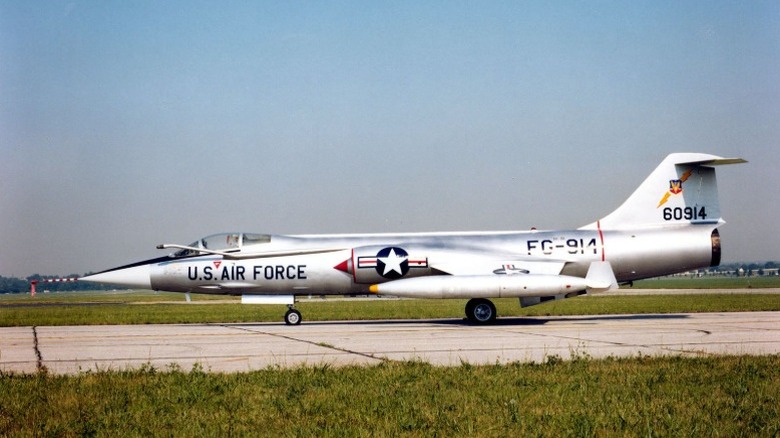
The F-104 Starfighter's designer, Clarence "Kelly" Johnson, certainly knew how to toy with speed. He was the same mind behind the SR-71 Blackbird, the fastest air-breathing manned aircraft ever. Of course, the F-104 couldn't dream of the Mach 3.2 capabilities of the latter. But it could still boast speeds of Mach 2, which was a first for a production fighter in an era of military aviation where speed was far more important than it is today. Powered by a single General Electric J-79-7A turbojet engine, the F-104 paired 15,800 pounds of thrust with a short 21 feet, 9 inches wingspan, earning it the nickname "a missile with a man in it."
For private collectors, the Starfighter's appeal is obvious. It's a Cold War icon with operational history stretching from Europe to the Vietnam War. Besides, very few aircraft can claim to fly at twice the speed of sound at altitudes approaching 100,000 feet. But enthusiasts are also well aware of the jet's abysmal safety records that led to grim monikers such as "flying coffin" and "widowmaker."
The F-104 Starfighter is long gone from front-line service globally, but that doesn't mean its legacy is. Civilian demonstration team Starfighters Inc. continues to wow crowds with its models at airshows and even listed one on the private market for $4.2 million initially, later dropping to $305,000.
Mikoyan-Gurevich MiG-29
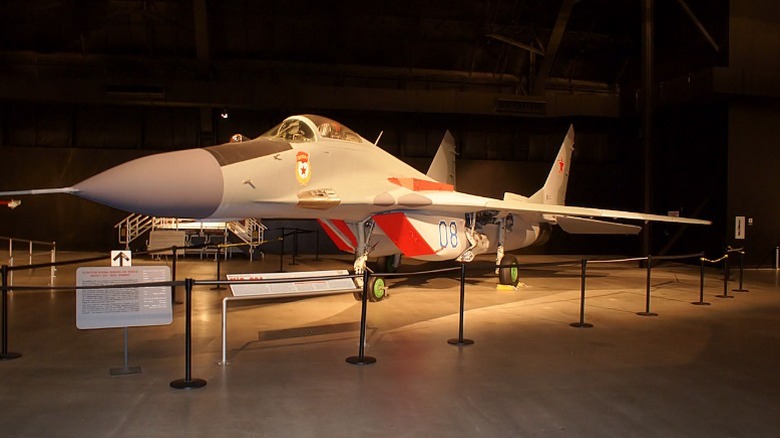
Another Cold War legend, the MiG-29 "Fulcrum" jet, is often cited as the fastest civilian-owned warbird in the world, capable of pushing up to Mach 2.25. That performance comes courtesy of its two Klimov RD-33 turbofan engines, and its design as a lightweight air-superiority fighter gave it an unusually high thrust-to-weight ratio. In simple terms, the jet was built to accelerate hard, turn fast, and win in a dogfight with enemy F-16s.
When the Soviet Union disbanded, the MiG-29 was barely a decade old, yet it was already serving in multiple air forces across the world. Many still fly today in post-Soviet states, as well as in countries like Poland, India, and Egypt. Its versatility spawned numerous variants, from the carrier-capable MiG-29K built for the Indian Navy to the more advanced MiG-35, which introduced upgraded avionics and multirole capability.
As with the Saab Draken, the MiG-29 was rugged enough to endure short-field operations. Earlier models even had auxiliary intake doors on the upper fuselage that opened when the main intakes shut to avoid incoming debris. For years, the MiG-29 earned the respect of many Western air forces. The U.S. Air Force even acquired several ex-Soviet MiG-29s from Moldova after the Cold War. To top it all off, late Microsoft co-founder Paul Allen bought one, and it was later sold to entrepreneur and pilot Jared Isaacman.