

How Reliable Are Volkswagens? Here's What Consumer Reports Says
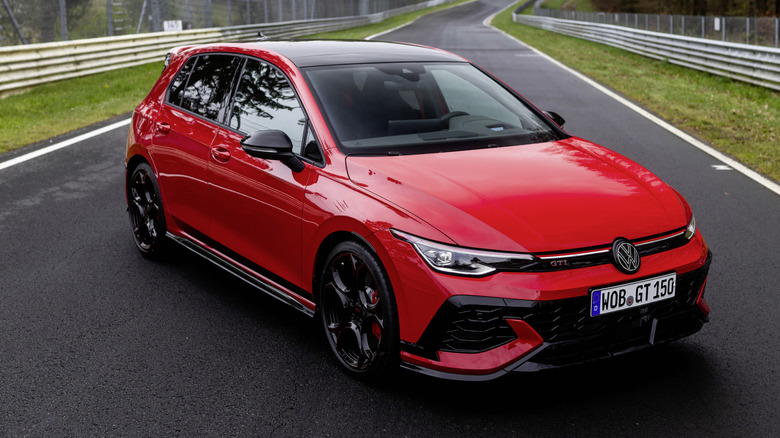
Volkswagen is one of the oldest and biggest car manufacturers in the world. For almost nine decades, the brand has lived through the early dominance of the Beetle, its rise as an automotive giant through acquisitions of Audi and Porsche, and, more recently, Dieselgate. VW's modern car lineup includes compact cars, SUVs, crossovers, and electric vehicles like the Volkswagen ID Buzz, which has the best vibes of any new car on sale. Within this large lineup of cars, specs and features vary — but how reliable are Volkswagens in general?
According to a Consumer Reports (CR) 2025 reliability survey ranking 26 different major brands, Volkswagen ranks 16th. The Golf GTI is the most reliable model in the current VW lineup, while the compact Taos ranks as the least reliable. These numbers place VW slightly below average. RepairPal ranks VW reliability numbers at 3.5 out of 5.0, which puts it as 12th across 32 different brands. These numbers tell you something, but not everything. Individual cars can perform very differently, so buyer beware: Picking the right VW model matters.
Volkswagen's reliability ratings are complicated
The ratings CR provides are based on real owner experiences in the past 12 months. Specifically, CR compiled data on 380,000 vehicles and separated that data into 20 different trouble areas that include the engine, transmission, in-car electronics, body hardware, and EV components. According to CR, the Taos "is less reliable than other cars from the same model year." It isn't all bad ratings for Volkswagen, though.
RepairPal is an independent automotive data company that bases its reliability ratings on millions of real-world repair invoices, historical statistics, and predictive data modeling. Based on their assessments, the Jetta, Golf, and Passat are "above average" in reliability, while the Tiguan and the Golf GTI are "average." To further complicate things, the picture shifts slightly when looking at used cars. In a separate 2025 CR study of used car reliability, Volkswagen is placed 13th out of 26 brands.
That placement isn't a complete game changer, but it's a bit better than VW's rating with new vehicles. In another hit to VW, a dependability study from J.D. Power that tracks reliability ratings for cars up to three years of age, placed Volkswagen at the very bottom of all brands, with an average of 285 problems across 100 vehicles. However, VW Jetta reliability is rated "Great" while the Golf GTI is only "Average." The Taos — one of the least satisfying SUVs you can buy – is also "Average."
Volkswagen's market presence and maintenance costs

Volkswagen is a major player in the U.S. car market, consistently ranking among the top-selling automotive brands. More than 10 years after the PR disaster that was Dieselgate, Volkswagen sold 316,504 vehicles in the U.S. in 2024 — a 19.4% year‑over‑year increase — suggesting that, despite its underwhelming projected reliability and past scandals, VW is a strong choice with buyers.
VW's best-selling models with U.S. buyers are the Tiguan, the Atlas, and the Jetta. The usual benefit VW enjoys compared to its German counterparts is that it offers German engineering at a cheaper price. VW does not match Mercedes, Audi, and BMW in terms of luxury, despite some higher-end models, but it does share some of its platforms with Audi. This means that Volkswagen, although it isn't as premium as Mercedes or BMW, does not suffer from costs typically associated with luxury brands.
According to RepairPal, the average annual repair costs for a VW are $676. Compared to premium brands like BMW at $968 and Audi at $987, Volkswagens seem like a practical choice, especially if you are worried about long-term repair costs. On the economy-side of the spectrum, Toyota, the brand with the best-selling passenger car of 2025, averages $441 in annual repair costs.