

Starlink Almost Had An In-Orbit Collision With A Chinese-Launched Satellite, And It's Only Getting Worse From Here
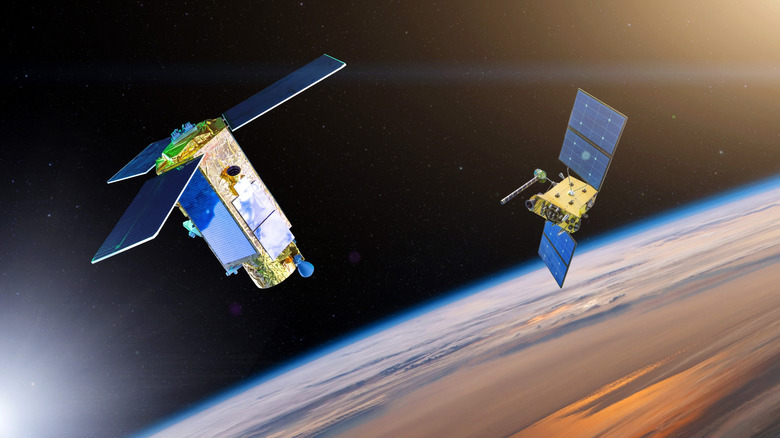
On December 12 at 1:42am EST, a Starlink satellite nearly crashed into a brand new satellite that SpaceX wasn't even aware existed. This satellite had only reached space 48 hours earlier, launched from China by CAS Space. According to SpaceX's vice president of engineering, Michael Nicholls, "As far as we know, no coordination or deconfliction with existing satellites operating in space was performed, resulting in a 200 meter close approach between one of the deployed satellites and STARLINK-6079 (56120) at 560 km altitude." 200 meters! In space terms, they basically high-fived. It could have been so much worse.
Whose satellite was this? That remains unclear; CAS launched orbiters from China, the UAE, Egypt, and even Nepal on that mission, per Space.com. What Nicholls is saying is that whoever it was, they didn't alert the rest of the spacefaring world about its trajectory or even presence, simply flinging its orbiter around the world in the blind. As astronomer Jonathan McDowell points out, there is currently no agreed upon system for this, but "we really need... an *international* space surveillance and coordination system in which both the US and China participate." Otherwise, there's nothing to force anyone to actually fly safely through space. As rough as the state of air traffic control might be, at least it exists! There is no space traffic control. But we need one sooner than later.
A space crash is getting likelier by the day

In November, a Chinese spacecraft docked at the Tiangong space station got hit by orbiting space debris, causing enough damage to strand taikonauts there for a little while. Meanwhile, Starlink itself has launched 10,000 satellites just since 2019, with plans for several times more in the near future. Amazon has started deploying its own mega-constellation, and militaries around the world want to follow suit. That could bring the total number of satellites to somewhere around 560,000. Tell me there won't be a crash, especially without traffic control.
Would a crash all the way out in space even matter that much? You'll be pleased to learn that the answer is yes, horrifyingly so! For one thing, crashes create debris, which can crash into more satellites, creating more debris, potentially spiraling into a chain reaction that wipes out all orbiters and renders space inaccessible (called Kessler Syndrome). For another, some of that debris will crash to Earth, possibly in a populated area and causing enormous damage. So it's good news that Starlink didn't crash into this other satellite, but as a sign of the times, it's a shot across the bow.