

These 3-Cylinder Engines Make More Power Than You'd Expect From A V6
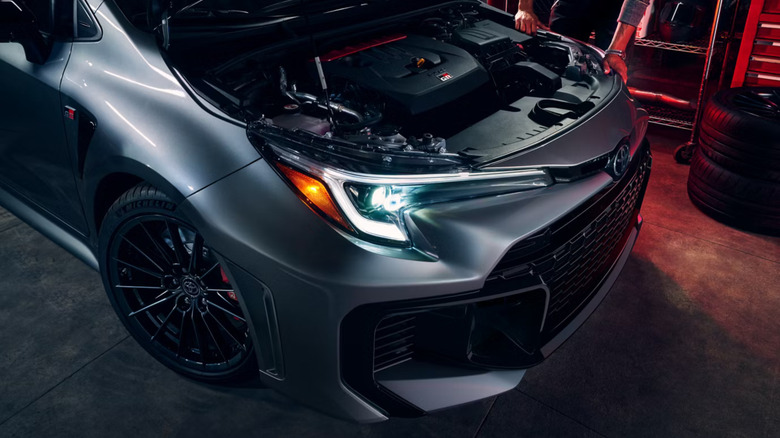
Efficiency has been the order of the day for some time now in the automotive industry. Regardless of whether an automaker is developing a sharp little city vehicle or a world-beating hypercar, technologies like turbocharging and hybridization are frequently used, ensuring the end result is as efficient as it possibly can be. Beyond these methods, another popular way of increasing efficiency is downsizing.
Downsizing in the automotive space refers to a new generation of a model sporting a smaller engine than its predecessor. Take, for example, the Toyota Tundra; the current generation employs a twin-turbocharged V6, whereas Tundras of old sported naturally aspirated V8 engines. The Honda Accord is another prime example, with top-flight models swapping V6 mills out for boosted inline-fours.
One engine that has risen to fame during this era of downsizing is the little inline-three. Not too long ago, three-cylinder engines just weren't seen. Now, though, we've got tire-melting hot hatches and even supercars toying with the tiny power plants. Granted, most performance cars still opt for something a little larger than a three-cylinder engine. The ones that choose this route are typically more interested in EPA ratings than they are in 0-60 mph runs. However, there are a few cars that buck that trend, squeezing out power figures that are more commonly seen on mills with twice the cylinder count.
Nissan Rogue: 201 horsepower
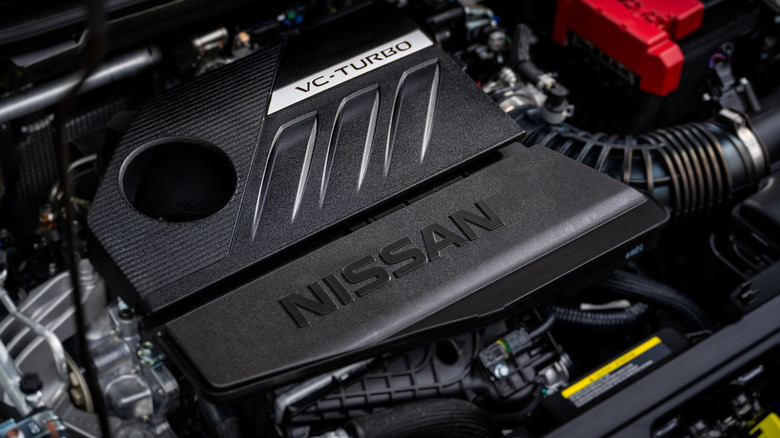
The Nissan Rogue is a compact crossover SUV that's more focused on being an economical and affordable grocery-getter than a vehicle with any modicum of real performance. Now, we're never going to argue that it's a slept-on performance powerhouse or anything like that, but its punchy inline-three is a little gutsier than you might first expect.
Under the hood of all Rogue trims sits a 1.5-liter turbocharged inline-three hooked up to a CVT. It'll send power to either the front or all four wheels, depending on the exact configuration. That output is rated at 201 horsepower, which might not seem like much, but it wasn't really all that long ago that 200 horses was a pretty standard figure seen with many V6-powered sedans and SUVs.
Take the fifth-gen Toyota Camry as an example. This ever-popular sedan took motivation from a 3.0-liter V6 — twice the Rogue's cylinder count and capacity — and yet it produced just 210 horsepower. Old V6-powered Nissan SUVs weren't much more powerful either; the midsize 2004 Pathfinder made do with 240 horses. In just around two decades, Nissan has managed to harness the power of a large naturally aspirated V6 and cram it into a tiny three-cylinder package.
Toyota GR Corolla: 300 horsepower
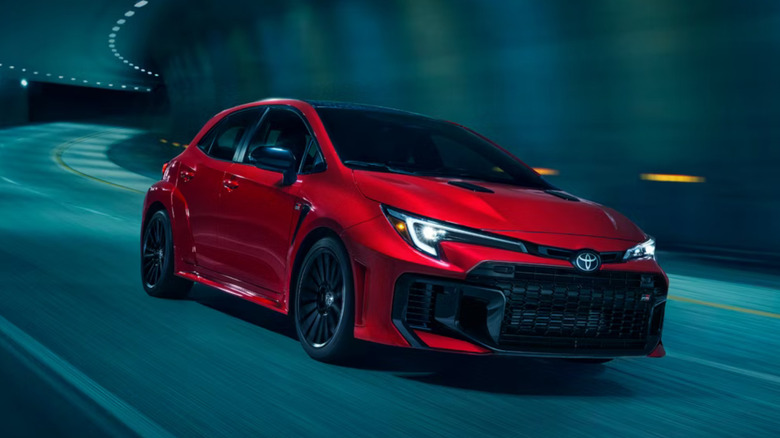
The Toyota GR Corolla is probably the most famous example of a three-cylinder engine kicking out a fierce amount of power. It's a thoroughbred hot hatch, and although it's been doing the rounds for a few years now, it remains one of the most fun cars money can buy. Blistered arches, a bulging hood, four-piston calipers, and a figure-hugging set of sports seats are all great features of the GR, but it's beneath that hood where the magic really happens. Here hides the 300 horsepower and 295 lb-ft of torque from the G16E-GTS boosted inline-three engine, which can be hooked up to either an eight-speed automatic or a six-speed manual transmission. All-wheel drive is standard across the range.
As it happens, this is actually the last all-wheel drive and manual-equipped hot hatchback on sale in America right now, and it flies the flag high for three-cylinder power, too. Plant your foot and it'll dart from 0 to 60 mph in right around 4.9 seconds. Keep your foot down and you'll not stop accelerating until the speedometer indicates 143 mph. As impressive as these figures are, though, the GR Corolla isn't the only high-performance three-cylinder Toyota. In fact, it wasn't even the first to the party.
Toyota GR Yaris: 280 horsepower
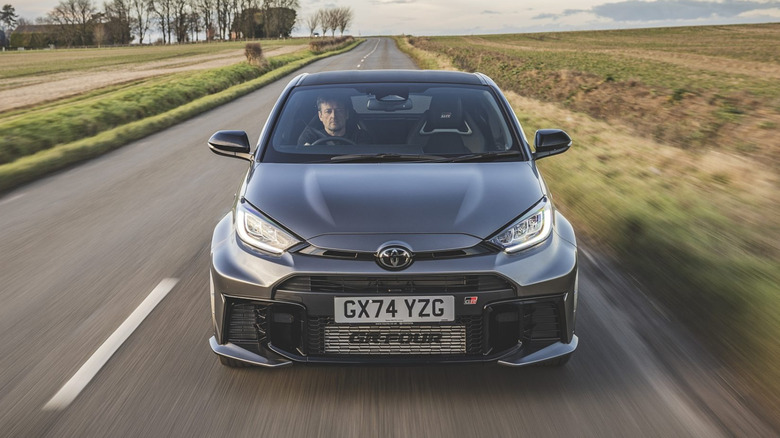
Before we were given the GR Corolla, Toyota gave the world the GR Yaris. Well, "the world" might be inaccurate, as the fiery little hot hatch never made its way into various markets — including American shores.
The main differences between the GR Yaris and the GR Corolla are their sizes. While the Corolla is certainly far from big, the Yaris is much smaller, available exclusively as a three-door. It does still have rear seats, but there's very little legroom or headroom back there. While the GR Corolla can easily double-up as a daily driver and small family car, the GR Yaris is very much a driver's tool first, with practicality only being an afterthought.
In terms of similarities, both of these hot Toyotas share a power plant. The G16E-GTS in the Yaris isn't quite so spicy, kicking out just 280 horses to the Corolla's 300, but the smaller proportions mean performance is pretty much identical between the two. The Yaris can crack 142 mph, and 0-60 mph times still come in at under five seconds. These two hot hatches do the three-cylinder engine proud. Rather than matching the outputs of V6-powered models of the past, they end up outpacing the larger blocks significantly. Just look back at cars like the 147 GTA, the Golf R32, and the Clio V6. They're all modern classics, but none of them are capable of matching the outputs of Toyota's little inline-three.
BMW i8: 231 horsepower
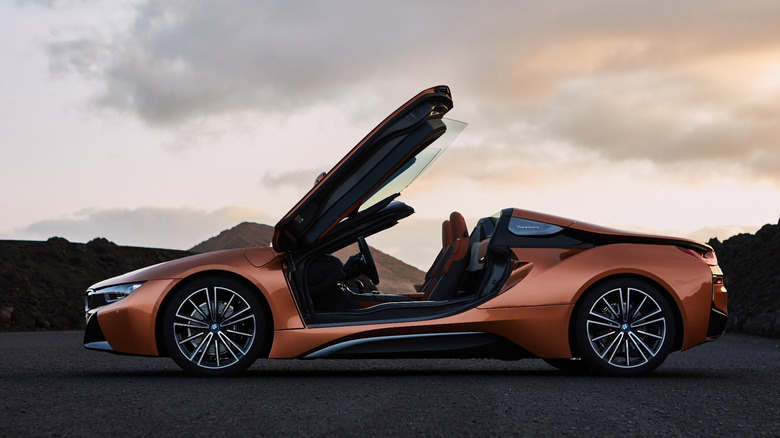
If Batman drove a BMW, he'd drive an i8. The sharp lines of BMW's hybrid supercar are just as striking today as they were when the model first launched.Providing its propulsion was not a silky inline-six or thumping V8 like you might expect from Germany's ultimate driving machine. Instead, the i8 was powered by a little inline-three engine, assisted by a turbocharger and two small electric motors using the strength of an 11.6-kWh battery pack. In total, output peaks at 369 horsepower, which means this most unusual BMW at least has the bite to match the outlandish styling.
The engine itself, a 1.5-liter unit taken from Mini, produces 231 horsepower. It sits mid-mounted in the i8's chassis for a true supercar experience. It's not much of a match for a proper full-fat supercar, but it'll certainly give some V6-powered sports cars a run for their money, even if it only has half the number of cylinders. The combination of a turbocharger and electrical assistance means BMW's three-pot i8 can out-output the Nissan 370Z, the Infiniti G37, and even the Lotus Exige S. It's impressive — and tempting, now that prices are dropping – but it's no match for our final contender.
Koenigsegg Gemera: 600 horsepower
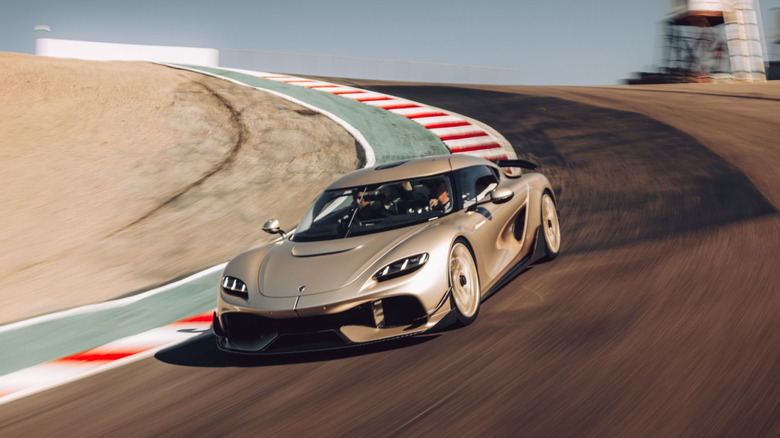
When you see Koenigsegg, it's hard not to immediately think of performance. Historically, the supercars and hypercars from this Swedish automaker have made use of some seriously powerful V8 engines. But for the Gemera, Koenigsegg decided to tear up the rulebook.
An all-new power train was developed. Dubbed the Tiny Friendly Giant, it's a twin-turbocharged three-cylinder that boasted dry sump lubrication, a compression ratio of 9.5:1, and a weight just shy of 155 pounds. Oh, it can also throw down 600 horsepower too. That's 200 per cylinder. If Bugatti was that efficient with its new V16 engine, it would kick out 3,200 horsepower, but it doesn't even manage a third of that potential.
Now, 600 horsepower is an awful lot, but it isn't Koenigsegg levels of power, so some electrical assistance was required. Three motors provide extra grunt, with two on each of the rear wheels providing 500 horsepower, and one on the crank that churns out an extra 400 horses. That gives the Gemera a total output of 1,700 horsepower while also delivering a maximum range of 621 miles. Forget V6 power, that's enough to beat out a V10 or even a V12 — and it's all done with a little inline-three at the center.