

This DIY Rig Is Maybe The Best Explanation Of Regenerative Braking We've Seen
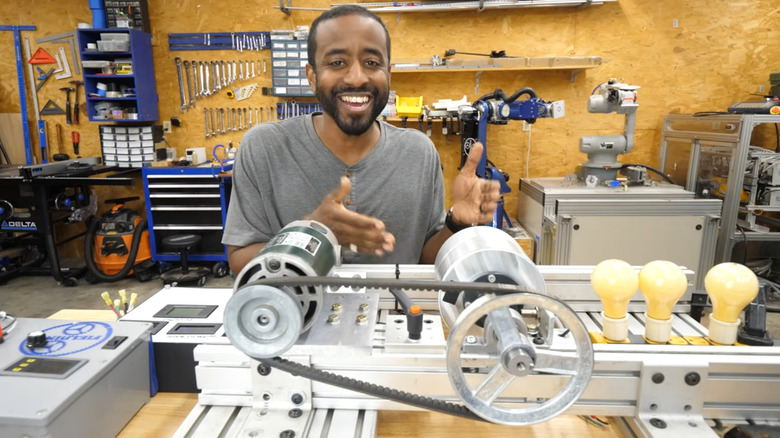
Regeneration is a wild concept. Young minds often explode when learning that some amazing starfish can grow new arms if one gets chomped off; the details of why and how come later. Similarly, many of us nod along when told that regenerative braking systems help recharge batteries, then tilt our heads like a confused dog when asked how it happens. We know, but do we KNOW? Jeremy Fielding is a talented YouTube creator with a contagious affection for mechanical engineering, and a regenerative braking rock star. His DIY rig and explanation of the science behind the scenes may be the best we've seen.
Every electric and plug-in hybrid vehicle sold in the U.S. has some sort of regenerative braking system. Ordinary brake systems use friction to stop a car, and the energy converts to heat. Regenerative braking turns forward motion into energy to recharge batteries, which can in turn help extend range, or run other systems, like the radio or air conditioning. It's so magical, regenerative braking can even make your kid fail their driving test.
Fielding shows and tells how the magic happens, using an impressive regenerative braking setup he fabricated himself. It features a DC speed controller and motor pulled from a treadmill, as well as a custom rpm and power display box, wired to a speed sensor. With a homemade flywheel as a stand-in for a car, and light bulbs that illustrate battery charging, the science comes humming to life when Fielding flips a drum switch to showcase acceleration and regenerative braking in action.
Electric motors, and braking without braking
People who aren't already amongst Fielding's 1.18 million primary YouTube channel subscribers may be inspired to know that he's a self-taught tinkerer, who switched careers in pursuit of his passion. He says at JeremyFielding.com that his goal is to "Draw people to mechanical engineering with amazing projects, inspire them with ideas, then teach them how to do it." Whether your car has regenerative braking or not, his presentation here is well worth the time.
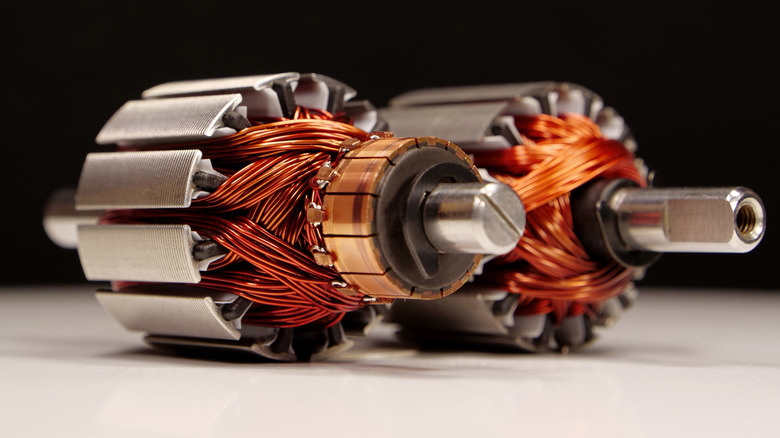
Fielding's video gets at why slowing down without hitting the brakes is a regenerative braking phenomenon: the accelerator pedal acts like a toggle switch. Goosing the pedal makes an electric motor a power user, sucking juice directly from the battery. Releasing the pedal turns the motor into a power generator, cranked by the force of the vehicle's forward motion. The more the motor sucks up that kinetic energy to recharge the battery or power other goodies, the faster the vehicle slows down — like this Lucid Air Pure AWD using just regen braking in its halt from highway speeds.
Through a series of beautifully simple demonstrations — including the most oddly hypnotic sequence of a cylindrical magnet floating down the inside of a copper tube — Fielding distills Lenz's Law of energy opposition, and we learn about the properties of electromagnetism that ultimately govern why an electric car can't just infinitely charge itself. Fielding also touches on the pros and cons of how regenerative braking can conserve brake pads, which some Tesla owners have proclaimed can last 100,000 miles in their electric chariots.