

Why Do Some States Mount Traffic Lights Horizontally?
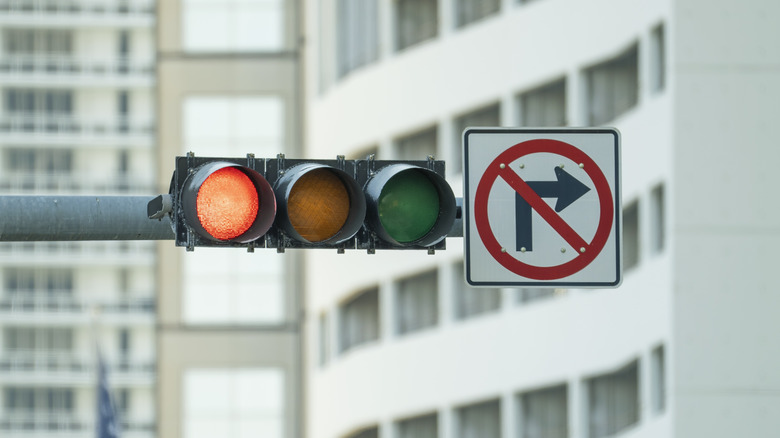
Traffic lights help traffic flow by directing specific lanes to go and others to stop. Some are more complex and include signals for buses. But at the end of the day, they're devices with red, yellow, and green lights, designed to prevent crashes at intersections. You'd think that there would be regulations behind how they should look and operate, and you'd be right. They're not always the same, though.
Driving in Ohio, you'll see traffic lights attached vertically to a light pole, with the red light on top. If you travel down to Texas, the lights are often mounted horizontally on the pole, with the red light on the left. So what gives? Why are they different? It could be several things, including traffic clearance, resistance to wind damage, or simply aesthetics.
A traffic light mounted on a pole above an intersection is susceptible to wind. If it's mounted vertically on that pole, there's limited surface area to hold the light steady. Vertical lights also have a flat surface area that wind can easily catch and attempt to move. In some ways, you could consider a vertically mounted traffic light like a sail on a sailboat. If the wind gust is strong enough, it could break the light free of the pole and damage the light and the area around where it lands. The wind plays less of a role when lights are mounted horizontally, helping reduce the risk of damage or injury.
Weather and visibility play major roles
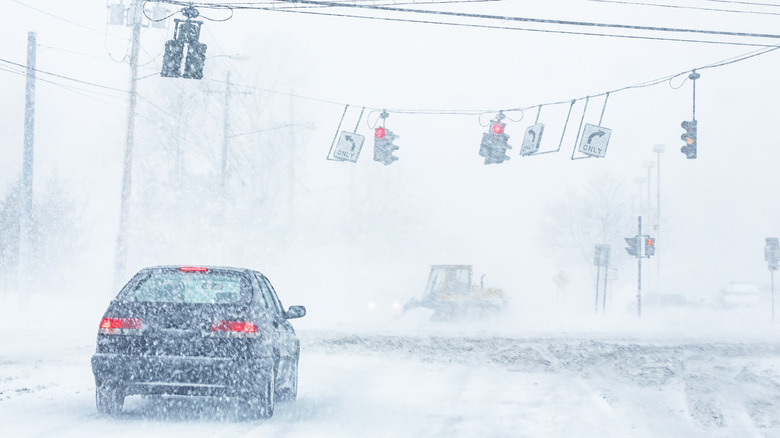
Clearance is also a factor. Semi trucks can be pretty tall, and engineers don't want the trailer roof to rip the traffic light off the pole every time a truck passes underneath it. Signals, at a minimum, must be 14 feet above the roadway. Mounting them vertically can save a few inches of space below the mounting pole, and in some cases, that extra couple of inches could make all the difference. When the traffic light is beneath a highway overpass, there's a physical limit to how high it can be mounted because of the overpass. A horizontal orientation can also provide more breathing room around the mounting pole in these situations.
At an the overpass, mounting horizontally can also improve signal visibility. There's a lower chance that structural elements of the overpass will obscure the light.
For traffic lights closer to the ground, like the ones mounted on poles on the side of the intersection, you'll likely find that those lights are mounted vertically. Those are easier to mount vertically because there's less wind to worry about, and mounted on the side of the road, a vertical light would be more easily seen by traffic. Some intersections even have lights on a pole over the intersection and on the sides, too.
Red light green light
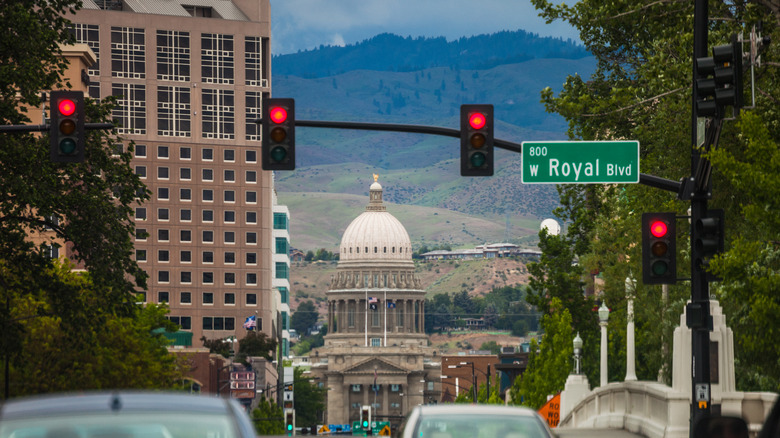
The only true constant with traffic lights is that they'll have a red light, a yellow light, and a green light (unless it's Japan, where the lights are blue instead of green). Beyond that, state and local governments control how and where most of them are mounted. That's why when you're driving in one state, the lights might be mounted vertically, and when you're driving in a different state, they're mounted horizontally. That's also why you might notice cameras and sensors mounted on certain lights, but not others.
For example, in Washington state, traffic lights must be vertically mounted unless there is a clearance issue or to match the orientation of other lights at the intersection. The state traffic engineer has to approve all horizontal installations. And in some areas, such as parts of Michigan, the traffic signal housings may be black while in other parts of the state they're yellow.
While specific signage is mandated nationwide to look a certain way, many decisions are made at the local level. Now you have something new to think about while stopped your next red light.