

At $7,995, Is This 1998 Chevrolet Metro A Small Wonder?

Given its caste in the automotive hierarchy, it's quite impressive that someone has gone to the trouble of giving today's Nice Price or No Dice Chevy Metro a significant refresh. It's even more astounding that, 500 miles after the fact, they now want to sell it. Let's see what that's all about.
There's an old exhortation that goes "There are old pilots, and there are bold pilots, but there are no old bold pilots." While its origins are unclear, it appears to have first emerged in the 1930s, and the smackdown has since expanded beyond aviation to include race car drivers, traders, and even wild mushroom eaters. Yum.
A similar admonition could be applied to automobiles: old cars and trucks that haven't seen careful maintenance and refreshing are nothing more than unfashionably old. Such a sentiment could easily describe the 1995 Mercedes-Benz E 300D we considered yesterday. There was nothing inherently wrong with the car. Still, the body dents and the lack of major mechanical maintenance detailed in the ad (aside from brake rotors) didn't instill much confidence in either the car or the $7,600 the seller was asking for it. As a result, you all voted it down in a 53% "No Dice" loss.
Joining a Cultus
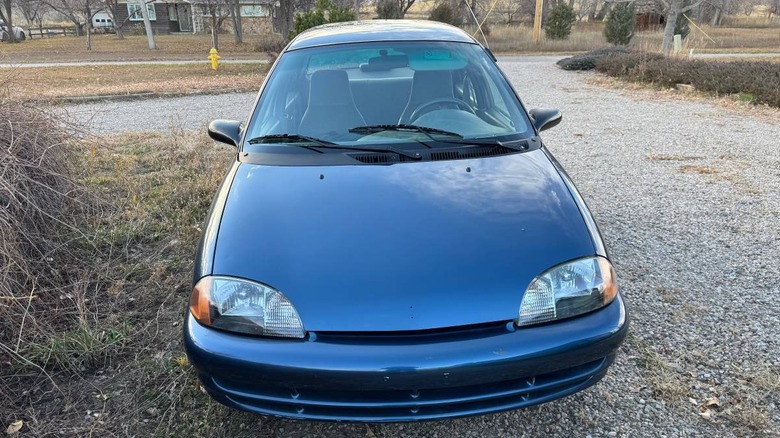
Fortuitously, today's 1998 Chevrolet Metro sedan hasn't been left fallow. Instead, it has reportedly been refreshed with new paint, interior components, engine maintenance, and a brand new windscreen. That might not seem like a big deal unless you ascribe to the seller's position that such work is never done on a car of this caliber, making it a fairly unique and quirkily desirable proposition. It's sort of the manic pixie girl/boyfriend of the car world.
That makes some sense when one considers the weird history of GM's smallest offering for the American market. This page in GM's portfolio was initially filled by the Chevy Sprint, a badge-engineered version of a car called the Cultus, built by Suzuki in Japan. The second generation of Sprint morphed into the Metro, and left Chevy for GM's hot new boy band, Geo. There it joined the Tracker we looked at on Monday, among others. Like the Tracker, the Metro needed a new home after Geo broke up, and similarly, was welcomed back into the Chevy fold. Shortly after the turn of the Millennium, Chevy bumped off the Metro for the Aveo, a model which also shifted from Suzuki to Daewoo, GM's. Korean manufacturing partner. The latest generation of that model is still available, but it is sold only in Mexico and South America, while it is built in China. That churn and burn history makes it a bit of a hot potato of a car.
Built in Canada, but not for Canadians
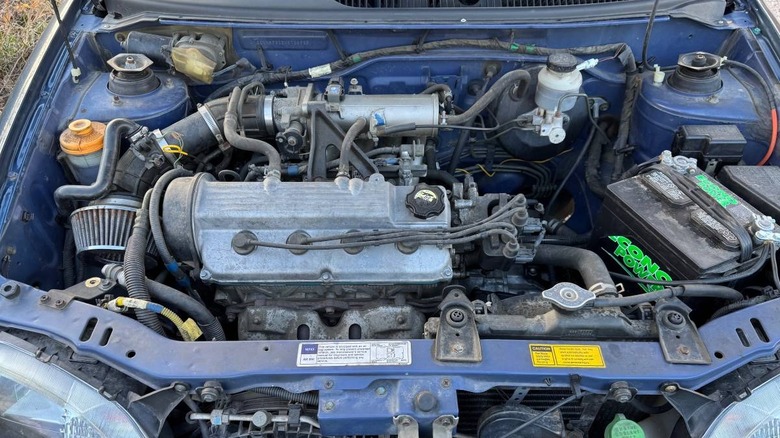
Along the way, our Metro made it out of GM's CAMI plant in Ingersoll, Ontario. Oddly, while that plant built Metros (and Trackers) for the United States market, it did not do so for its home country's buyers. Canadian cars were all sourced from Suzuki's Japan plants.
While all of the engineering for the small car was done by Suzuki, including development of its 1.3-liter SOHC four and FWD five-speed manual gearbox, some of the styling was handled by Chevy. That brought it in line with the larger Cavalier. All told, the Metro makes 70 horsepower and 74 pound-feet of torque. As the seller notes, this isn't a sports car, but what it lacks in quickness, it more than makes up for in unmitigated sloth. As a side benefit, however, it should get great mileage and will happily run on regular gas. According to the seller, the car's substantial 203,000 miles shouldn't cause prospective buyers to dismiss the Metro out of hand. They claim the engine is bulletproof and, anecdotally, say they have come across junked Metros at Pick-A-Part with over 350K on the clock. Make of that what you will.
Rip Van Metro

The seller further notes that the car was squirreled away for six years due to "health reasons." Upon reawakening, it has successfully completed a 500 shakedown and seems to be working without issues. Aesthetically, it looks solid, as well. The paint (which the seller says is a non-original color taken from the Saab catalog) appears to be in great condition and free of post-paint issues.
We don't get to see the interior—seriously, for so small a car, the seller couldn't even get the whole thing in one of the ad pics—but at least we know that the headliner is new. Where does one get a headliner for a nearly 30-year-old captive-import car? A benefit of that age is a lack of complications. Aside from a modern stereo head unit installed in the dash, there are really no electronics of note on a car like this, something the seller touts in the ad's closing. Another plus is the clean title. And unlike yesterday's somewhat tired Mercedes, this, per the seller, is "a restored car for someone who truly understands its merits."
No insults
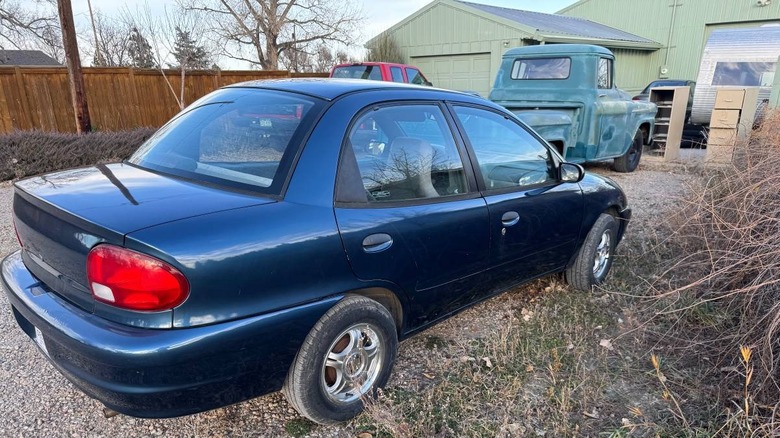
As a restored car, being sold on its merits, there's a lot to consider here. More so, I would imagine than anyone might have expected out of a little Chevy Metro from bygone days. Why would someone go to the trouble and expense of restoring such a throw-away car? Who knows? The sale seems a more reasonable scenario, as the ad indicates that health issues led to the car's storage and may now be the reason that it needs to find a new home.
The seller kindly asks shysters to peddle their scams elsewhere, advising, "Please don't bore me with some unrealistic NADA values, which probably don't even exist. or low ball or insulting offers."
Fair enough. We'll still have to gauge whether the seller's $7,995 price tag is in line with this odd duck of a restored Metro. What do you say? Does that feel fair? Or does that price make this a Metro-no ma'am?
You decide!
Nice Price or No Dice:
Fort Collins, Colorado, Craigslist, or go here if the ad disappears.
Help me out with Nice Price or No Dice. Contact me at robemslie@gmail.com and send a fixed-price tip. Remember to include your commenter handle.