

Do Golf Carts Need Wheel Alignments?
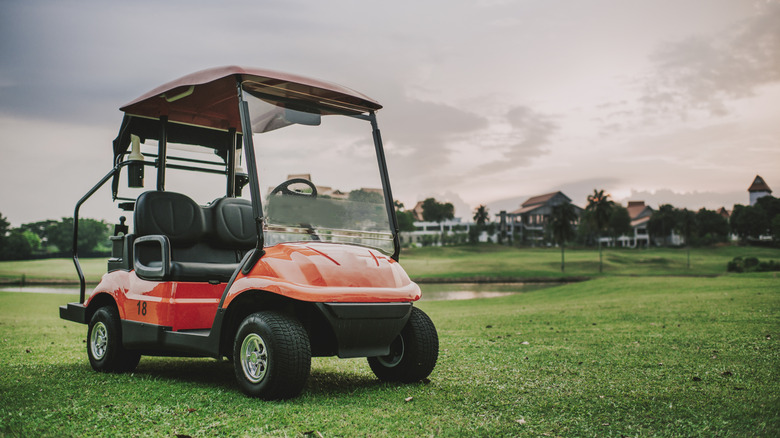
Most people treat golf carts like oversized toys, but their wheels follow the same steering and alignment rules as your daily driver. If the alignment is off, the cart won't track straight, and it can compromise your safety. You don't want a golf cart crash or a rollover, do you?
Golf cart wheel alignment refers to how the wheels sit parallel to each other and perpendicular to the ground. The two big parameters are camber, which is just the tilt of the wheels when viewed from the front, and toe, the inward or outward angle when viewed from above. It is an often underappreciated but vital golf cart maintenance procedure. Whether it's a gas or electric golf cart, don't skip out on wheel alignment. Just like cars, alignment specs depend entirely on the cart's make, model, suspension design, and whether it has aftermarket parts. A lifted and a stock golf cart will most likely have different alignment settings.
On the other hand, be aware of signs of misalignment that show up. Signs of poor wheel alignment can include uneven tire wear, drifting to one side, or a cart that runs uncomfortably and bumpy like it's in a crazy ATV off-road race. In some instances, rubbing wheels during tight turns may be also an indicator of misalignment. Also, if you installed a lift kit for some all-terrain action, it could mess up your golf cart's alignment, and you may need to check it more frequently.
DIY versus professional alignment, and smart golf cart maintenance
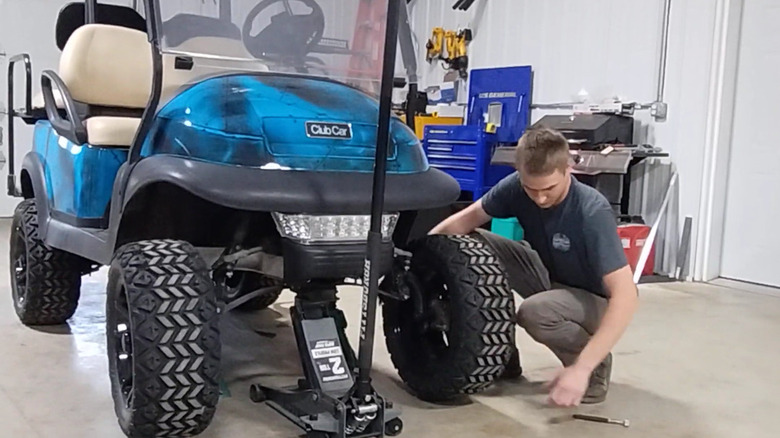
A golf cart alignment isn't that complicated. You can either go the DIY route or get professional help. Professional shops have technicians that will ensure you'll get the best golf cart care. It'll cost you around $50 to $100 for a basic golf cart wheel alignment, but it could cost more if parts need to be replaced. If you don't want to get your hands dirty and DIY isn't your thing, visiting a professional is a good move.
On the other hand, a DIY golf cart alignment is absolutely possible. After all, golf car suspension and tire systems are simpler than those on cars, but precision still matters. With a flat surface and your tools (jacks, accurate tape measures, and wrenches), you can safely do basic camber and toe adjustments. We'll discuss the process in greater detail later.
As for general cart maintenance, alignment ties into almost every other part of the system. It may matter less than it does on your daily driver, but tire pressure is still critical for making golf cart tires last longer. Maintain tire pressure between 15 and 25 psi, depending on the model. Also, rotate your golf cart wheels once in a while just like you do with your car. It's also important that you avoid driving your golf cart like you're in an F1 race. Drive it smooth and steady, and enjoy the view. Lastly, do keep it clean, and use tire protectant to avoid drying out those tires.
How to adjust camber and toe on your golf cart
First, find a flat surface to work on, and make sure the tires are evenly inflated. Start with the camber. Using a straight object against the tires, like a carpenter's square or a level, check to see if there's a gap at the top or bottom. Negative wheel camber is not necessary here — we ain't racing. If there's a gap, loosen the lower control-arm nut (the bottom Heim joint), and adjust the tire position until it's straight up and down. Tighten it up, and repeat the procedure on the other side.
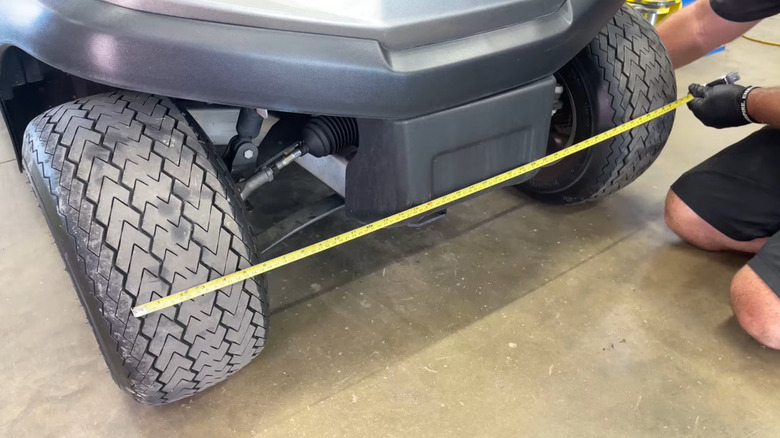
Next, we adjust the toe-in measurement. Using a marker or chalk, locate and mark the centerline on the front tread in the same spot on both front tires. Do the same on the back sides of the front tires. Now, measure the distance between the two front-side marks and the two back-side marks. The front of the tires should be about 1/8-inch closer to each other than the back of the tires. To adjust it, loose the jam nuts, and rotate the tie rods evenly on each side. Remember, golf cart tie rods are reverse-threaded on both sides. Rotate them in the intended direction by the same number of turns until the measurement is within an appropriate range.
After the adjustment, roll the cart forward a few feet to let the suspension settle, and then re-measure. It isn't glamorous work, but it can make a golf cart steer straight again.