

How Chevy's 327 Small Block Earned Its 'Mighty Mouse' Nickname

The Mighty Mouse – not to be confused with another very famous cartoon mouse with the same initials – was an animated hero created by the Terrytoons studio for 20th Century Fox in 1942. Mighty Mouse gained popularity through its numerous appearances in films and television programs in the following decades. As a pocket-sized superhero, the mouse became known for packing a powerful punch in a minuscule frame, inspiring colloquial use of his name to refer to anything that was small but mighty.
Between 1962 and 1969, Chevrolet produced a new and much-beloved iteration of its small-block — the 327-cubic-inch V8 — that was just that: small, but respectably mighty. It weighed 100 pounds less than Chevy's 348 (a big-block), but produced over 300 horsepower in some configurations. The 327 likely earned its Mighty Mouse nickname as a natural result of both the engine and the character reaching heights of cultural popularity in their respective industries for being compact but powerful. The big blocks of the era earned their "Rat Motor" nickname in a similar manner; mouse is to rat as small-block is to big-block.
The Mighty Mouse's legacy
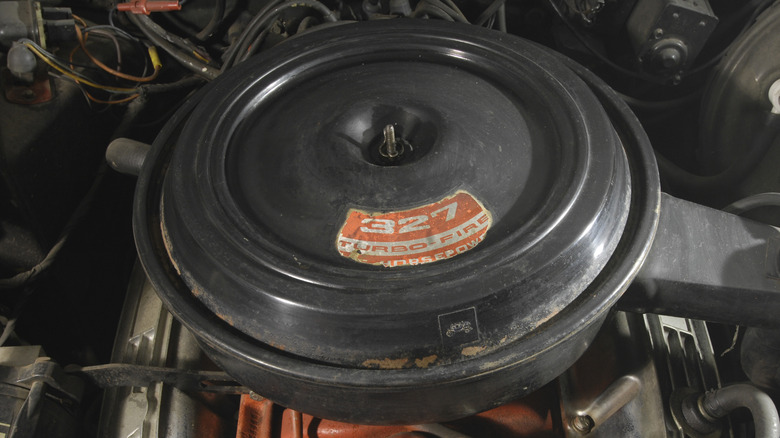
The Chevy 327 "Mighty Mouse" V8 is a small-block engine that was installed in nearly every vehicle Chevy produced during that period — everything from the Impala to the El Camino. The 327 produced respectable power (250 hp, 350 lb-ft of torque in the base models). Despite its classification as a small-block engine, it had a 3.25-inch stroke and a four-inch bore, displacing 327 cubic inches. Its cylinder size and rod-to-stroke ratio made it highly compatible with the most common carburetors and pistons of the era, and suitable for fast-revving engine builds. The stroke length was also considered near-optimal for power generation; longer than its predecessors so as to make more power, but not so long as to be inefficient.
The 327 ultimately isn't one of the most powerful small-block engines Chevrolet has ever built (variations of its successors, including the 350 and 400 engines, produced more horsepower in the same era, for example), but the 327 was beloved for its versatility and substantial horsepower potential for its size. At any rate, the 327 small-block proved that a lot of power could be generated in a modest package — just like the Mighty Mouse.