

What's The Difference Between Ford's Megazilla And Godzilla V8 Engines?
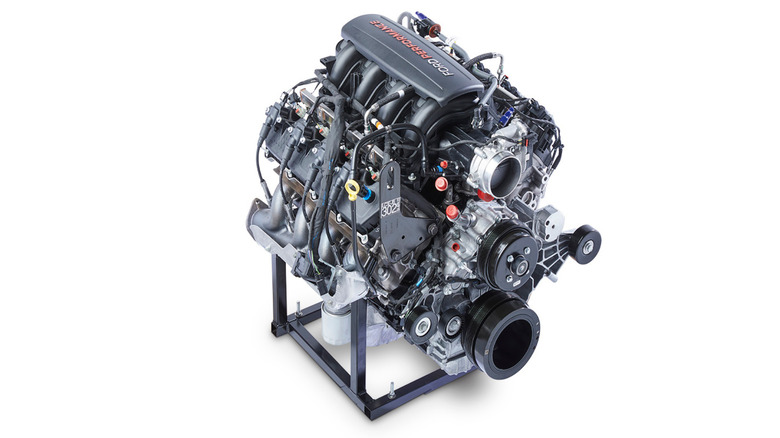
Torque, which describes twisting force, is crucial in terms of producing heavy-duty trucks capable of towing significant amounts of weight. While diesel engines like Ford's 6.7-liter Power Stroke V8 remain on top for pulling muscle with 1,200 pound-feet of torque, it may not be the best choice for everyone. Instead, some might opt for the more robust gasoline option from the automaker, the 7.3L naturally aspirated V8, nicknamed "Godzilla," which has some big differences from the Power Stroke. The Godzilla launched in 2020 and continues to provide ample performance for its type, currently offering 430 horsepower and 485 pound-feet of torque in the 2026 Super Duty.
In 2022, Ford unveiled the "Megazilla," which it would release the following year. As impressive as the Godzilla is, the Megazilla essentially dials everything up, significantly boosting output to 615 horsepower and 640 pound-feet of torque, for those who need something even more monstrous under the hood. In 2025, the racing division of the automaker announced a Megazilla 2.0 update, potentially boosting horsepower to over 1,000 with the help of a Whipple supercharger.
As big as these engines are, do you remember when Dodge and Ford offered V10-powered pickup trucks? Fortunately, while they're shy two cylinders, Ford's newer engines still manage to easily outclass those older V10s through improved technology and efficiency. But beyond a supercharger, horsepower, and torque figures, what sets Ford's largest gasoline engines apart?
The Megazilla incorporates performance parts and stronger components
While both engines share a similar foundation, Ford Performance swapped out integral parts like the connecting rods, pistons, and throttle body to push the Megazilla harder. While the Godzilla comes equipped with an I-beam connecting rod design made from powdered metal, the Megazilla opts for a robust forged H-beam configuration from Callies.
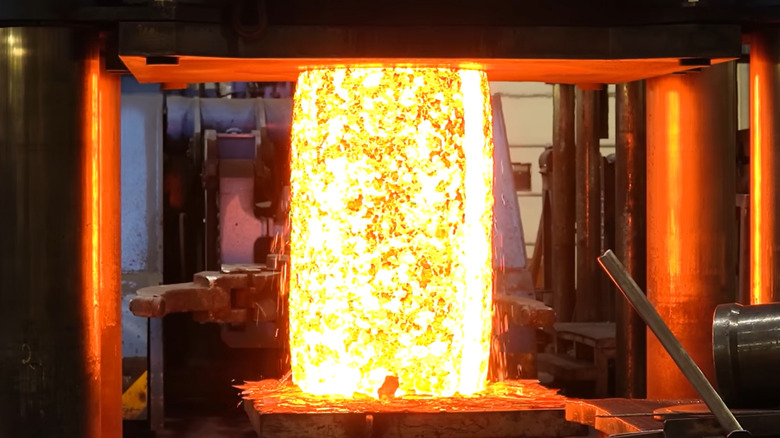
In another move to further bolster the Megazilla, engineers replaced the Godzilla's cast hypereutectic aluminum pistons with Mahle forged ones. The forging process takes an aluminum ingot (in the case of the Megazilla), and forces it into a piston shape using a combination of high thermals and compressive force. This is why some high-performance cars need forged pistons, as this process helps eliminate impurities in the structure of the metal, resulting in a part that can stand up to more punishment without failing.
Another notable upgrade for the Megazilla is the larger 92mm throttle body, which replaces the Godzilla's 80mm component. The throttle body is a part that regulates air inside the engine. So, by increasing the bore for the Megazilla, it increases airflow, improving acceleration response over the Godzilla.
Availability and legality
One of the advantages of the Godzilla engine is that it's available in Ford's Super-Duty trucks, such as the F-250 and F-350. Alternatively, you can also purchase it in crate form for just under $9,800 directly from the automaker. Conversely, no Ford trucks come from the factory with a pre-installed Megazilla engine, so it's only available aftermarket in crate form for build projects.
This souped-up monster will also cost you, though, with prices north of $25,000 – and that's not the version with the supercharger. A Whipple supercharger kit for a 7.3-liter engine is just shy of $10,000 if you want to buy the part separately. The Megazilla 2.0 isn't yet available for purchase, so it's unclear what Ford will be asking in terms of price, but it will surely be a costly investment when it goes on sale.
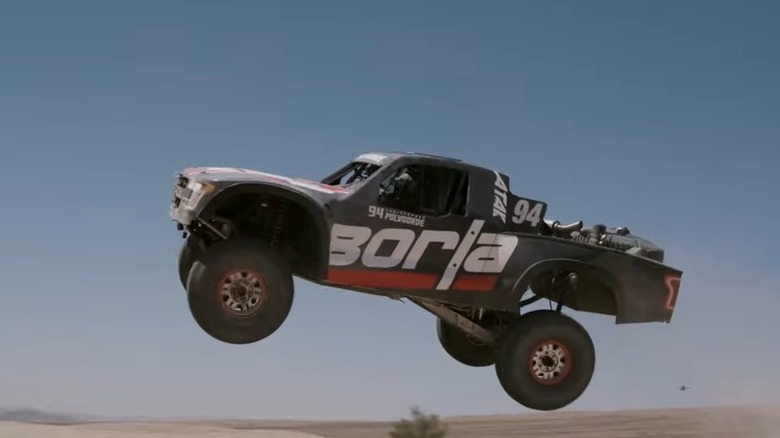
Another notable difference between the two Ford engines is that the Godzilla is street legal. The Megazilla, on the other hand, is only slated for use on the drag strip, the track, or off-road, lest you incur the potential ire of law enforcement. Emissions requirements are likely the cause, as performance was paramount, which may have led to ditching certain components and control systems regarded as unnecessary to maximum output.