

Every Production Car With A Hellcat Engine
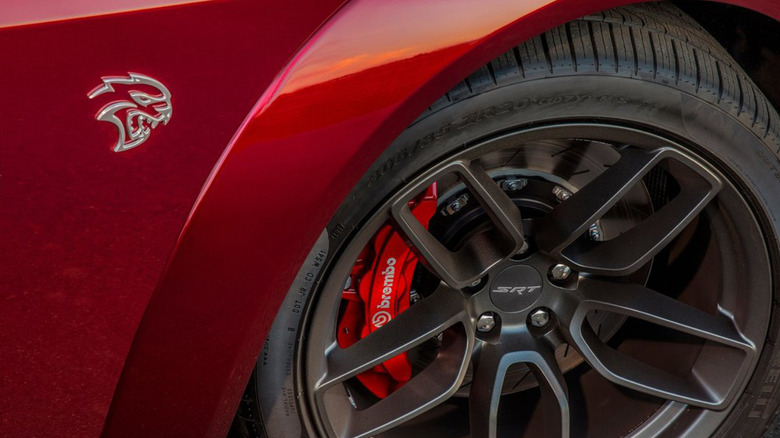
What do you do when you have a 6.2-liter, supercharged V8 at your disposal? Of course, you put it in every type of vehicle imaginable. Okay, a Chrysler vehicle never got a Hellcat engine, but the supercharged monster wasn't a good candidate for a minivan to begin with. It did, however, appear in everything from trucks and SUVs to two-door and four-door muscle cars.
And frankly? Hell yeah! Yup, it drinks fuel like a cargo ship, but it also produces gazillions of grins. Horsepower? Supercar-to-hypercar level. Rear tires: burned. Drag strips: terrorized. Oh, and the sound? A menacing harmony of classic American V8 burble and supercharger whine. The Hellcat may have lived for less than a decade, but it has left a deep mark in Mopar history. So much so that it makes us cringe to learn that the brand-new Dodge Charger Sixpack has a twin-turbo inline-6.
Sure, the Hurricane engine is fine, but the Hellcat never dealt with fine. The Hellcat was excessive from the get-go. Unnecessary, even. It stood firm in an era where automakers tried to convince us that downsizing and electrons are the only solution. Ultimately, that's what made it great, earning it legendary status among octane-blooded humans. So, let's celebrate all that by revisiting all the great cars that were lucky enough to carry a Hellcat under the hood!
Dodge Challenger SRT Demon 170 (2023)
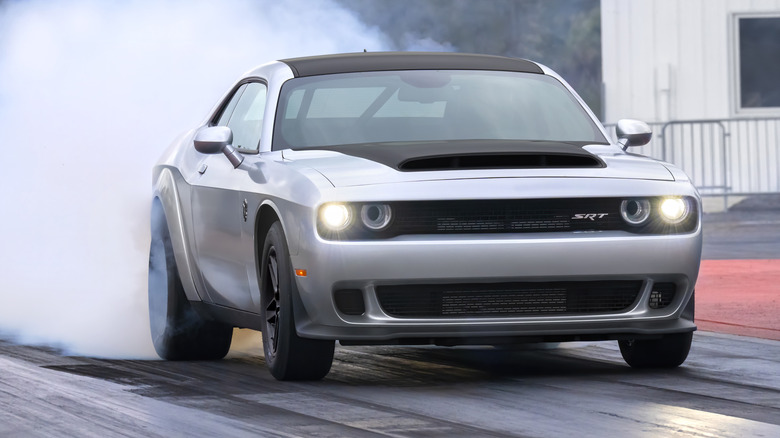
What better way to start this story than with the ultimate Hellcat car — the Dodge Challenger SRT Demon 170. Like any other Hellcat sibling, the Demon 170 has the traditional 6.2-liter V8 hiding under the hood. However, it also has a massive 3.0-liter supercharger — as big as Stellantis' Hurricane inline-6 engine — which produces 21.3 psi of boost. The result? 900 horsepower and 810 pound-feet of torque.
Savage, huh? Well, these figures only apply if you feed the engine with E10 gas. Give it E85, and the Challenger SRT Demon 170 produces 1,025 hp and 945 lb-ft of torque — enough to worry Ferrari and Lamborghini drivers. Oh, and the acceleration numbers are even more obscene. 0-60: 1.66 seconds. Quarter mile: 8.91 seconds. And yes, the Demon 170 does these with an eight-speed automatic that channels the power only through the rear wheels.
Let's get real for a second — the Demon 170 is designed specifically for the drag strip. So, it has a 53% stronger differential housing, Drag Mode adaptive-damping shocks for maximum weight transfer on the rear tires, and a staggered widebody design. Heck, the meaty rear tires are Mickey Thompson ET Street R — a barely street-legal model that was specifically designed for use on drag strips. Dodge also achieved those numbers on a prepped surface, with a skilled factory driver behind the wheel.
None of these upgrades takes away from the sheer absurdity of the Demon 170. Besides, at $100,361 (2023 model year), it was a steal. Yes, the similarly prized Model S Plaid was quicker in the real world, but an internal combustion car? No. Chance.
Dodge Challenger SRT Demon (2018)
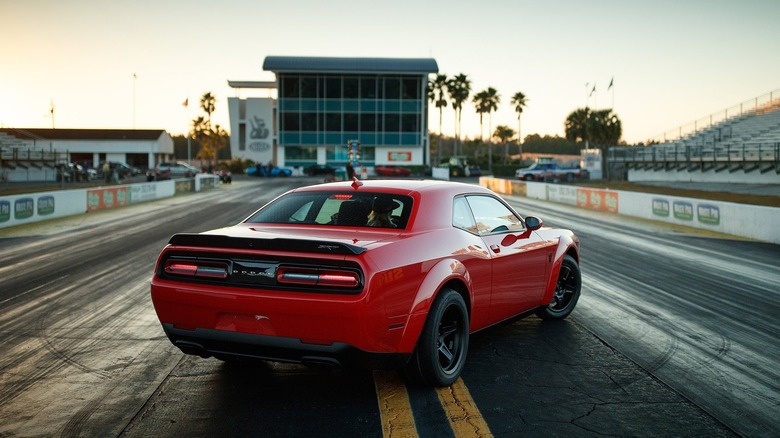
The first Hellcat-powered Demon looks normal next to the 170. 840 hp and 770 lb-ft of torque on high-octane gas. 0-60: 2.3 seconds. Quarter mile: 9.65 seconds. But back in 2017, when Dodge launched this car, it had the world's most powerful V8 engine. Heck, it was the world's first production car to do a wheelie and holds the Guinness World Record for the longest wheelie from a standing start in a production car.
The Challenger SRT Demon was a hypercar-killing weapon, too. Remember the 950-hp, $1.42 million Ferrari LaFerrari? It did the quarter mile in 9.8 seconds, same as the 903-hp, $1.15 million McLaren P1. Yeah, yeah, the Challenger SRT Demon is mostly a one-trick pony, designed specifically to tackle drag strips. But you could afford it without selling a kidney and still have a great time smoking hypercars.
Dodge's engineers made sure that happens every time. The Demon was equipped with special Nitto drag radial tires, designed for maximum grip off the line. A high-strength driveshaft, 41-spline axle shafts, and eight-ball CV joints ensure everything stays in one piece when you ask for all those 840 hp. The eight-speed manual also received a transbrake feature for quicker, 400-millisecond shifts, same as in the Demon 170.
Oh, Dodge didn't just turn up the boost to reach 840 hp. The 2.7-liter supercharger (14.5 psi) certainly played the biggest part, but the engineers redesigned 65% of the components. Demon's Hellcat received stronger crankshaft, connecting rods, and pistons. Redesigned valves had increased spring rates. Even the block was modified to increase oil capacity for better lubrication and cooling.
Dodge Challenger SRT Hellcat (2015 to 2023)
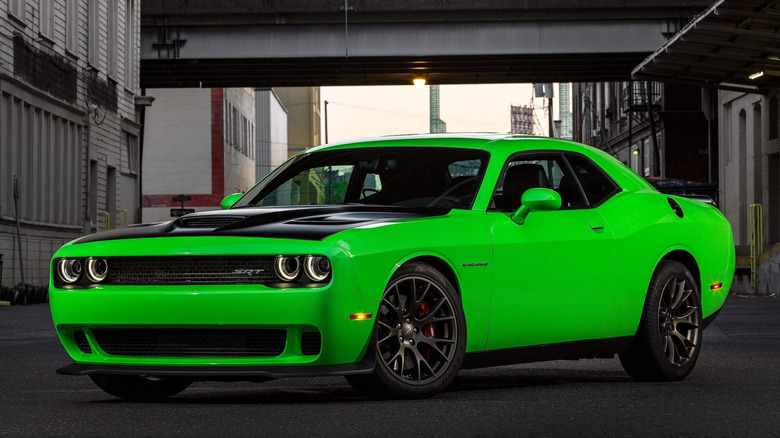
Let's spin the odometer back to 2015. The Camaro ZL1 massaged the LS crowd with a 580-hp, 6.2-liter supercharged V8. The Mustang Shelby GT500 dominated headlines with a 662-hp, 5.8-liter supercharged V8. Mopar's answer? A brand-new 6.2-liter supercharged V8 straight from hell, producing 707 hp and 650 lb-ft of torque. The Hellcat Hemi completely shifted the dynamic in the hotly contested muscle-car category, giving the Challenger a new lease on life. But it was only the beginning; Dodge upgraded the SRT Hellcat to 717 hp in 2019 and introduced even more nuclear versions down the line.
Today, we look differently at 700-ish horsepower, but a decade ago, the Dodge Challenger SRT Hellcat put the fear of God into colleague Patrick George. Sure, the damp roads played a huge role, but regardless, he was mostly driving it in the 500-hp valet mode. Not that it surprises us. Let's remind you — the SRT Hellcat is rear-wheel drive. In other words, it loves to burn those rear tires, which, in this case, weren't drag radials, but Pirelli P Zeros.
On dry, hot asphalt, with launch control engaged (eight-speed automatic), the Challenger SRT Hellcat could hit 60 in 3.5 seconds. Quarter mile: 11.2 seconds. But you don't want the automatic. The Challenger SRT Hellcat is at its best with the six-speed manual. Yes, it means even more burnt rubber, but isn't that where all the fun lies? The real kicker? Dodge asked only $59,000 for a Challenger SRT Hellcat in 2015. Anyone with a time machine — raise your hands in the comments below.
Dodge Challenger SRT Hellcat Redeye (2019 to 2023)
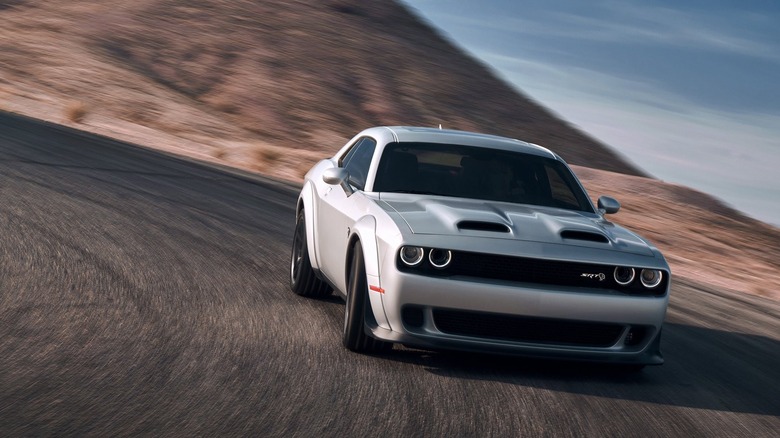
By 2019, Dodge deemed the Challenger SRT Hellcat not potent enough. There is no other explanation for the Redeye model, introduced for the 2019 model year, which now produced 797 hp and 707 lb-ft of torque. 0-60: 3.4 seconds. Quarter mile: 10.8 seconds. Top speed: 203 mph. That made it faster than a 2019 Lamborghini Huracán Evo (202 mph) and 2019 Mercedes-AMG GT R Coupe (198 mph). Mic. Dropped.
But real enthusiasts might want to pick up the mic — the Challenger SRT Hellcat Redeye was only available with the eight-speed automatic. Bummer. Hey, at least you got to look at a 220-mph red speedometer and an SRT Hellcat Redeye logo splash screen! Or you could've saved some money and chosen the regular Hellcat paired with a Tremec six-speed manual.
The Redeye is a significant upgrade over the regular model, though. It packs a larger 2.7-liter supercharger, compared to the 2.4-liter one found in the SRT Hellcat, leading to a higher 14.5-psi boost. To feed the supercharger, the Redeye is equipped with a dual-snorkel hood, driver-side Air Catcher headlamp, and an additional inlet near the wheel liner.
Redeye's rev limit was also raised from 6,200 to 6,500 rpm, and Torque Reserve was added to increase engine torque at launch. Speaking of which, Dodge offered two final drive ratios on the Challenger SRT Hellcat Redeye — 2.62:1 for more comfortable real-world driving and 3.09:1 for drag strip catapulting. Finally, to efficiently cool the increasingly more potent Hellcat engine, Dodge also equipped the Redeye with SRT Power Chiller and After-Run Chiller.
Dodge Challenger SRT Super Stock (2021 to 2023)
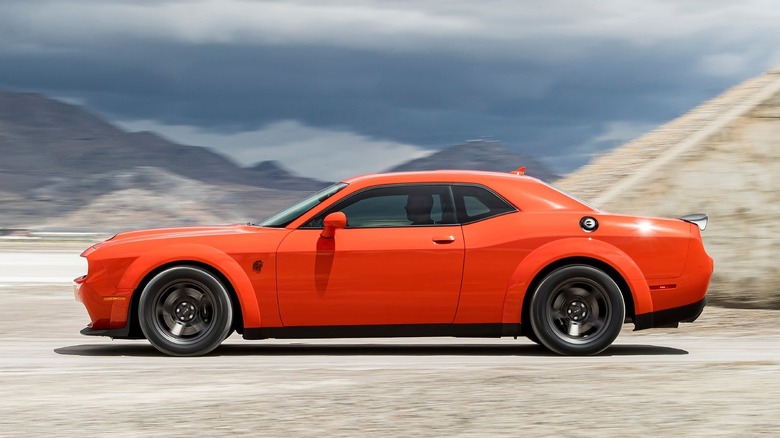
For the 2021 model year, Dodge added another nameplate to the Hellcat family — the Challenger SRT Super Stock. Built for drag strips, it succeeded the Demon but with slightly more down-to-Earth specs: 807 hp and 707 lb-ft of torque. Okay, okay, the Super Stock is still a rubber eater that makes supercars look tame by comparison. It sprints to 60 in 3.25 seconds. Quarter mile: 10.5 seconds. Top speed: 168 mph. Why? Dodge had to set a hard limit because that's how much the Nitto NT05R drag radials were rated for.
Should you care? Well, Elizabeth Blackstock says the Dodge Challenger SRT Super Stock helped her embrace the divine feminine. So, no. You'll still smile from ear to ear — by mainly driving it in a straight line. The Super Stock will turn, but it's the stoplights where it shines. Or the drag strip. On that note, the Super Stock has a Line Lock feature that engages the front brakes, letting you do a burnout to heat and clean the rear tires. To help you make a perfect launch every time, there is also Launch Control on board. Another neat feature is Launch Assist, which detects wheel hop and reduces torque momentarily to protect the driveline from damage. The standard eight-speed automatic also has an acceleration-optimized calibration.
Your eyes don't deceive you — the Super Stock is a handsome piece of kit. As standard, Dodge equipped it with the widebody trim, which has added 3.5 inches to the overall width. The result — a more menacing, purposeful look, although it's there to make room for the drag radials.
Dodge Charger SRT Hellcat (2015 to 2023)
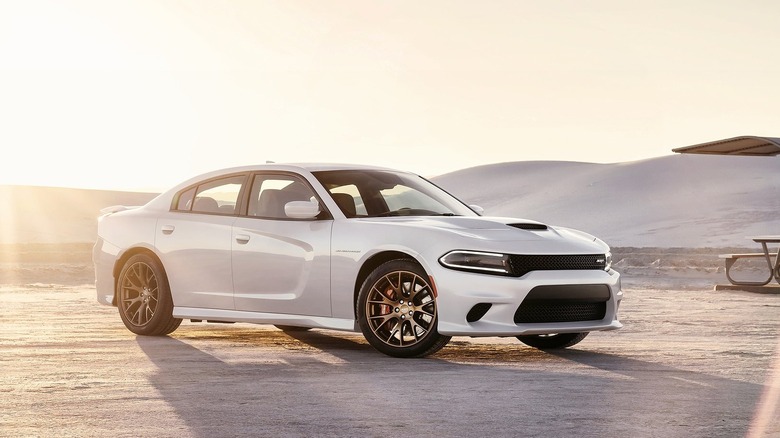
Ever since it first appeared in 2014, the Charger SRT Hellcat has been the most insane family car you can buy. Yes, it has four doors and ample space for passengers and cargo. But this thing is also certifiably unhinged, packing the same 707-hp supercharged V8 as the Challenger SRT Hellcat.
Sure, the Charger SRT Hellcat is undoubtedly a more practical take on the Hellcat fever. But nobody would've mistaken it for a rational purchase. Instead, this was a present for Mopar enthusiasts with families. Scratch that — present for automotive enthusiasts, in general. A decade ago, the Charger SRT Hellcat was the fastest and most powerful sedan on sale — worldwide. Heck, with a top speed of 204 mph, it could overrun most exotics from its time. Come on — it even covered the quarter mile in 11 seconds. 0-60: 3.7 seconds.
Apart from performance figures that still demand respect in 2025, the Charger SRT Hellcat also came with upgrades that made it easier to drive, like stiffer suspension and massive Brembo brakes. Not enough to chase a BMW M5 on a mountain pass, of course, but enough to keep it in check once the speedometer shows three-digit numbers.
Ah, yes, you'll arrive at those quickly, no question about it. But for the sake of the rear tires, you'll want a gentler approach. Yup, the Charger SRT Hellcat never came with all-wheel drive (AWD), which would've made it a better car for most people. At the same time, the eight-speed automatic was always the right choice for the Charger — a manual wouldn't have made sense here, anyway.
Dodge Charger SRT Hellcat Redeye (2019 to 2023)
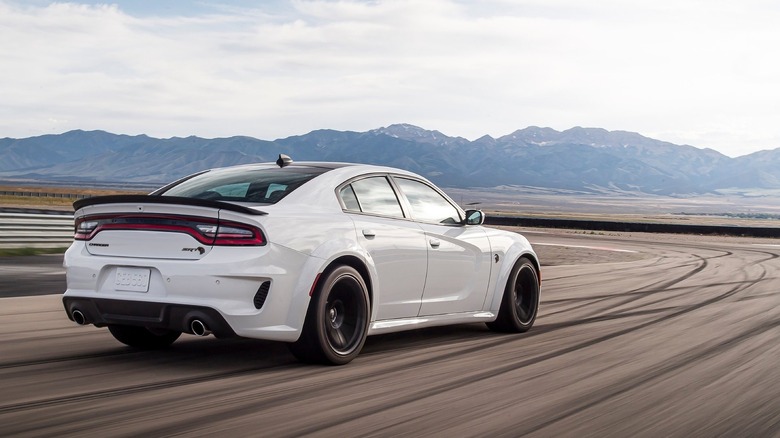
Dodge gave the Charger the Redeye treatment for the 2019 model year. You'd argue the Charger SRT Hellcat never needed this power upgrade but come on — Mopar has always been about excess. So, like in the Challenger Redeye, Dodge equipped the sedan with a 797-hp tune of the Hellcat engine, achieved using a larger supercharger, stronger connecting rods and pistons, high-speed valve train, and a new fuel injection system. A neat standard feature on the Charger SRT Hellcat Redeye is SRT Power Chiller, which lowers the intake air temperature using the air conditioner, further increasing performance.
As a result, the Redeye engine has shortened the quarter-mile time to 10.6 seconds. The more potent engine has also shaved 0.2 seconds of the 0-60 time. However, due to the standard widebody's added drag, the Charger SRT Hellcat Redeye has a lower 203-mph top speed. In fact, with the widebody trim, the regular Charger SRT Hellcat tops at 196 mph.
Crucially though, according to Dodge, the more powerful model is 1.2 seconds faster on a 2.1-mile road course, or seven car lengths. Now, that's not achievable only with an engine tune — cornering speed is usually more important. So, the Charger SRT Hellcat Redeye also received wider 305/35ZR20 tires, alongside SRT-tuned Bilstein three-mode Adaptive Damping Suspension. Oh, yes, like its two-door sibling, the sedan also has Line Lock, which engages the brakes on the front wheels to let you do burnouts and give the audience real red eyes.
Dodge Durango SRT Hellcat (2021 to Present)
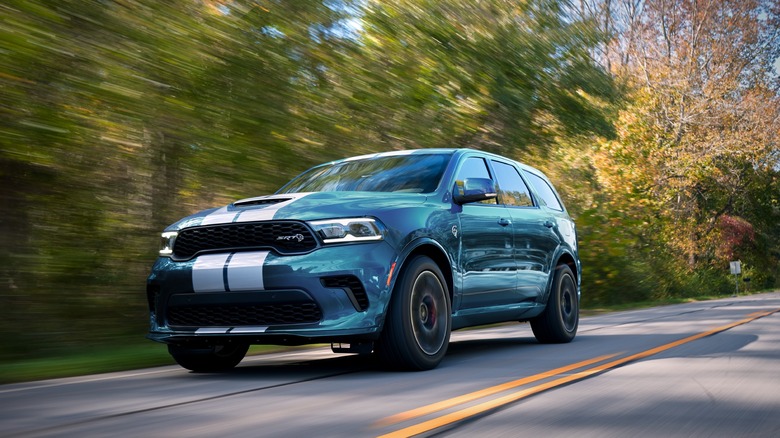
Using the Hellcat engine in a sedan was of course not enough for Dodge, so for the 2021 model year, the automaker decided to drop the engine inside the Durango SUV. Hardly surprising, this made the Durango SRT Hellcat the most powerful SUV at the time, packing 710 hp and 645 lb-ft of torque. Unlike the Charger and Challenger, the Durango was also equipped with AWD, so despite its sheer mass, it accelerated to 60 in a hardly believable 3.5 seconds. Top speed: 180 mph.
Do we need to mention you can seat up to seven people in the Durango SRT Hellcat? Yes, it's an obscene car that still has no equal in the automotive world. Seriously, you'll smoke any German three-row SUV at the traffic light like it's nothing. The Audi SQ7? That has a 4.0-liter twin-turbo V8 with 500 hp and sprints to 60 in 4 seconds. The BMW X7 M60i — 523 hp. Heck, even the Alpina-tuned XB7 produces only 630 hp.
Thank you for pointing out that the German rivals are probably better to drive in the corners, but will you really be bringing your Durango SRT Hellcat on the track? Besides, the adaptive dampers work just fine, providing a nice balance between handling and comfort. And for 2026, the Durango SRT Hellcat Jailbreak even offers premium-level customization options. You can choose a few different interior color trims with the six-seat configuration — including seat belts in contrasting colors. Those dual stripes also add boy racer vibes, right?
Jeep Grand Cherokee Trackhawk (2018 to 2021)
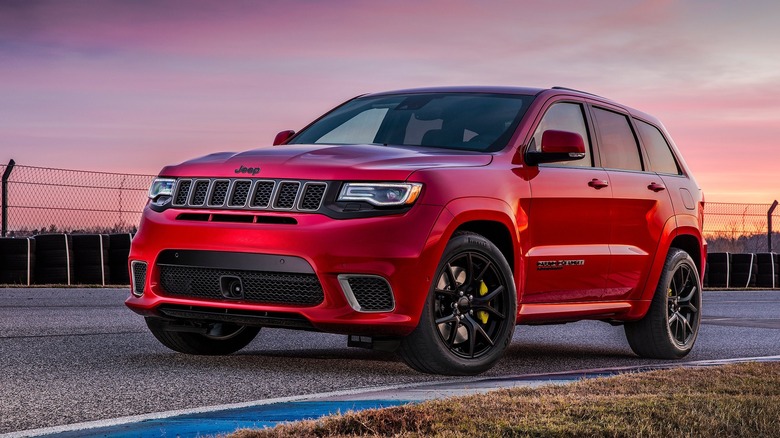
The Durango SRT Hellcat wasn't the first SUV with the 6.2-liter supercharged V8 engine. That title goes to the unhinged 2018 Jeep Grand Cherokee Trackhawk. For this model, Jeep used the 707-hp tune of the Hellcat engine, mated to an eight-speed automatic with launch control and standard AWD.
In 2018, the combo made the Grand Cherokee Trackhawk a hugely practical supercar but also the fastest SUV with an internal combustion engine on the planet. How fast? 0-60 took just 3.5 seconds. Quarter mile: 11.6 seconds. Top speed: 180 mph. But the Trackhawk wasn't only a one-trick pony; Jeep also said it could generate 0.88 g on the skid pad and stop from 60 mph in just 114 feet.
To make the Trackhawk more palatable on the street, Jeep equipped the Quadra-Trac on-demand AWD system with electronic limited-slip rear differential. Furthermore, the driver could choose from among five driving modes: Auto, Sport, Track, Snow, and Tow. The Track mode, of course, was designed to get the most out of the engine with 30/70 torque split and blazing 160-millisecond transmission shift times. Like most cars equipped with the Hellcat engine, the Trackhawk came with Bilstein adaptive dampers and larger brake rotors.
The Trackhawk was a gift from the gods, but the absence of a factory Hellcat Wrangler remains a gaping hole in our hearts. It's not a hallucination — Jeep teased us with the Hellcat-powered Trailcat concept way back in 2016. Two doors. Open top. Real off-road chops. 707 supercharged horsepower on solid axles. It's so absurd that the Wrangler 392 feels like a mere consolation price.
Ram 1500 TRX (2021 to 2024)
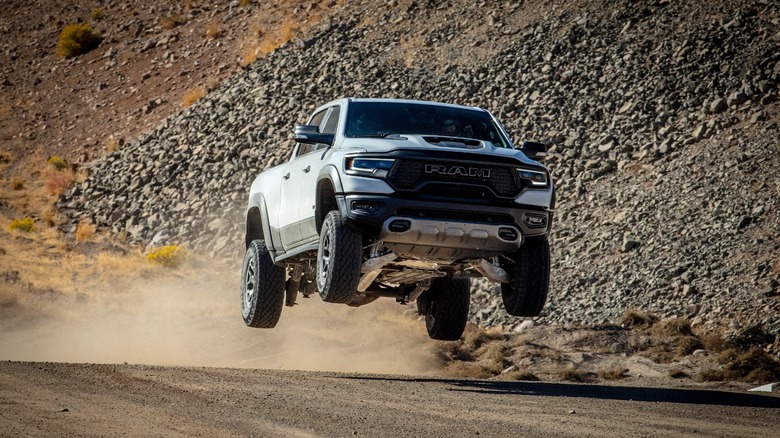
Fortunately, off-roaders got their Hellcat medicine in the Ram 1500 TRX. Yes, it's a full-size truck, but a mega fun one. And by this, we mean launching and landing a 6,443-pound vehicle on Baja-style off-road courses. Or smoking sports cars at the traffic light. With its 702-hp Hellcat engine, the Ram 1500 TRX can do any shenanigan you throw at it and bring the full-size SUV to 60 in just 4.5 seconds.
We tested the 2021 Ram 1500 TRX, and it's truly awesome off-road, shocking precisely zero people. From the reinforced frame to the Bilstein Black Hawk adaptive dampers, the 1500 TRX has everything it needs to plow through the most uneven terrains — at speed. It's also equipped with massive all-terrain tires, which provide higher off-road traction but take away from the truck's on-road dynamics. So, the top speed is limited to just 118 mph.
To make things worse, the Ram 1500 TRX is generally challenging to drive in traffic and not just because it's huge. The throttle is jumpy. The steering and brakes feel disconnected. Oh, and there is so much body roll in the corners that it beats the point of a Hellcat-powered truck in the first place.
Curiously, Ram might be working on an updated 1500 TRX for next year. It should have even more power because today the 700-hp Ford F-150 Raptor R also exists. Let's just hope that Ram solves the gremlins and turns the 1500 TRX into a real competitor.