

4 Reasons Your Car's Heater Will Only Blow Cold Air (And What To Do About It)

Having a car heater that only blows cold air isn't just uncomfortable, but it can also be dangerous. One of the unbreakable rules of winter driving is to keep your windshield clear. Even if you scrape all of the frost, snow, and ice from your windows, driving in subfreezing temperatures can quickly lead to more accumulation, especially if the heater only blows cold air.
The bad part is that we usually don't notice a non-functioning car heater until temperatures have dropped to a point that we'd rather be inside where it's supposed to be warm. The good news is that there's a possibility of restoring your car's heater to its former glory with one quick step. However, if that doesn't work, the repairs can get a little more complicated.
Let's explore some reasons why your car heater will only blow cold air. While we're at it, we'll talk about what it'll take to get the heat back on.
The coolant level may be too low
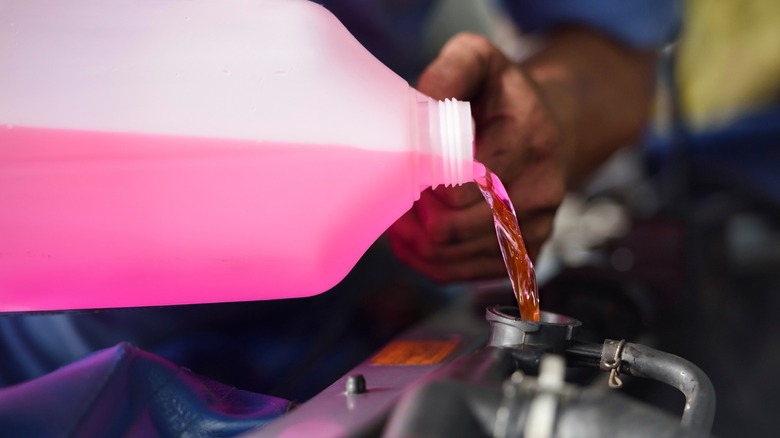
Fluid leaks are among the car maintenance items everyone should check on, but they often go unnoticed. They're especially hard to see unless you have a private parking space to call your own. In any case, it's better to check the fluids directly rather than hope to spot a leak or wait until the heater stops working.
The depleted fluid that relates to your car's heater is the engine coolant, a 50/50 mixture of water and antifreeze. The cooling system uses liquid coolant to absorb heat from the running engine. The coolant then sheds the heat when it passes through the radiator. Your vehicle has another radiator-like component called a heater core, which is also part of the cooling system and is often located underneath the dash. Your heater blows air through the heater core, causing it to absorb heat from the coolant and circulate warm air inside the car.
Since engine coolant's main job is to keep your vehicle's engine from overheating, it prioritizes that function over supplying hot coolant to the heater core. So, the first thing to check when your car's heater only blows cold air is your engine coolant level. It may be as easy as topping off the coolant reservoir with fluid that's approved for your vehicle. Just remember to follow your owner's manual's instructions when adding coolant to the system.
You could have a faulty thermostat or debris in your coolant
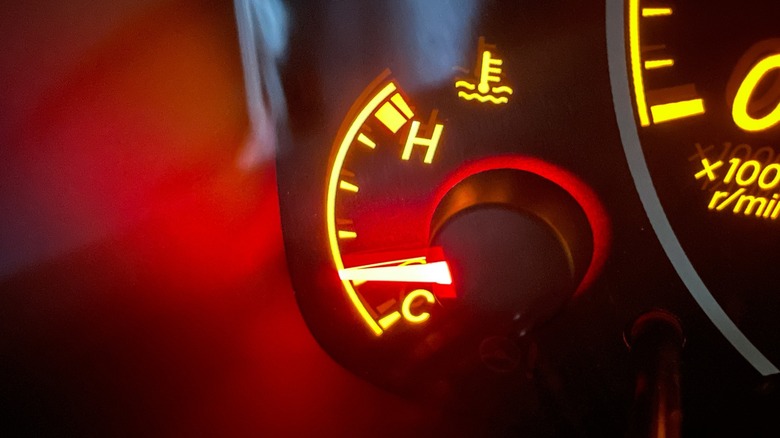
The flow of coolant inside your engine is controlled by the thermostat, which stays closed while the engine is cold and opens to allow circulation when it warms. If the thermostat sticks open, the engine coolant, and your car's temperature gauge, may never warm up in cold weather. If stuck in its closed position, the thermostat can prevent hot coolant from circulating to the heater core and, even worse, could cause the engine to overheat.
Replacing the thermostat is a relatively simple repair that requires basic mechanic tools, though it still may not be the easiest job for automotive novices. The procedure varies across vehicle makes and models, but it's not out of the realm of weekend DIY projects.
Assuming your cooling system is filled to the recommended range and your thermostat is in solid shape, another cause of a heater blowing cold could be debris or air in the system. If that's the case, flushing your radiator could solve the problem, and it's a good way to ensure the health of your car's cooling system anyway.
A clogged heater core could be the culprit
While flushing your car's engine cooling system is a good step, focusing on the heater core may be necessary. Shut off the engine when it reaches operating temperature with the heater set on full blast. Open the hood and look for a pair of rubber hoses entering the firewall, the wall between the engine bay and the passenger compartment. Those are the hoses leading to the heater core. At this point both hoses should be very warm or hot. If only one is hot, the heater core is likely plugged.
If you don't change your engine coolant as recommended, it can lead to corrosion inside your engine cooling system. As the corroded particles break free, they circulate through the system and become lodged in tight passageways, often in the heater core. If it's not too impacted, you may be able to flush the heater core by using a garden hose to push water through it in reverse. If one heater core hose was much hotter than the other with the engine running, try flushing water through the cooler of the two hoses.
If flushing the heater core doesn't work, or if it causes coolant to leak onto your floorboards, the heater core most likely needs to be replaced. This often requires the complete removal of the dash, a big job for any DIYer. Consider your mechanical skill level and determination before starting such a job. Once the dash is disassembled you'll need a wrecker to take it to a repair shop if you cannot finish the task.
Malfunctioning controls can cause the heater to blow cold

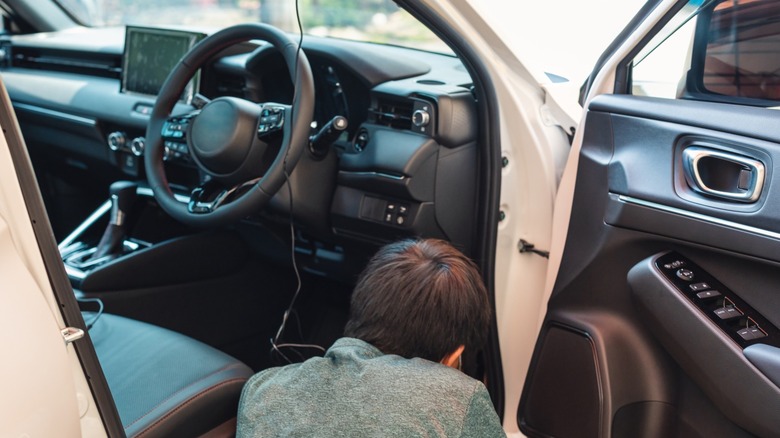
Another problem that could cause your car's heater to blow cold also lurks behind the dash. While many modern cars use electronic climate controls accessed through a touchscreen, older vehicles often employ a series of cables, vacuum lines, and actuators to regulate the temperature and direction of the climate system. In either case, these controls can fail, causing the system to pull cold outside air into the system and blow it directly into the vehicle or not blow any air at all.
When functioning properly, the system moves a series of doors to change the airflow from cool to heated air that flows to different outlets. It can come out of the windshield defrost vents, dash vents, floor vents, or nearly any combination of those. In addition, the system regulates the temperature of the air it discharges by blending heated or air conditioned air with ambient air.
If the control system in a modern car fails, scanning the car's OBD-II system may be able to reveal the cause. Older vehicles and those with more manual systems will likely require manual diagnostics, which could also involve at least partial removal of the dash.
The best approach often involves investigating the simplest solutions first. Look for leaks and repair the causes, check and fill the coolant reservoir, feel heater and coolant hoses to ensure the system is flowing properly, and address any deficiencies or take it to someone that can help.