

Why Did Cars Switch From Distributors To Coil Packs?
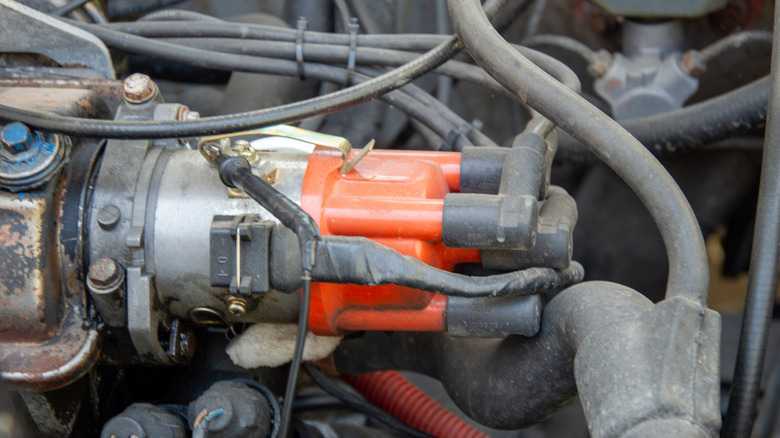
Engines need spark plugs to burn their air/fuel mixture, and the spark plugs need a jolt of electricity to do their work. Older cars with conventional distributor-based ignition systems did it by sending voltage through an ignition coil and into the spark plugs. That system includes a distributor that disperses electricity, a rotor within the distributor that spins and routes power to the correct cylinder, and spark plug wires that send high-voltage electrical power to each plug in the cylinder head.
The power generation and distribution both happen in just a few milliseconds to keep the engine running. The system needs to generate sparks more quickly as you drive faster, but distributor systems tend to be less efficient at higher engine speeds. Moreover, the distributor and rotor can prematurely wear out, requiring frequent cleaning, tune-ups, and upkeep. Despite being around since the early 1900s, the old-school breaker-point and electronic systems had to eventually give way to coil packs using distributor-less ignition.
Whereas the old way requires a single ignition coil that produces electricity for all spark plugs, coil packs — or coil-on-plug systems — give each spark plug its respective ignition coil, eliminating the need for distributors, rotors, and spark plug wires. They also gained computer systems to distribute the sparks. Those sparks are stronger and more precise as a result, leading to better combustion, improved fuel economy, and lower emissions. The need for more powerful and efficient engines through potent, reliable, and detailed spark deliveries has rendered distributor-based ignition systems obsolete.
Pros and cons of coil-on-plug ignition

Besides offering better performance, responsiveness, and efficiency, coil-on-plug ignition has more technical upsides. Since the distributor is driven by gears connected to the engine's camshaft, eliminating it means the engine has less drag. Plus, distributors are sensitive to moisture and will most likely cause starting problems when contaminated by water. Coil packs don't have this issue, providing a robust system that is more resistant to such moisture problems.
However, coil packs have downsides, too. Although these systems have fewer moving parts and require less maintenance, the sophisticated electronic parts are usually costlier to replace and more challenging to diagnose when they do face issues. Some engines have coil packs that cost $35 each, but others can have packs that cost upwards of $300 each. Coil packs are hardy and can last 100,000 miles or more, but they do eventually wear out and need replacing. In some cases, replacing the ignition coils when changing spark plugs is necessary, especially if your engine is running long-life platinum or iridium plugs that have a similar 100,000-mile lifespan.
These replacements might sound excessive, but wonky ignition coils can damage your car's engine and rack up even more expensive repair bills. For instance, a failing ignition coil can cause misfires, which could send unburnt fuel to the exhaust and clog the catalytic converter – a necessary component that costs hundreds (or thousands) of dollars to replace.