

These Are The Most Powerful Cars Oldsmobile Ever Made
There are plenty of auto brands killed by GM, but it's especially sad in Oldsmobile's case, as the brand stood as one of America's longest-serving automakers. It opened its doors way back in 1897, and while it lasted for over 100 years — until 2004 – it managed to produce some real gems. While Oldsmobile hasn't always been a brand associated with raw performance and big outputs, it stands to reason that an American automaker during the golden era of muscle car manufacturing had at least a handful of high-output heroes making their way off of the brand's production line.
Some of those models are desirable muscle car icons sitting alongside flagship Dodge, Ford, and Chevrolet offerings as some of the most collectible cars of the 1960s and '70s. Others are largely forgotten, despite deserving to be remembered. It's also worth noting that, while many cars featured here are indeed big-block brutes from the muscle car era, the most powerful Oldsmobile of them all came from an entirely different time and didn't even house a V8. You'll have to stick around until the end for that one, as the below cars are ranked from least to most powerful. For clarity, this list focuses only on cars produced by Oldsmobile, so modified models from third parties are excluded from the findings.
These classic Oldsmobiles each kick out 370 horsepower
With more than 100 years' worth of models to choose from, Oldsmobile's back-catalog is pretty extensive. Even so, narrowing down the most powerful models is pretty easy, as most hail from the 1960s and '70s. It was during this era that outputs and engine capacities soared, with pretty much every American automaker model sporting some kind of V8.
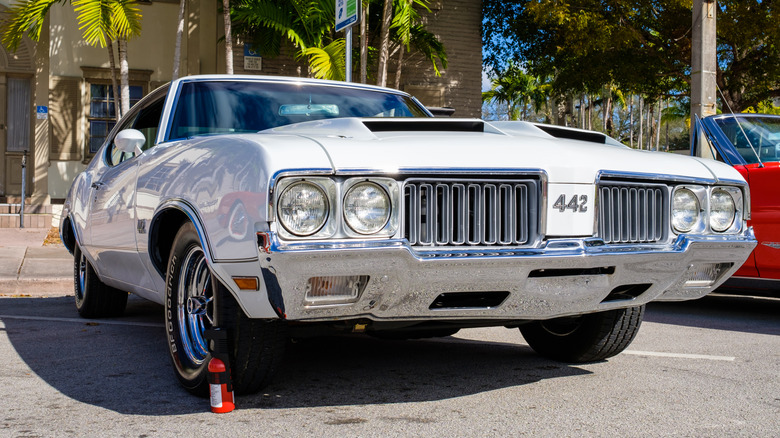
Oldsmobile was certainly not one to buck this trend, with a smattering of V8 engines available under the hood of various models. Among the line-up were the Jetstar and 4-4-2 models. In their top guises, these would both throw out 370 horsepower. In order to obtain such grunt from the Jetstar, it had to be optioned with the 425 cubic inch V8, which came standard with the Jetstar I line. That engine also came standard with all Dynamic and Delta 88 models, although output would sit at 'just' 300 horses, unless you upgraded the carburetor. Such factory upgrades would see output swell to that magical 370 figure.
For the full muscle car experience, though, it's hard to beat the 1970 4-4-2 W-30. While the regular 4-4-2 made do with 350 horses, the optional W-30 package managed to squeeze out an extra 20. This was thanks to a more aggressive camshaft profile, a redesigned aluminum intake manifold, and different cylinder heads.
Oldsmobile provided us with a Hurst-tweaked 390 hp two-door in the muscle car era
Sending 370 horses to the rear wheels certainly sounds like heaps of fun, but automakers were constantly one-upping each other in this era to stay on top, and Oldsmobile was no different. One such way to get even more horsepower was to buy a 1968 Oldsmobile Hurst/Olds; a car that came to fruition thanks to a collaboration between the two brands (Oldsmobile and Hurst, if the name wasn't obvious already).
The sleek coupe would be equipped with Oldsmobile's chunky 455ci V8. Here, though, it came furnished with modified cylinder heads, a sportier cam, a re-jetted carburetor, and a tweaked distributor, which enabled it to achieve an oh-so impressive output of 390 horsepower.
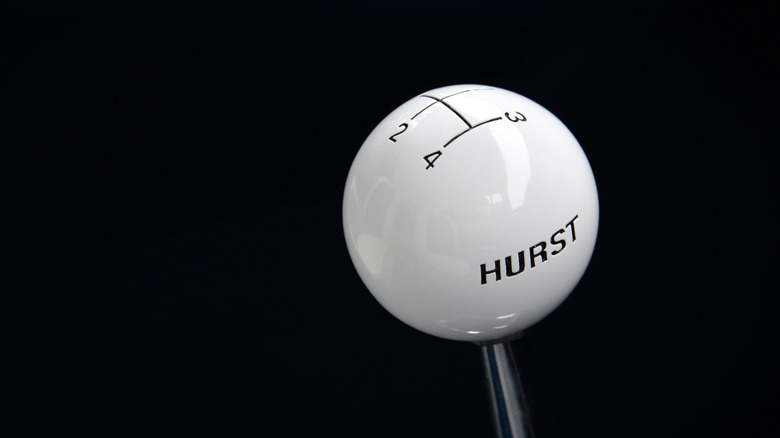
A smattering of Hurst accessories and trim pieces were affixed — including one of the firm's iconic shifters — as well as some sharp black vinyl upholstery. Initial plans were a little more flamboyant, with Hurst envisioning an adjustable rear spoiler and hideaway headlamps, but time constraints meant such tweaks were left on the drawing board. Even Hurst's iconic gold paintwork was left off by the time cars hit the showroom floor. A total of 515 models were produced, with most being two-door coupes, although 56 two-door sedans were part of the line-up.
The Oldsmobile Toronado is a high-power icon
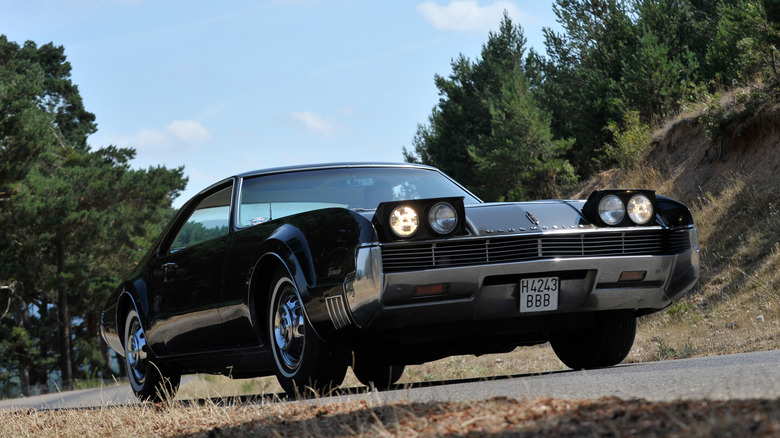
You might have clocked that American cars of this era tend to have a pretty familiar recipe. A big engine, rear-wheel drive, and two doors. It's a formula that worked for many, but for those that needed (or simply wanted) something a little different, the ever-innovative Oldsmobile cooked up the Toronado.
It still sported two doors and a great big V8 engine, but the Toronado sent its power exclusively to the front wheels. Now, there's not anything particularly special about that — Cadillac is certainly no stranger to front-wheel drive V8 models — but what makes the Toronado special is the amount of power that gets sent frontward. Cutting to the chase, this late '60s-to-'70s Olds sends a full 400 horsepower through the front wheels. For some perspective, that's nearly 100 horsepower more than the second-generation Focus RS, which was a turbocharged rally car for the road, and the last of its kind before the RS went all sensible and drove on all four wheels.
The Toronado shares the distinction of being the most powerful front-wheel drive production car ever with the equally eye-opening Cadillac Eldorado. It, too, kicked out 400 horses from a gargantuan 500ci V8 while the Olds made do with a measly 455ci motor. Even though both the Caddy and Toronado sported dimensions and mass similar to a small continent, they were fairly swift, all things considered. Oldsmobile's Toronado also takes the title of the most powerful production car from the brand to ever be produced, but that doesn't mean our list is quite done with yet.
This race-bred Oldsmobile is a fire-breathing monster
Think back to the days of the Oldsmobile Aurora, if you remember it, that is. It was a fairly understated sedan, equipped with a pleasant interior and a pretty terrible exterior, if we're honest. Under the hood sat the infamous Northstar V8, developing a perfectly adequate 250 horsepower — just enough for a comfortable, simple commute.
Now, gut the interior, furnish the exterior with a slew of aerodynamic packages, and slam a 650 horsepower 360ci V8 under the hood. That gets you the Oldsmobile Aurora GTS-1; a purpose-built race car developed for the International Motor Sports Association, with endurance experience and multiple race wins under its belt. Perhaps most notably, one such Aurora GTS-1 won at Daytona's 24-hour endurance race in 1996, which stands as a testament to both the performance and durability of these striking racers. This is no longer your grandpa's sedan. It's a purpose-built machine which will spit flames and spin tires all day long, and yet it's still shy of being the most potent Oldsmobile to ever hit the road.
Oldsmobile's Aerotech was the Veyron before the Veyron
As the above entries will prove, many of the most powerful Oldsmobiles featured big and brutish V8s. However, such engines fell out of favor after the American muscle era peaked due to rising costs and ever-stricter emissions regulations. Automakers had to turn to other solutions for power and performance. During this time, Oldsmobile began experimenting with smaller engines — in this instance, the all-important Quad 4 engine. To showcase its performance, a series of special supercar-like Aerotech builds were produced during the '80s. In the lineup's first single-turbo guise, output peaked around the 900-horse figure, and upon testing, it managed to crack 218 mph.
The engineers at the time figured that results were still being left on the table, and so they set about making improvements. Long-tail bodywork was added to aid high-speed runs, and an extra turbocharger was provided courtesy of Fueling Engineering. The result was around 1,000 horsepower and a top speed of 275 mph — and 250 mph with the short-tail body — achieving Veyron-like results two decades before the Veyron even existed. Oh, and this was with half the turbo power and just a quarter of the cylinders.
A total of 47 speed records would be set by the Aerotech car in late 1992, cementing it as one of the most important Oldsmobile cars of all time, in addition to being the most powerful. Oldsmobile might be extinct now, but cars like these remind us why so many still love the brand, even decades after it disappeared from showroom floors.