

Jeep's AMC History: Every Model Made Before Chrysler Took Over
Jeep's origins famously date to the Second World War. In July 1941, just five months before the attack on Pearl Harbor, the Willys-Overland Motor Company won a contract to build the Willys MB for the U.S. military. Ironically, for such a famously tough series of vehicles, the history of Jeep's corporate owners since has been a litany of weak companies bought out by other corporations.
Willys-Overland, which trademarked the name "Jeep" in 1950, struggled in its limited niche. The Kaiser-Frazer company bought Willys-Overland in 1953, renaming it Kaiser Jeep a decade later. Kaiser Jeep, in turn, was sold to American Motors Corporation (AMC) in 1970. AMC owned Jeep until 1987, when Chrysler acquired the struggling AMC company. Despite AMC's financial woes, its tenure as Jeep's owner saw Jeep become a mainstream manufacturer.
AMC inherited several utility and pickup truck models from Kaiser Jeep. Even though AMC was one of America's also-ran carmakers, it had the resources to supply V8 engines, new models, and the Quadra-Trac 4x4 system, introduced in 1972, just in time for the surge in popularity of 4x4 vehicles. AMC's ownership may have saved one of the industry's iconic brands.
DJ-5 Dispatcher Jeep

Strictly speaking, under AMC's ownership, the DJ-5 Dispatcher Jeep was actually built by AMC's AM General subsidiary starting in 1970. However, "Jeep" is still in its name, and it was one of the models AMC inherited from Kaiser Jeep, so it very much belongs on this list. Plus, it's one of the most recognizable Jeep-based models, thanks to the U.S. Postal Service driving vast numbers of them from 1968 until well into the 1980s. The little trucklet became a key phase in the evolution of the U.S. mail truck.
The DJ-5 rode on a stripped-down version of the Jeep CJ chassis. A luxury vehicle this was not, with a bone-rattling ride and, in USPS versions, the driver's controls were on the right-hand side to allow postal workers to reach mailboxes. The "passenger" side featured a sorting box. The side doors were sliders. Kaiser put a variety of engines in them, including a Chevy four and a Buick V6. AMC used straight-sixes from 1970 through 1978, then Audi engines for a few years — probably the closest this rough little utility ever came to offering luxury.
Jeepster Commando

AMC also inherited the offbeat Jeepster Commando, which you may not know existed. This oddly stretched-out, long-wheelbase utility vehicle borrowed part of its name from the Willys Jeepster, which was Willys-Overland's unsuccessful attempt to enter the passenger car market in 1948. Perhaps Kaiser Jeep intended the Jeepster Commando, introduced in 1966, to be a callback to that earlier Jeepster, since it pitched the Jeepster Commando as a 4x4 with passenger-car comfort. It offered multiple body styles and competed with utes like the Ford Bronco.
AMC continued the model with few changes until 1972, except for adding an available Hurst Jeepster in 1971. For '72, it refreshed the model with a longer wheelbase (104 inches instead of 101) and more powerful inline-six and V8 engines. It also gave it a more conventional front end instead of the original model's CJ-like grille and round headlights. Plus, it dropped the "Jeepster" part of the name, now calling it just the Jeep Commando. It sold only 20,000 Jeep Commandos in 1972 and 1973 before discontinuing it.
CJ-5
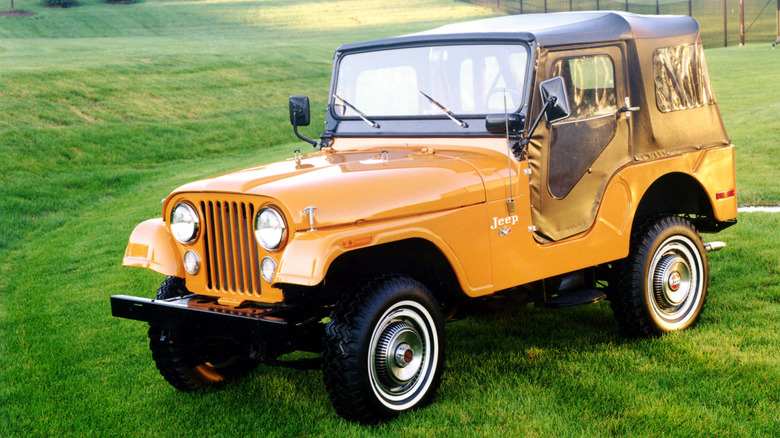
Perhaps the best-known model AMC inherited from Kaiser Jeep was the CJ-5, the "Civilian Jeep." Produced from 1955 until 1983, it was based on the military-grade M38A1 that served in the Korean War. Willys adapted it for civilian use with a rear seat and road-standard lighting, although it didn't reach production until Kaiser bought Willys. Kaiser offered special option packages to broaden the rugged 4x4's appeal, including the 1970 Renegade I, which featured an enclosed rear body, a limited-slip rear differential, and an upgraded interior.
Upon buying Kaiser Jeep, AMC enhanced the Renegade package in 1971 with alloy wheels, upgraded tires, and wild colors like Mint Green, renaming it the Renegade II. Next up, in 1972, was an engine upgrade, with AMC's 304-cubic-inch V8 topping the range. The wheelbase and nose were lengthened to accommodate the larger engines. The CJ-5 was one of only two small SUVs to offer a V8. 1976 saw the introduction of the Quadra-Trac 4x4 system. By 1983, production wound down amid controversy over the ute's alleged tendency to roll over. Still, more than 600,000 were built in almost three decades.
CJ-6
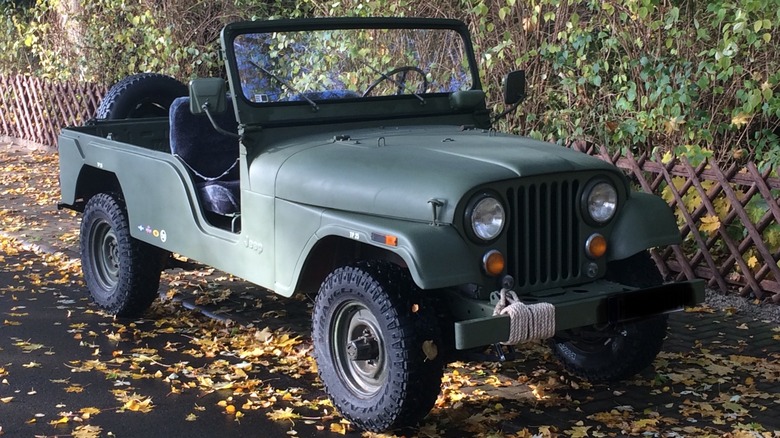
Basically a stretched CJ-5, the Jeep CJ-6 answered the call for more passenger and cargo room. AMC inherited this model, too, and upgraded it along with the CJ-5. The CJ-6 added 20 inches to the CJ-5's wheelbase, for a total of 101 inches, giving it a noticeably longer appearance. AMC widened its track and beefed up the axles and brakes. Starting in 1973, AMC offered its 304-cubic-inch V8 as an option, delivering 150 horsepower and a fairly hefty 245 pound-feet of torque — not bad for such a lightweight vehicle.
Collectors seek out good examples of the CJ-6 today. This may be partly due to rarity, since the CJ-6 was something of an afterthought compared to its CJ-5 sibling. After 1976, Jeep played down the CJ-6 in the U.S. market, although it remained an export model. After 1979, the CJ-6 was dropped from Jeep's U.S. lineup altogether. Production ceased completely in 1981, two years ahead of its CJ-5 sibling. The CJ-8 Scrambler would take the CJ-6's place in Jeep's showrooms starting in 1981.
CJ-7
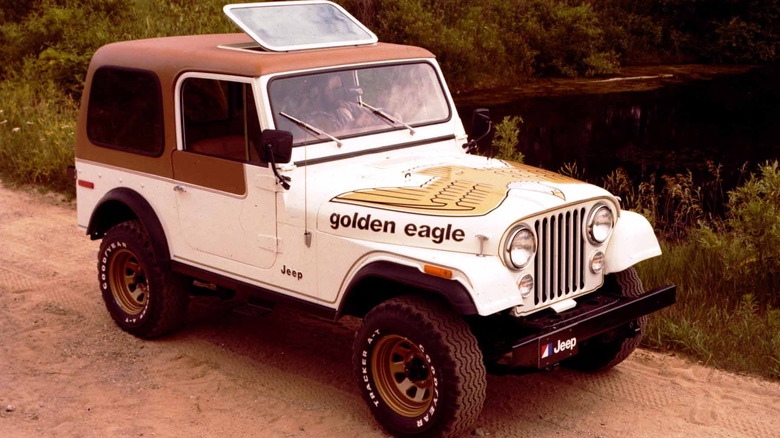
The CJ-7 was a huge step forward in the CJ lineup's transformation from a rough-and-tumble military-style vehicle into the kind of SUV that we're familiar with today. Originally code-named the CJ-5.5, the CJ-7 debuted in 1976 and would be produced for a full decade after that, through the 1986 model year. 380,000 were built, making them one of the most popular jeeps of the era and an archetypal beach vehicle. The CJ-7 and its CJ-8 variant were the last Jeep models that traced their ancestry directly to the stalwart World War II design.
The CJ-7's wheelbase stretched 10 inches longer than that of the CJ-5, giving the CJ-7 better handling and stability at higher speeds. It also featured built-in, removable doors along with the removable roof. AMC provided a range of engines from four-bangers to V8s. Quadra-Trac four-wheel drive preserved its go-anywhere Jeep ethos, while power steering and power brakes, along with its improved ride and handling, made it an accessible everyday driver for a much broader slice of the motoring public. Jeep offered several trim packages, including the Renegade and the upscale Laredo, which sported a chrome grille and trim.
CJ-8 Scrambler
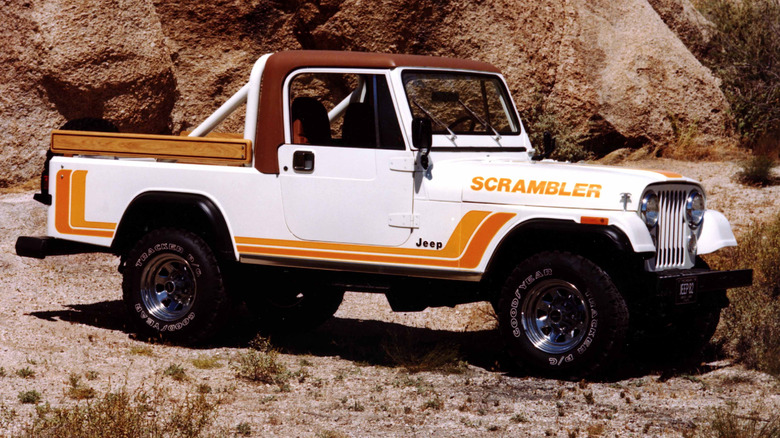
The CJ-8 Scrambler was Jeep's bare-bones, go-anywhere pickup truck. Just as the CJ-6 rode a stretched version of the CJ-5 platform, the Scrambler was a longer version of the CJ-7, although in a pickup truck form. Its wheelbase measured 103 inches, and its long rear overhang gave it decent cargo room for a small pickup. Its total length of 177.3 inches exceeded the CJ-7 by nearly 2 feet. The Scrambler joined the Jeep lineup in 1981 and would be produced alongside the CJ-7 until 1986.
The Scrambler offered an 82-hp four-cylinder and a 115-hp six-cylinder. It provided a V8 option in only one year, 1981, when it could be equipped with AMC's 304 V8, rated at 150 hp. The Scrambler was available with soft tops and hard tops, and there was even an Australia-only, 8-passenger hardtop wagon with longitudinally mounted rear benches for extra passenger room. Sadly, the Scrambler never sold in nearly the numbers that the CJ-7 did, although it had one very notable fan: Ronald Reagan bought one for his ranch.
Despite modest sales, it has become a highly sought-after collector's item in recent years. This led Jeep to release a Jeep Scrambler JT concept in 2019, but to date, there is no hint of it entering production.
Wrangler (YJ)
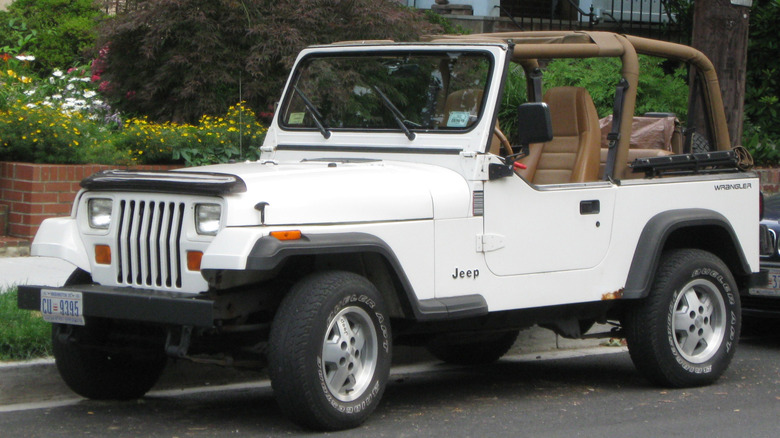
The Wrangler YJ line replaced the venerable CJ model family in 1987, making it one of the last Jeeps designed during the AMC era before Chrysler purchased AMC later that year. The YJ model was the first in a long series of Wranglers that continues to this day. To mark the break with its CJ predecessors, the Wrangler YJ sported square headlights instead of Jeep's traditional round ones. Some Jeep partisans were not amused by the change, but the new model offered numerous improvements to the frame, suspension, transfer case, and soft top.
The Wrangler debuted with a choice of a 2.5-liter inline four or a 4.2-liter inline six, the latter of which would be upgraded to a 4.0-liter fuel-injected engine in 1991. It featured a wider track for better stability, and exterior design cues included a grille that angled slightly backward about halfway up. Other than these modest differences (and the square headlights), the Wrangler still looked recognizably similar to the CJ models. However, it shared more parts with the Cherokee introduced in 1984 than the CJ. Its interior was modernized, as well. Production of the YJ continued through 1996.
Wagoneer and Grand Wagoneer (SJ)

The Wagoneer (SJ) also came along with AMC's purchase of Jeep, having been in production since 1963; it would remain in production into the Chrysler years in 1991. Despite a prototypical SUV aesthetic, Jeep branded the Wagoneer as a station wagon, although it was also available as a panel van. Jeep intended the station wagon variant to be a luxurious vehicle, and to that end, it featured several firsts for a 4x4. These included an independent front suspension and an automatic transmission.
The AMC years would see an upgrade to AMC V8 engines, including 360-cubic-inch and 401-cubic-inch models. AMC also added its Quadra-Trac full-time 4x4 system. In 1978, Jeep introduced the Wagoneer Limited model, arguably the most luxurious 4x4 in the world at the time, and the predecessor to the Grand Wagoneer. By the mid-1980s, tastes were shifting toward more fuel-efficient SUVs, so the Wagoneer name was shifted to an upscale version of the then-new Cherokee in 1984. The original Wagoneer would continue as the Grand Wagoneer until 1991, and has since become a collector's item, fetching prices as high as $40,000.
Cherokee (SJ) and Cherokee Chief (SJ)
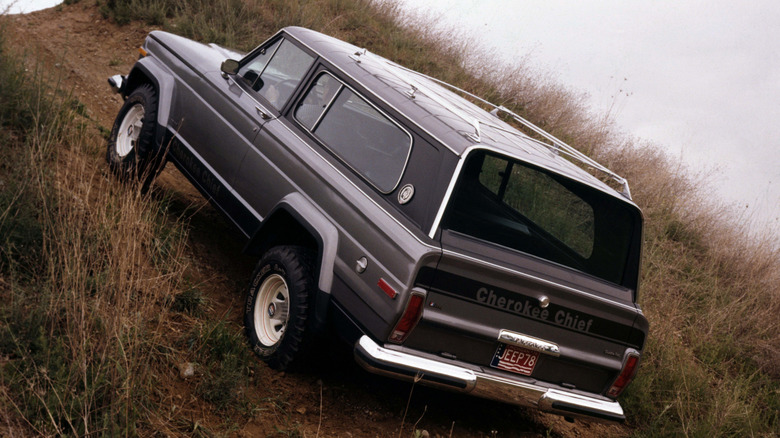
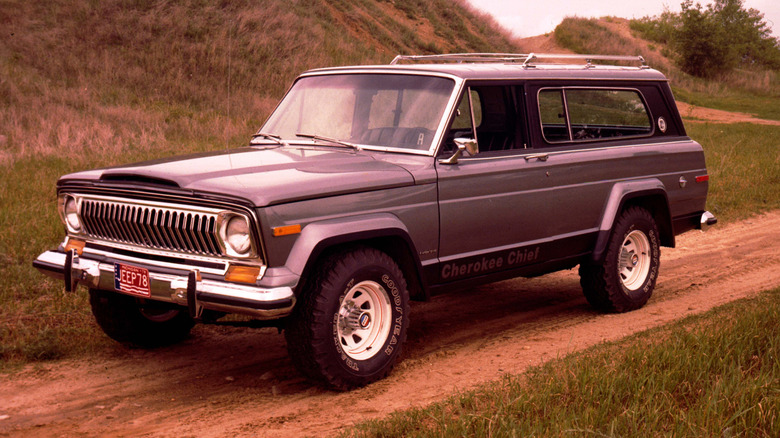
From 1974 to 1983, Jeep built a two-door SUV on the Wagoneer's SJ platform, which it dubbed the Cherokee. The goal was to create a sportier, youth-oriented variant of the SJ platform, and we all know that two doors are sportier than four, right? But the sporting details went beyond the door count: the Cherokee also offered bucket seats and a sporty steering wheel, among other premium touches. The model was impressive enough to win Four Wheeler's Achievement Award for 1974. The styling by Brooks Stevens (who also designed the Oscar Mayer Wienermobile in 1958) was another high point.
The Cherokee came in regular and wide-track models, and in 1977, it offered a four-door model, blurring the lines between it and the Wagoneer to at least some extent. Trim packages included the Cherokee S, Laredo, and Golden Eagle models. There was also a Cherokee Chief package, a model that was different enough for Jeep's website to feature its own listing separate from the regular Cherokee. This wide-track model came with larger wheels, beefier axles, interior upgrades, and other distinctive features.
Jeep Gladiator/J-Series Pickup

Jeep's J-line of pickups, originally known as the Gladiator, debuted for the 1963 model year. The lineup included the J-200 and J-300, which later became known as the J-2000 and J-3000, later to be joined in 1969 by the J-4000. It stood out from the truck competition as the only pickup with standard 4x4. This was the full-size pickup truck family that AMC inherited when it bought Jeep. By 1971, the Gladiator name was dropped, and Jeep referred to it as the J-Series. The J-Series could also be ordered as snowplows, dump trucks, and tow trucks. There was even a J4800 Camper Special.
AMC gifted the Gladiator with its 360-cubic-inch V8 and its 401-cubic-inch V8. A pair of inline-sixes and a Buick V8 were also available. Buyers could choose from numerous transmissions over the years, with a couple of the most reliable being the GM TH400 and the Chrysler TorqueFlite 727. The T-19 four-speed manual also worked great with the truck's powerful V8s. Sadly, AMC's also-ran status among American carmakers meant it didn't have the resources to properly update the Gladiator, so by 1987 it was positively archaic by comparison to offerings from Ford, Chevy, and Dodge. Chrysler pulled the plug on the truck after buying AMC in that same year.
Jeep Cherokee XJ and Wagoneer XJ

The XJ version of the Jeep Cherokee, introduced in 1984, would prove to be one of the most critical models in Jeep's history, with Jeep selling almost three million units by the time it ended production in 2001. It's hard to overstate how big a quantum leap the Jeep Cherokee was over the SJ-series Cherokee and Wagoneer. The XJ Cherokee was the first fruit of a partnership between AMC and the French automaker Renault, which gave AMC access to Renault's engineering resources. It also meant the new Cherokee was designed for international success as well as domestic sales glory.
The Cherokee was smaller than its predecessor, in line with the public's increasing taste for more fuel-efficient SUVs. Plus, it now featured a unibody platform and could be ordered in both two-door and four-door configurations, both of which rode on the same wheelbase. All of these features gave it a leg-up on its two-door, pickup-based compact competitors from General Motors and Ford. It drove and rode more like a car, and had useful rear doors for families. Initial engines included a 2.5-liter inline-four and a 2.8-liter V6, though the latter was replaced with a 4.0-liter inline-six in 1987.
The XJ platform also spawned the Wagoneer, which should not be confused with the SJ-series Wagoneer, which, as we noted earlier, continued until 1991 as the Grand Wagoneer. The XJ version was essentially an upscale XJ Cherokee. The biggest exterior differences were quad headlights and fake wood side trim on the Wagoneer Limited. Plus, even base-model Wagoneers were also more fully loaded than the Cherokee.
Comanche (MJ)

While the Cherokee's SUV competitors were built on pickup-truck platforms, the Jeep Comanche evolved in the opposite direction: it was based on the XJ Cherokee's carlike unibody platform. It hit showrooms in 1986, offering the only unibody pickup on the market at the time. It was larger than its compact competitors and came with either a 6 or 7-foot bed, making it genuinely useful. With Selec-Trac or Command-Trac 4x4 systems available, the Comanche could handle trails pretty well despite its unibody construction.
An AMC-built, 117-hp, 2.5-liter four-cylinder powered the 1986 Comanche. Most buyers opted for four-wheel drive and automatic transmissions. The following year, Jeep introduced a more powerful four-cylinder base engine and made a 4.0-liter six-cylinder engine optional. A Jeep print ad from this time period stated that the inline-six generated 173 hp and 220 lb-ft of torque, and boasted that both the inline-four and the inline-six produced more power than the engines offered in small pickups from Chevy, Ford, Nissan, and Toyota. The Comanche remained in production under Chrysler's ownership of Jeep until 1992, but it never sold nearly as well as its XJ cousins.