

Ford Bronco Vs. Jeep Wrangler: How The Off-Road Specs Compare
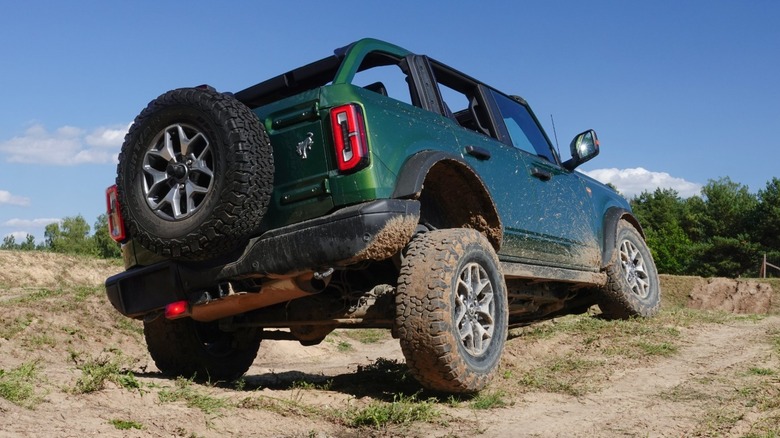
The Jeep Wrangler's reputation precedes it as a vehicle that can handle itself off the beaten path. It's made for open terrain and is among the best off-roaders of all time. But the 2025 Ford Bronco isn't too shabby either when it comes to off-roading. In fact, it has a few tricks up its sleeve in that area, with the Sasquatch package that includes several nice features.
We compared these two vehicles, looking at ground clearance, approach and departure angles, breakover angle, water fording rating, horsepower, torque, tires, towing capacities, and the availability of locking differentials. Going by the numbers, it is certainly a contest. The Wrangler beats the Bronco when it comes to approach, departure, and breakover angles, and is close to the Bronco on ground clearance.
The Bronco, on the other hand, has a few inches on the Wrangler when it comes to water fording. But it's not so cut-and-dried in the other categories. The Wrangler edges the Bronco out on available horsepower, but falls short when comparing torque and locking differential availability. Tires on both vehicles are pretty comparable, as is payload capacity. Towing capacity is a bit of a toss-up, as the highest capacity comes from a very specific configuration of the Wrangler, while the Bronco's higher capacities are available "off-the-shelf," so to speak.
Determining which vehicle is better for off-roading really comes down to your needs and where you plan to go off-road. If you're crossing a lot of streams and flooded areas, we'd say go with the Bronco. If you encounter a lot of steep inclines, you're probably better off with the Wrangler because of its higher approach and departure angles. But make sure you get the right options, regardless of which vehicle you buy.
Ground clearance, approach, and other important angles
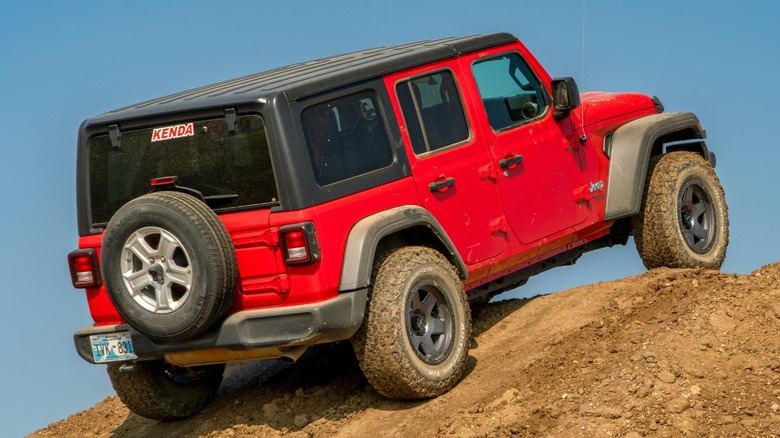
Off-road trails provide plenty of obstacles, like logs, rocks, roots, and raised ground that would love to tear a hole in your gas tank or some other part of your undercarriage. That's why you need a vehicle with high ground clearance. Approach angle is also important. The greater the approach angle, the steeper the incline your vehicle can take without scraping the front bumper. And then there's the departure angle, which determines how steep of an incline your vehicle can leave without scraping the rear bumper. Finally, there's the breakover angle, or the maximum angle between the tires and the undercarriage. A high breakover angle can keep you from getting stuck on a ridge.
The Wrangler Sport, the base trim of the Wrangler, edges out the Bronco Base in ground clearance. The Bronco Base comes standard with about 8.3 to 8.4 inches of ground clearance, compared to 9.7 inches on the Wrangler Sport. Adding the Sasquatch Package to the Bronco Base will give you 11.6 inches, whereas you'll have to upgrade to a different trim on the Wrangler entirely, the Rubicon, to get comparable ground clearance, at 12.9 inches. But the Bronco Raptor barely takes the cake at 13.1 inches.
Looking at the other angles, the Bronco Base's approach angle of 35.5 degrees falls short of the Wrangler Sport's 41.4 degrees. The two-door Wrangler has a higher departure angle, too, at 35.9 degrees compared to the Bronco Base's 29.7 degrees. The breakover angle advantage goes to the Jeep Wrangler, as well. The Wrangler Sport's breakover angle is about 25 degrees compared to the Bronco Base's 21.1 degrees. We'd say the numbers are clearly in the Wrangler's favor when it comes to angles, while ground clearance is a bit of a toss-up.
Water fording
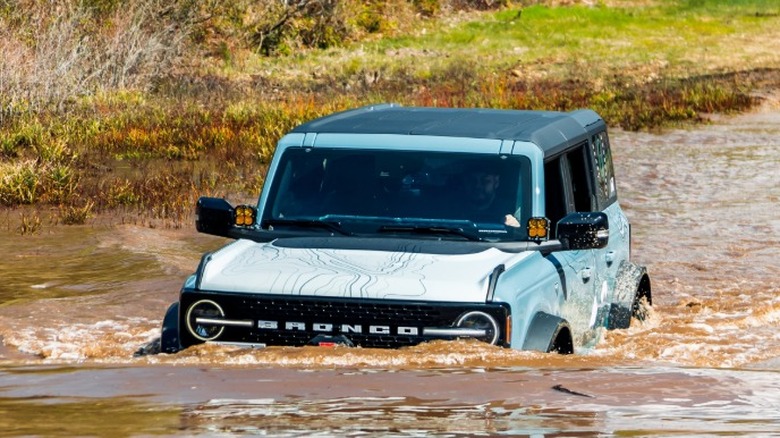
Are your off-roading plans so ambitious that you plan on laughing at streams and small creeks as they cross your path? Or, more seriously, do you foresee the need to drive into flooded areas in emergency situations? Then you need to think about your vehicle's water fording capabilities. Both the Bronco and the Wrangler offer impressive performance in this regard when you opt for some upgrades and make sure that your vehicle is properly fitted out.
The Bronco outmatches the Wrangler a little when it comes to venturing into deep waters. The Bronco Base has a standard water fording rating of 31.5 inches, or 33.5 inches if you opt for the Sasquatch Package on any model. The Wrangler water fording rating starts at 30 inches but goes up to 31.5 inches if you upgrade to the Rubicon trim with its standard LT285/70R17 tires, or to 34 inches with the Rubicon 392 and its LT315/70R17 tires. But the Bronco Raptor has a water fording rating of 37 inches.
We should point out that just because the water fording rating on your vehicle is 37 inches doesn't mean you should go out looking for streams that are 37 inches deep — that water fording rating is for level ground. Ground on the trails is rarely level and ground under a stream or flooded ground is almost never level. You'll encounter ruts and holes you can't even see. And snorkels are not magic. They do help protect the airbox to a certain extent, but they don't make your engine and transmission waterproof. So, give yourself a buffer of several inches below the water fording rating when deciding whether a body of water is too deep to pass.
Horsepower, torque, and locking differential
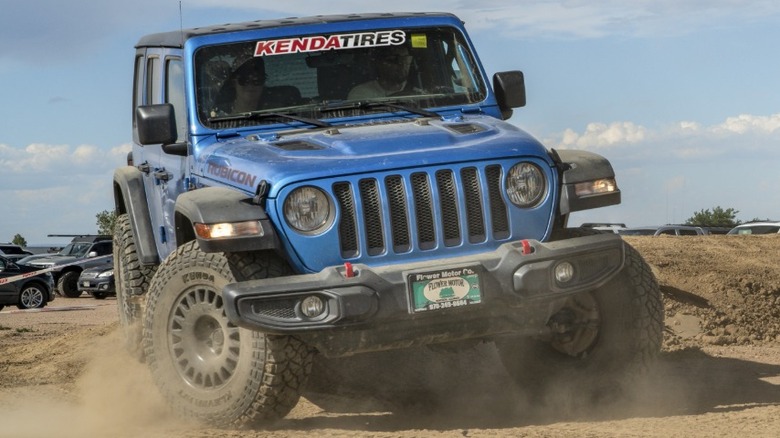
The need for enough horsepower in your off-road vehicle is obvious when you're tackling a steep incline. But torque is at least as important as horsepower when off-roading. Torque keeps the wheels turning when you're trying to traverse those steep inclines, as well as get through mud and other tough terrain at low speeds. Differentials matter, too. An open differential will allow your wheels to spin at different speeds. That can be great on the road, not so much on open terrain, where all the power might get diverted to a wheel that's come up off the ground. A locking differential ensures that equal power goes to both wheels on an axle, so the wheel that is still gripping the ground will spin.
The Bronco comes standard with a 2.3 L EcoBoost I4 that can crank out 275 hp and 315 lb-ft of torque, compared to the 285 hp and 260 lb-ft of torque produced by the standard 3.6 L V6 found in the Wrangler Sport. But the Wrangler offers more engine options, including the 6.4 L V-8, which cranks out 470 hp and 470 lb-ft of torque. As we noted in our review of the 2023 Ford Bronco Raptor, the most powerful engine offered for the vehicle is the 3.0L EcoBoost V6, which produces 418 hp and 440 lb-ft of torque.
An electronic locking differential is optional, but not standard, for both axles on the Bronco Base. It's standard on higher-tier trims, starting with Heritage Edition. Surprisingly, locking differential options are not available on the Wrangler Sport, though the Tru-Lok electronic locking differentials are on both axles of the Wrangler Rubicon models. We're going to give this category to the Bronco, considering the torque advantage and locking differential option on the base model.
Tires
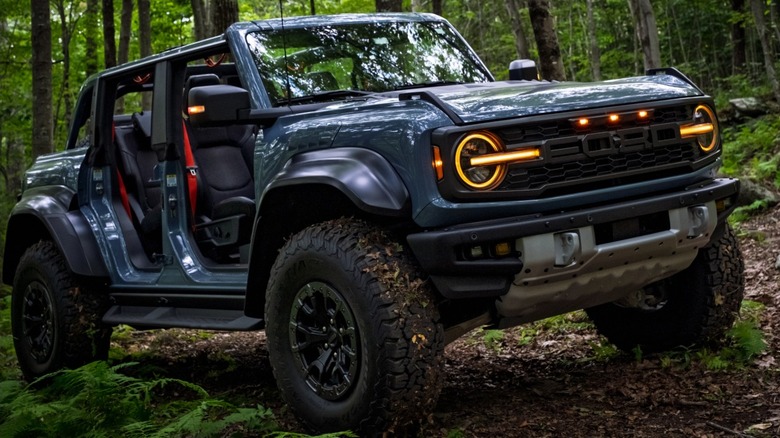
We don't have to explain why we've included tires in this comparison — you know how important tires are when you go off-road. The right tires make all the difference when you're trying to get through a muddy patch in the road without getting stuck. It would be nice if the vehicle you chose for off-roading already had the right tires. If not, you're in for an expensive aftermarket upgrade.
Jeep puts Nexen tires on the Wrangler, and equips the Sport with the Nexen Roadian HTX2. These tires are made for highway terrain, and customer reviews we've seen haven't exactly been full of praise for their ability to handle mud and gravel. You can opt for the Nexen Roadian ATX, even on the Sport. These are all-terrain tires, and they hold up well off-road, according to Off-Road Expo. However, you'll find BFGoodrich All-Terrain T/A KO2 tires on the higher-tier Wrangler trims, and these are widely praised for their off-roading capabilities.
Bridgestone all-season tires come standard on the Ford Bronco Base, and they are not designed for serious off-roading. However, you can go with mud-terrain tires, designed specifically for off-roading. And just like the higher-tier Wranglers, the Bronco Raptor comes standard with the BFGoodrich All-Terrain T/A KO2 tires. Overall, we're going to call this category a draw. If you're getting either of these vehicles, make sure to choose the BFGoodrich All-Terrain T/A KO2 tires if you're going to go off-road a lot.
Payload and towing capacities
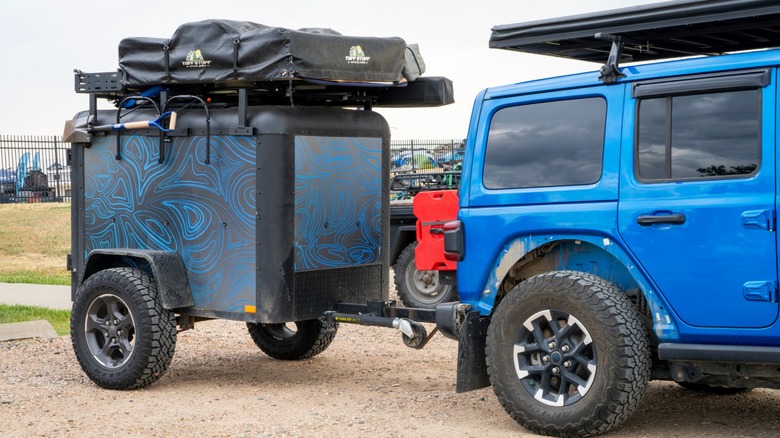
Some folks like to go far off-road to camp, carrying plenty of gear with them. It's nice to know you have the payload capacity to do it. Recovery is also important, since most off-roaders are going to have to be pulled out of a rut at some point. And towing capacity has a lot to do with whether you can pull your buddy's truck out of a ditch.
Towing capacity starts at just 2,000 pounds on the two-door Wrangler Sport. It goes up to 3,500 lbs on higher-tier trims. However, if you can get your Wrangler configured with the 2.0 L I-4 engine and the 4.10 axle ratio, that towing capacity goes all the way up to 5,000 lbs. Payload capacity ranges from a little over 1,000 pounds to around 1,300 pounds, depending on your configuration.
The Bronco's towing capacity is 3,500 lbs on every trim and configuration, except for the 4-door Raptor, which will get you 4,500 lbs. Its payload capacity is pretty comparable to the Wrangler. We're going to give this one to the Bronco, even though it's possible to get a higher maximum towing capacity with the Wrangler. The average customer probably wouldn't know how to find out the exact build they would need to get a Wrangler with that 5,000-pound towing capacity. But you could just walk into a Ford dealership and drive off with a new Bronco Raptor with its 4,500-pound capacity, no special build required.
So, which is the better off-road vehicle, the Jeep Wrangler or the Ford Bronco? Going purely by the numbers, we have to say the Bronco has a slight edge. Some of you are dying to tell us how wrong we are, so tear us apart in the comments.