

Jet Engines Are So Valuable, Nearly New Airbus Planes Are Being Scrapped To Get Them
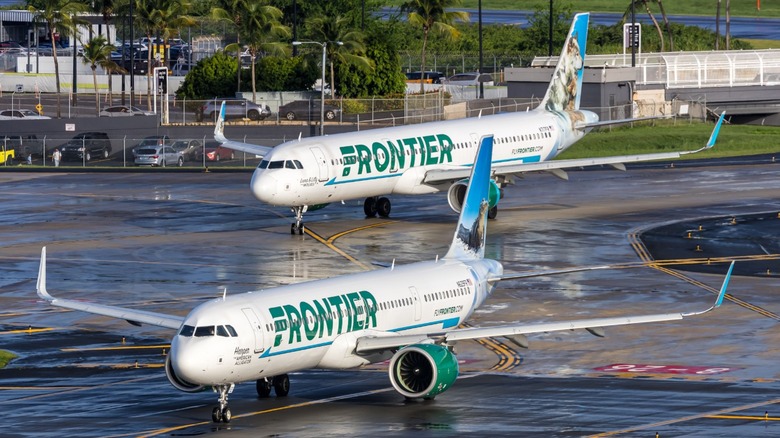
The aviation marketplace is a weird place sometimes. Take the current shortage of jet engines, for example. A whole confluence of issues has caused a global engine crisis, resulting in Pratt & Whitney, a major engine manufacturer, getting way behind in production. That means airlines are short of jets while airplanes are in high demand.
Normally, an airline would just keep older jets in the air until new ones became available. But hundreds of jets have been grounded due to delays in maintenance and repairs. That's why there are several Airbus A321neo jets at Castellon Airport in Spain being stripped of their engines, which will be made available for lease.
These must be old jets, right? Maybe they've incurred some damage or they're just worn out, which is why they're being scrapped? Nope. We're talking about perfectly fine 6-year-old (in some cases) A321neo jets being stripped just for their engines. If that name doesn't ring a bell, it's a variant of the Airbus A320 jets that are now the most-delivered jetliner in the world, having knocked the Boeing 737 off the top spot. But now some of them are being scrapped after being around for less than a decade.
Why would perfectly good airplanes be taken apart for their engines? Because companies like eCube have decided it's more lucrative to lease out an engine to airlines that need spares than to rent out an entire plane. The going monthly rate for geared turbofan (GTF) jet engines right now is around $200,000. That's a little less than half as much as leasing an A321neo. And for Delta, this is another clever way to get around tariffs.
What's causing the engine shortage?

So why is there a shortage of jet-plane engines? Specifically, we're talking about Pratt & Whitney GTF engines, which are suffering a shortage in production. It started with a failure to keep up with maintenance and engine repairs, causing planes to be grounded and increasing demand for the engines themselves. Then in 2023, Pratt & Whitney notified customers of a powder-metal default that could cause cracking. This led to a call for upward of 700 planes to be inspected.
Some estimate that as many as a third of planes equipped with Pratt & Whitney GTF engines are grounded or in storage. For comparison, only 4% of planes powered with engines from Pratt & Whitney's competitor, CFM, the world's largest producer of jet engines, are grounded for repairs.
It's not as if this is a regular occurrence in the aviation industry. Lee McConnellogue, CEO of eCube, the company that is harvesting these planes for parts, told The Economic Times, "I can't say I remember it happening on this scale before, because we've never had an issue like this on such a popular engine."
This has led to the GTF engines that are still in good shape being as hot as a catalytic converter on a Honda Accord, except they are way harder to steal. They're pretty complex to take off legitimately, as well. You might be picturing someone simply detaching these engines from the wings. It's a lot more complicated than that. The shell of the engine remains on the plane. The technician has to gut the engine from the inside, removing all of the components.
How lucrative is it to scrap new jets for their engines?

All of the effort to remove these engines from their planes is apparently worth it. GTF engines sold as spares can go for as much as $20 million. Not looking to buy right now? Renting one of these engines runs around $200,000 a month. Airlines with grounded A321neos are having to decide whether to leave their existing jets grounded and lease entire planes for $460,000 a month or rent an engine for less than half of that. So leasing an engine instead of a plane is a clear choice. Even if they decided to buy instead of rent, an Airbus A321 goes for $132.5 million, far more than buying a spare engine.
And for eCube, the company harvesting these engines from working planes, leasing out parts separately seems to be more lucrative than leasing out entire planes. Each A321neo has two engines and eCube claims to be able to recycle every part of the plane. In this case, the parts are greater than the sum.
The crisis with these jets is disrupting the industry, and it doesn't seem like it will get better any time soon. The GTF engine inspections for the powder-metal defect are expected to run into 2026. Chris Calio, CEO of RTX, Pratt & Whitney's parent company, said recently that even though the number of planes being grounded had stabilized, the company has "more work to do." So for now, eCube continues to tear apart Airbus jets at that airport in Spain.