

What Your Honda's Maintenance Minder Codes Actually Mean
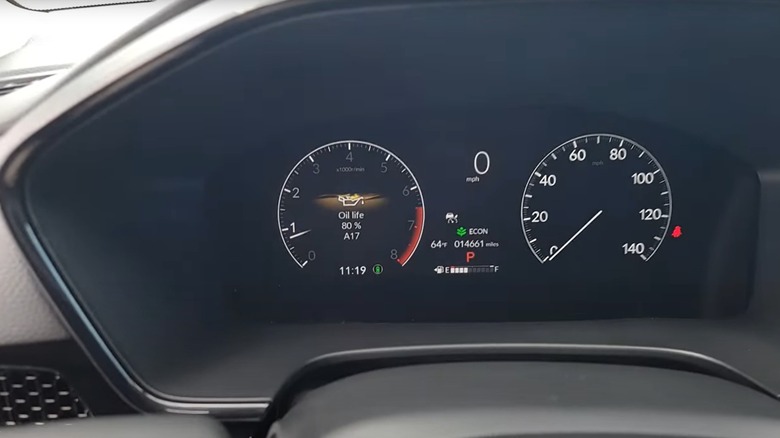
Remember the old "Check Engine" light? That dash light was just cryptic enough to be ignored by anyone who doesn't own a code reader. Honda improved on that with its Maintenance Minder light, which is more specific yet somehow just as cryptic. If you're a Honda owner, you've seen the little wrench accompanied by an alphanumeric code that comes with that message — usually an "A" or "B," followed by at least one number.
These codes have to do with important maintenance items you shouldn't ignore. The good news is that you only have to know what two letters and six numbers mean. "A" just means you need to get your oil and filter changed. "B" also means it's time to get the oil and filter changed — plus check a few other things. That would include the brakes, the emergency brake, tie-rod ends, steering gearbox and boots, suspension components, driveshaft boots, brake hoses and lines, all fluid levels and conditions, exhaust system, and fuel lines and connections.
What about those numbers? "1" means tire rotations. "2" means check the air cleaner element, drive belt, dust filter, and pollen filter. "3" means it's time to change the transmission fluid. "4" indicates that the spark plugs, timing belt, water pump, and valves need to be checked. "5" displays when you're low on coolant. "6" means check the differential fluid. And "7" means change the brake fluid. Then there's the oil life indicator — 15% means get an oil change soon, 5% means do it now, 0% means you're overdue.
If you own a 2018 or newer Honda model, your car might display "0" instead of "A". If it displays "0" and "9," it's time to perform the same comprehensive maintenance tasks that the old "B" code indicated. Simple, right?
How does your Honda know it's time to check these things?

So, how does your car know when you need to check the brake fluid or the timing belt? You might think it's a mileage thing, but it's about more than mileage — time is important when it comes to oil changes. Your car's onboard computer also considers driving conditions, engine operating parameters, and environmental conditions.
What if your car needs an oil change, but the next tire rotation isn't due yet? In cases like that, when another service will likely be due soon, Honda's Maintenance Minder will move up the other service so that both can be performed at the next maintenance visit. This will help you save time and avoid some of the inconvenience that comes from taking your car to the dealership.
Is Honda doing that just to stack services at the dealership? We don't pretend to be able to read the minds of automotive executives, but even if your tires don't have to be rotated at the exact time your oil needs to be changed, they will need to be rotated eventually. It just makes sense to combine those services so you don't have to make multiple trips.
What if your Maintenance Minder doesn't come on?
Maybe you just happen to be looking at that little sticker in the top left corner of your windshield. You know, the one the quick lube manager slapped on your windshield without even asking. But as you're looking at it, you realize you haven't gotten an oil change in almost a year. Your oil life indicator isn't lit up, though. Does that mean you don't have to worry about it? Not necessarily, and it's debatable how much you can trust the oil life monitor in modern cars.
There may be occasions when your Maintenance Minder isn't, well, minding the maintenance, and a reminder hasn't come up when it should. Honda owner's manuals acknowledge this, and specifies the intervals at which you should get certain maintenance tasks done. For example, the manual for the 2016 Civic (this link will download a PDF to your device) says to get your oil changed at least once a year (not every three months, like the guy at the quick lube center says), even if the oil life indicator hasn't come on.
Likewise, the air cleaner element needs to be changed every 15,000 miles if you drive in dusty conditions. Meanwhile, the dust and pollen filter should be changed every 15,000 miles if you drive where there are high concentrations of soot in the air. If you drive in the mountains, change the transmission fluid every 25,000 miles, regardless of what Maintenance Minder says. The brake fluid needs to be changed once every three years.
Those figures are specifically for the 2016 Honda Civic. You'll want to check your owner's manual for the maintenance intervals for your Honda. That's also where you'll find out what those Maintenance Minder codes mean.