

Why The Boeing 787 Has Four Cockpit Windows Instead Of Six
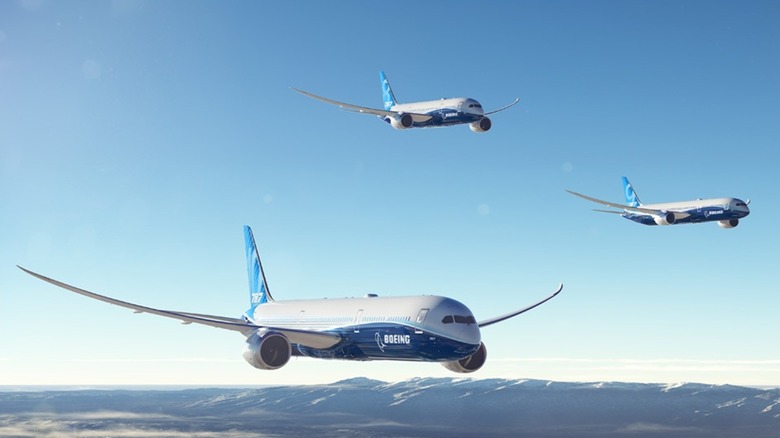
Since the Boeing 787 Dreamliner was revealed back in 2007, it has represented a few firsts in the aviation industry. It was the plane that Virgin Atlantic used for the first flight fully powered on sustainable aviation fuel (SAF). Unlike prior models, it was also the first to feature only four cockpit windows.
This change was made possible because the Dreamliner uses composite carbon fiber-reinforced polymers in half of its construction, as opposed to relying mainly on aluminum like previous models. This material is more elastic and is also why the Boeing 787's wings can bend a lot further than you might think. While other commercial aircraft have incorporated this material in the past, the 787 included more of it than ever before.
Though there are only four cockpit windows, Boeing's design made each of them larger, which gives pilots ample visibility during operation. These windows on the flight deck feature several layers, including a gold film which defogs the glass and is similar to the system used in fighter jet canopies. Boeing had another reason to switch to four windows on the 787: These windows are heavy, and having fewer can cut back on weight.
The 787 is Boeing's push for greater fuel efficiency
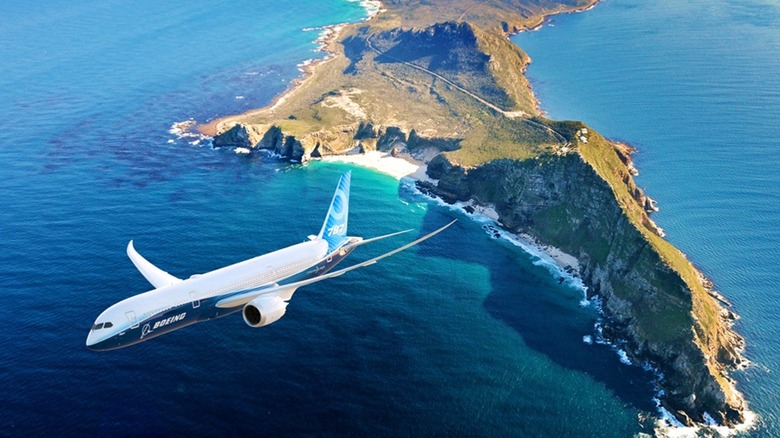
The lack of additional cockpit windows on the Dreamliner is directly related to Boeing's desire to produce a more efficient passenger aircraft by reducing weight. This is also why the Boeing 787 doesn't have winglets. Jet fuel can comprise as much as 30% of an airlines operating budget. By designing an aircraft that is lighter, airline carriers can potentially use less fuel and reduce the costs of flights. Boeing was largely successful on this front, as the company claims that the 787 offers 20% greater fuel efficiency than comparable models.
Some iterations of the 787 can also fly farther than its 777 predecessors, although the latter can hold more passengers. According to Boeing, the Dreamliner has opened up an additional 425 nonstop routes across the globe that were previously unavailable. Instead of having larger planes that went to capitals or other central locations, the 787 allowed the company to instead travel to smaller airports with more direct flights and fewer passengers.
What do pilots think of the 787?
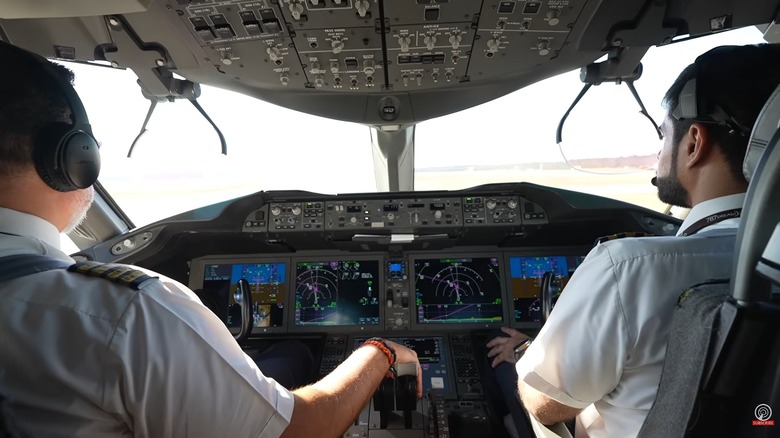
Pilots who have flown the 787 have noted that the aircraft does climb well due to the weight reduction measures. Others have commented that the 787's cockpit is exceptionally ergonomic, with fewer windows not being an issue at all. As retired British Airways Captain Michael Napier said via Key.Aero, "The Dreamliner flight deck is a very comfortable working environment — it is quiet, and the large display screens make it feel uncluttered and very roomy."
The Boeing 787 Dreamliner also contains a tucked away compartment in its design that includes basic sleeping accommodations for pilots on lengthier flights. One Dreamliner variant, the 787-9, is being used by Qantas to fly from Perth, Australia to London, England, which is a trip that lasts for 17 hours. Fortunately, the aircraft is equipped with a crew rest area, which provides a dedicated space for recuperation. It's even sometimes furnished with bedding from first-class.