

Toyota Made A HEMI Engine Six Decades Ago, And Nobody Noticed

Despite what clever branding may have tricked you into thinking over the past two decades, hemi engines are not exclusive to what are now Stellantis-owned brands. Although "HEMI' has been adorning hot Dodge and Chrysler models for as long as you can remember, there is a much richer and deeper history to that word. It's now essentially just a trim level, anyway, as modern hemi engines aren't even that.
See, hemi is short for hemispherical, and it refers to the shape of the engine's combustion chamber. Modern hemi engines don't sport such combustion chambers, so they aren't true hemis — the word has become more of a branding exercise. However, before this, Chrysler was producing genuine hemi engines, and it wasn't alone. Despite the spotlight always being shone on Chrysler's engine offerings, Toyota had also been busy developing its own hemi. This wasn't some bizarre one-off creation that never saw the green light for production, either; it was produced over several decades, and found a home in some of the Japanese giant's most prestigious models.
Toyota's hemi V8 first arrived on the scene in 1963, under the hood of the all-new Crown sedan at the Tokyo Motor Show. This model was developed to provide Japanese businessmen something Japanese they could float about in, as opposed to having to choose an imported luxury car. Sporting hemispherical combustion chambers, Toyota's engine — initially codenamed V — was a true hemi, much like the Chrysler FirePower engines that inspired its creation.
A closer look at the technical specifications of Toyota's hemi V8
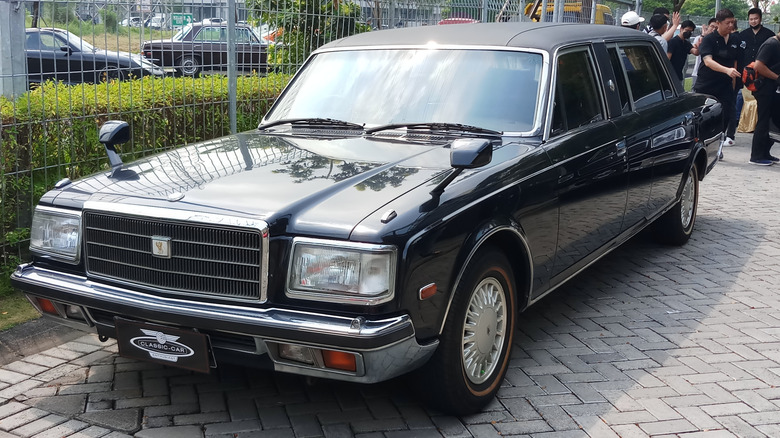
Despite taking inspiration from Chrysler's V8, the Japanese alternative was quite different. Instead of all-cast-iron construction, Toyota's hemi V8 boasted an aluminum block, so it was significantly lighter — which no doubt aided comfort and handling in those early Crown models. It was also smaller and less powerful, since Japanese city streets didn't require the same sort of grunt as wide-open American spaces.
It was 2.6 liters in capacity, and output of early iterations peaked at 114 horsepower and 144 pound-feet of torque. However, improvements soon saw capacity swell to 3.0 liters, and output grew to a more competent 148 horses, alongside 173 lb-ft.
The final update came in 1983, and this version served Toyota's finest flagship models until 1997, when the V12-powered Century sedan took on the baton. In this final guise, dubbed the 5V, Toyota's Hemi V8 had swollen to 4.0 liters, and managed to kick put 188 horsepower and 239 lb-ft. Even at this late stage, Toyota refused to succumb to the Western world's idea of a V8. Instead of chasing heady outputs and smoking tires, this often-overlooked hemi focused on being quiet and capable, destined only for the brand's most luxurious applications.
The engine was developed and built in collaboration with Yamaha. Not only was it wonderfully smooth and the perfect solution for Japanese businessman from the '70s to the '90s, it was also remarkably well-engineered, and has proven impressively reliable over the years.
Buying Toyota's hemi-powered sedan in 2025
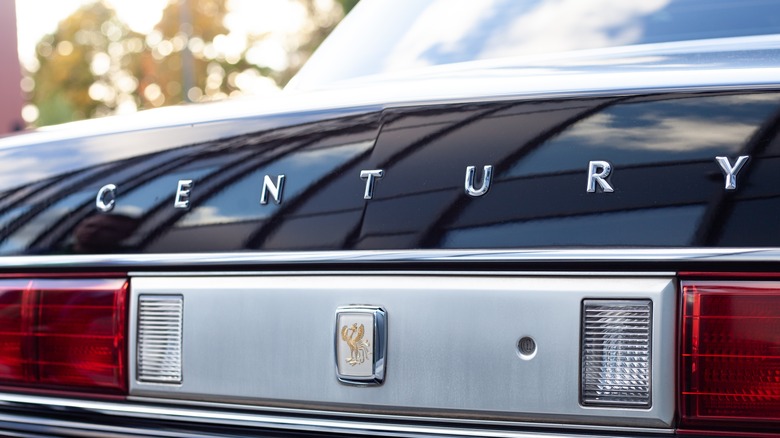
Owning a hemi-powered Toyota in 2025 is an attractive proposition for gearheads with a taste for the finer things. The only problem is that they were made only for the Japanese market. That's right, Japan's most interesting car was deemed too luxurious for America. But due to the 25-year import rule, it's now possible to bring over Crown and Century models with the V engine — something numerous enthusiasts have done. Furthermore, despite being the brand's flagship model for decades, it's now somewhat overshadowed by the later Century that sported Japan's only mass-produced V12 engine, so getting hold of a hemi-V8-motivated Toyota isn't all that expensive.
Early models are harder to come across, although examples of the Century from the early 1990s crop up on enthusiast auction sites. When they do, they rarely command figures higher than $10,000. This is for examples which have already been imported, and so you don't have the hassle of import fees, paperwork, and lengthy wait times to deal with, either.
We considered a 1990 Century the deal of a lifetime at $7,500, but there are other costs involved with keeping such a rare beast on the roads in the U.S., and the scarcity of parts and those knowledgeable enough to work on such an engine may detract from the budget-friendly allure of a classic Century model. Still, all worth it for the die-hard fan who gets to drive around in the hemi that nobody else even knows about.