

Is The Front Splitter On Your Car Increasing Drag? Here's How The Physics Work

It sounds a little like a trick question. After all, automakers and race teams alike spend piles of cash trying to improve their vehicles' aerodynamics, so why would anyone design a body part that actually adds drag? Because, to be sure, splitters do indeed increase aerodynamic drag.
Well, it turns out there's more than one way to manage airflow for improved performance, and among the tactics is increasing downforce. Downforce presses a car down onto the pavement, and that, in turn, puts more pressure on the tires, giving them a better grip on the road (or track) for better handling and acceleration. This is where Bernoulli's principle comes into play.
It basically says that when the speed of a fluid — and air is a fluid — increases, its pressure decreases. So if you have an airplane wing, for example, and it's been engineered to allow faster airflow on the top and slower on the bottom, the high pressure from below will push the wing upward against the area of low pressure, eventually lifting the plane off the ground.
Well, a splitter is like an upside down airplane wing. It creates downforce through increasing drag on its upper surface to build up pressure, which then pushes the car down. The main action of splitters, however, comes from the vacuum-style operation of the low-pressure zone below, which actively sucks the car downward. For example, the McMurtry Spéirling drives upside down by maximizing that vacuum power with actual fans.
More fun with physics

Many different aspects of a splitter can make a difference in its performance, although it all starts with the leading edge. It needs to be rounded off and taper back to the trailing edge, again like an airplane wing.
Now, you might think a knife edge would better cut through the air, but the rounded shape actually keeps things flowing more smoothly with the air staying "attached" to the surface of the splitter. Having a thin edge first separates the air flow from the splitter itself to cause extra, unwanted drag.
Some drag is necessary to help create the high air pressure above the splitter, but that's not where the main downforce is coming from. More important is what's happening on the underside, where the vacuum action operates. With that in mind, an effective front splitter also needs a proper undertray. This is the actual horizontal surface on which the airflow presses (from the top) and sucks (along the bottom).
The tray has to be mounted at the right position, too. Generally speaking, the lower it is to the ground, the better, thanks to the Venturi effect — no, not the one you get from the Venturi 300 Atlantique French supercar. The one we're talking about means that when a fluid, like air, is squeezed through a tight space — like the bottom of a splitter tray and the ground — it speeds up and therefore, due to the Bernoulli principle, creates a zone of low pressure.
What's the difference between a splitter, an air dam, and a front spoiler?
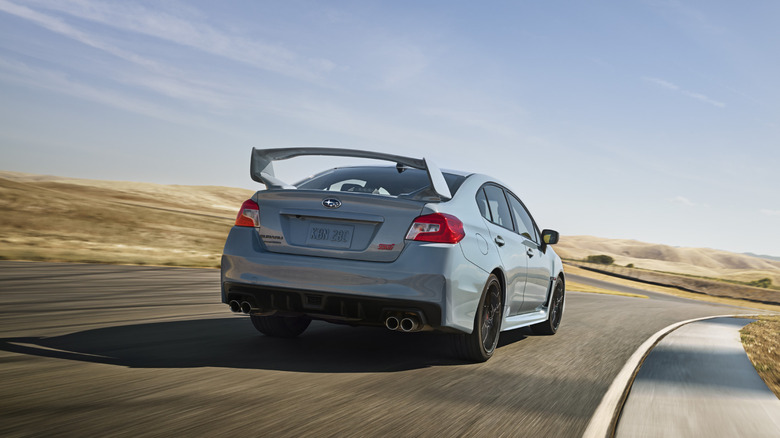
The splitter sits at the front of your car beneath the bumper, and that real estate can also be home to other aero features that work in addition to, or as part of, the splitter proper. Now, there's no officially accepted dictionary of aerodynamic terms on the internet, but it's fair to say that a front air dam — a vertical surface that prevents air from getting under your car to cause unwanted lift — is a specific type of spoiler.
A spoiler, in general, is a part engineered to disrupt — or "spoil" — the flow of air for the same reason, and it does so by creating a high pressure zone to push down on the car. Rear spoilers are different from rear wings as well. A wing is mounted separately from a car's body so that its top and bottom surfaces are exposed to the airflow. (FYI: These cars have the best wings ever.) A spoiler is connected to the body, usually the trunk lid, so only one surface is presented to the wind.
Getting to the splitter, it can be integrated with an air dam/spoiler to help create that previously mentioned area of high pressure. Yet because it's also really a wing, a splitter has a significant horizontal surface — the undertray — to speed up the flow of air for creating a low-pressure zone underneath it to suck the car down.