

Harley-Davidson's Trippy New Color-Shifting Paint Reminds Us When Paint Used To Be Special
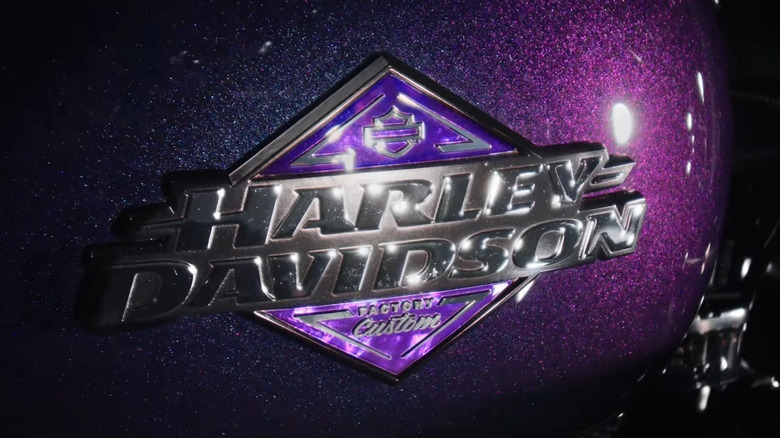
Interesting car and motorcycle colors these days are a bit like the first shavings from a freshly opened but still mostly frozen pint of ice cream: We'll take what we can get, but look forward to more. Sometimes, however, a color bursts forth from a manufacturer that makes us feel alive again, like picking a pint that's the perfect consistency for an immediate heaping spoonful. Harley-Davidson's dazzling Mystic Shift paint is that pint on steroids, where a combination of your favorite flavors wallop your senses from first bite to last. If you're frustrated by the infestation of boring "color" options for motorcycles and the overwhelming ocean of clay-colored cars, this is the hue for you.
Can we even call Mystic Shift a "color," though? It sparkles as if it were embedded with the stars of the night sky, all while phasing between shades like a Rorschach-test mood ring. As the sun pelts it with photons, you'll notice bursts of blue, purple, gray, and orange. To paraphrase Obi Wan Kenobi, "the color you see is true, from a certain point of view."
What's definitely true is that Mystic Shift isn't cheap. If you're ordering a new 2025 Harley-Davidson Road Glide, the suggested price starts at $27,999, and Mystic Shift adds $2,200. Perhaps this is to get your eyes to bug out upon seeing your wallet bleed money, which prepares them for taking in your new bike's stunning kaleidoscope of coloration. Ultimately, it's a small price to pay in the battle against bland. Did you know that in Europe, Africa, and the Middle East, beige is increasingly popular? Don't paint your vehicles like a 1998 Dell desktop, please.
Before there was Mystic Shift, there was Mystic(hrome)
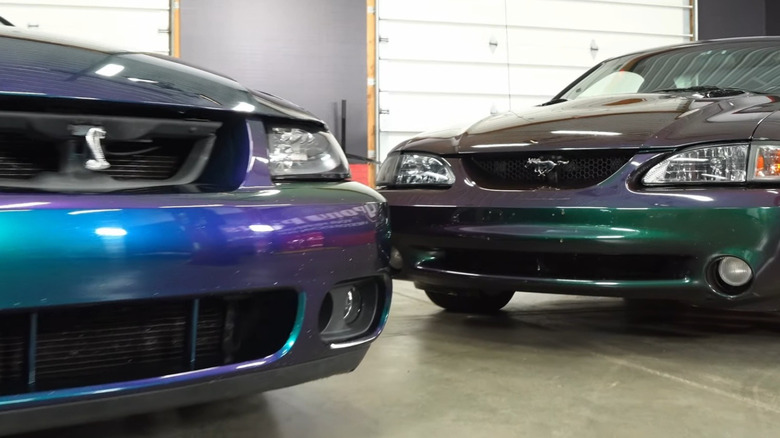
Back in 1996, long before Harley's Mystic Shift, you could stroll into a Ford dealership wearing your finest Gap clothing and Jonathan Taylor Thomas haircut to order a new Mustang SVT Cobra in a beetle-shell-like green-purple called Mystic. It cost an extra $800 ($1,652 today), and Ford only made 2,000 of the Mystic '96 Mustang Cobras, the first production cars to feature such a color-shifting paint. For the 2004 SVT Cobra, Ford turned to DuPont to create a variation on the original Mystic paint, now called Mystichrome, and limited production to just 1,010 examples. Mystichrome is perhaps the finest manufacturer car color ever sold.
This amorphous color came courtesy of the ChromaFlair pigment first produced by JDS Uniphase Corporation (now by Viavi). ChromaFlair's embedded multicolored flakes reflect light in varying colors depending on viewers' angles. It was revolutionary technology, even featured on the redesigned 1996 $100 bill and 1998 $20 bill. Grab one and look at the "100" or "20" on the bottom right. It will change from green to black depending on the light thanks to ChromaFlair pigment, a feature added to prevent easy counterfeiting.
But protecting money wasn't the original intent of angle-shifting finishes. The concept was pioneered by the forward-thinking Arthur Francis Turner, who co-developed groundbreaking anti-reflection and interference coatings at MIT in the late 1930s. His idea was to embed thin-film flakes into a finish to reflect different colors depending an observer's viewpoint. Specifically, the University of Arizona notes, he thought it would make a good paint for a getaway car, as a bank guard would report, "There goes that red — no, green — no, blue car." If anyone's ever used a Mystichrome Mustang Cobra to rob a bank, perhaps Turner would be proud.
Embrace the Mystic Shift, treat it carefully
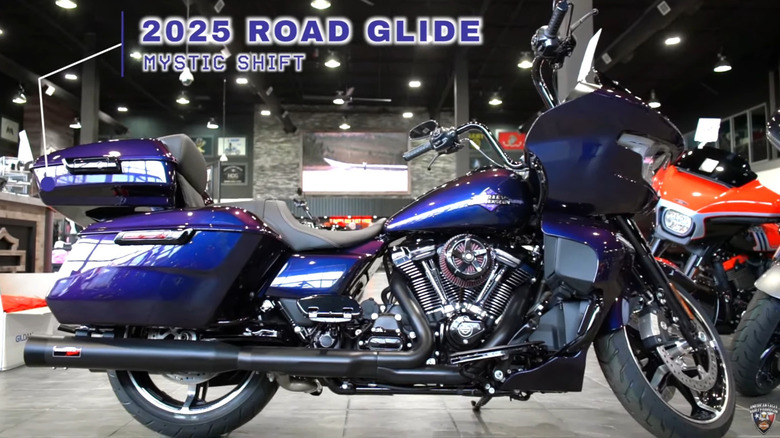
That lustful luster of your Mystic Shift Harley deserves preservation, and you may want to buy a Mystic Shift touch-up pen from ColorRite for about $20 to keep on hand. Just be glad it doesn't cost the same $26,600 per gallon Mystichrome will run you.
If you know the basics of washing a bike, this process will be familiar. Park in the shade, clean the paint using a scratch-free microfiber cloth, use gentle cleaners, and always dry the paint afterward with a super-soft towel. Then wax the finish for protection and extra sheen. The toughest part is deciding how much you want to ride around and show off your Mystic Shift Harley versus how badly you want to hide it in a climate-controlled garage to guard it from the elements. Investing in a protective cover is worthwhile, especially since it will be a fraction of the cost of the Mystic Shift paint.
And should you choose to go with black, white, gray, or silver on your Harley, fine. Developing colors that maintain their shade and shine takes time and money, and that cost gets passed on to you, the customer, so maybe you want to save money. Also, a color you find mesmerizing may be stomach-churning to someone else, and you may fear that selling your uniquely hued car or motorcycle may be an uphill battle, netting you less money than you'd like. Yes, traditionally, dealers love black and white finishes because they're the Sprite of colors: inoffensive and tolerable to just about everyone.
But times are changing, and cars with distinct colors are maintaining resale value better than the chromatically deficient. Maybe this is the Mystic Shift we've been waiting for.