

Some Car Brands Are Rethinking Touchscreens And Bringing Back Physical Buttons: Here's Why
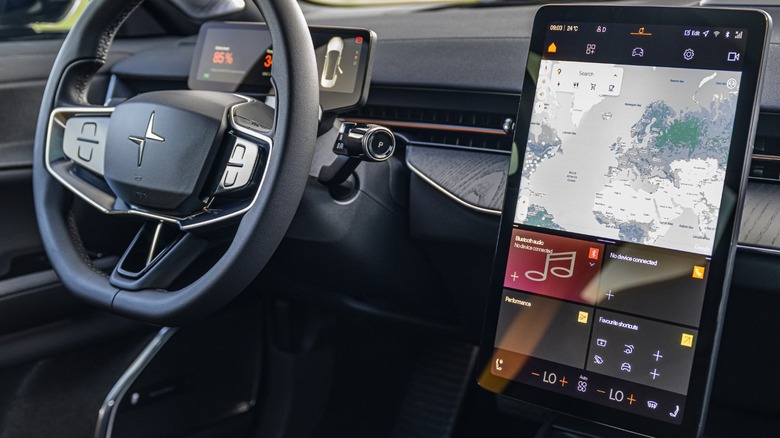
You know those movies where some scientist inadvertently creates something that almost ends the world? There's always someone who scolds the scientist by saying something like, "You were so busy figuring out if you could do it, that you never stopped to think if you should!" Someone should have said that long ago to automakers when they started replacing easy, go-to buttons and dials on the dash with big obnoxious touch screens, a feature many would pay to have removed.
Apparently these geniuses thought that adjusting the A/C while hurtling down the freeway during rush hour was getting just a little too easy, so they decided to put those controls on a screen buried in a menu. Remember the days when your stereo did not affect air conditioning? That was archaic technology. Now, when the touchscreen goes out, so does your sound system and climate control, as well as, depending on your model, your gear shifter, turn signals, and windshield wiper control. Yay for progress!
We're happy to report that several automakers have either started putting buttons back into their cars or have committed to doing so going forward. These brands include Mercedes-Benz, Audi, Subaru, Hyundai, MINI, Volkswagen, Porsche, Genesis, and Ferrari. You may have noticed Tesla is missing from that list. Shocker, right? Nope, Tesla is sticking to their buttonless guns for now, continuing as an industry leader in providing features no one asked for.
We expect more automakers to join this list, though. Volkswagen is already being sued for its use of touchpads on the ID.4 steering wheel, and a prominent European agency has announced it will no longer give 5-star safety ratings to vehicles without buttons for essential functions. We'll have to see how many automakers end up coming to their senses.
The brands who have seen the light
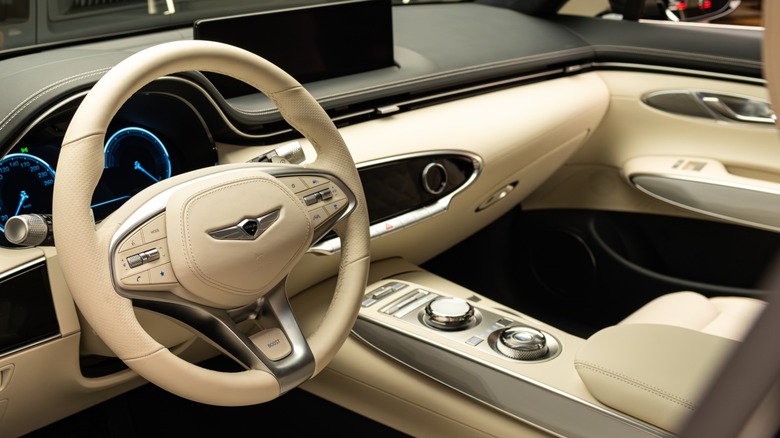
Mercedes-Benz is famous for its large hyperscreens, but it announced recently that they were going to start re-integrating knobs and buttons onto the dash, most likely in its SUVs. Autocar reported that Gordon Wagner, design lead at Mercedes, said at the Munich motor show that "we have reached a point where you cannot make the screen much bigger." He also told ABC News that touchscreens are "not luxury", and that he wants to focus on "craftsmanship and sophistication". Magnus Östberg, software boss at Mercedes, told Autocar that, "the data shows us the physical buttons are better." You don't say.
Several other brands have already started putting buttons back in their cars. Hyundai has already put more buttons into the Ioniq 5 and Tucson. However, this is another automaker that had to look at the "data" first. Per Motor1, Ha Hak-soo, VP at Hyundai Design North America said that, "we also tried out putting touchscreen-based controls, and people didn't prefer that. When we tested with our focus group, we realized that people get stressed, annoyed, and steamed..."
Audi is another brand that has seen the light, and has said it is moving away from capacitive controls. MINI has kept some buttons in the interior of the Cooper. VW is rolling back to knobs and buttons, but had to learn the hard way after getting slapped with a hefty lawsuit. Still, the brand's design chief admitted to Autocar, "It's not a phone: it's a car."
Subaru, Genesis, Porsche, and Ferrari, have also jumped on the button bandwagon. To be clear, these companies aren't getting rid of touchscreens entirely but just adding back some buttons.
Admitting a mistake
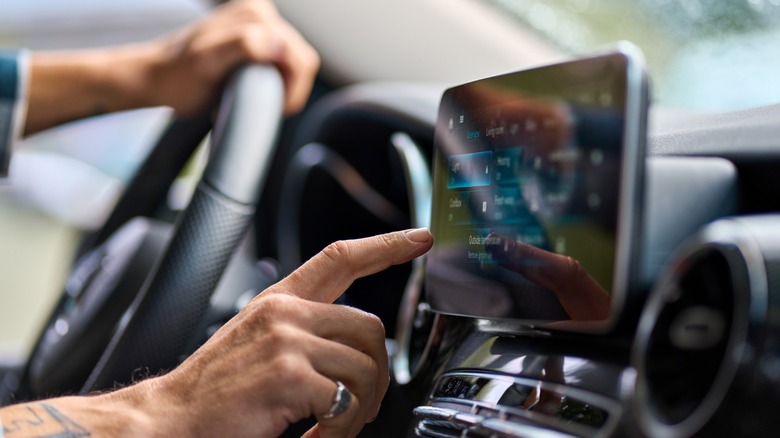
Multiple automaker executives have done something utterly shocking in response to all of the negative pushback about touchscreens — they're admitting they made a mistake. Volkswagen design chief Andreas Mindt said in an interview with Autocar, "We will never, ever make this mistake any more." That's right, he used the M word.
Other car companies haven't been quite so explicit when commenting on the errors of their ways, but they have openly acknowledged that stuffing every control into a big tablet was not the right move. Ferrari's Enrico Galliera told Autocar that replacing actual buttons on the steering wheel with touch-sensitive ones in many of its models wasn't "... 100% perfect for the use that is done in the car. So this became clear and it was feedback that we received very loudly from our clients."
Hyundai were also somehow surprised at their customer's negative reactions to being forced to scroll through menus just to turn down the vent fan. The company's head of design, Sang Yup Lee, said in an interview with Motor1, "Haptic [buttons] are cool, but if it's not helping others, it's not a good feature."
Personally, we think the jury is still out on how cool haptic buttons in cars are. After all, touch sensitive technology has been commercially available since at least 1983 when HP offered its first touchscreen computer for sale. Still, this backtracking on touchscreens means you're probably more likely to hear an admission of fault from an auto executive lately than in any other circumstance.
People are suing Volkswagen over their touch pads
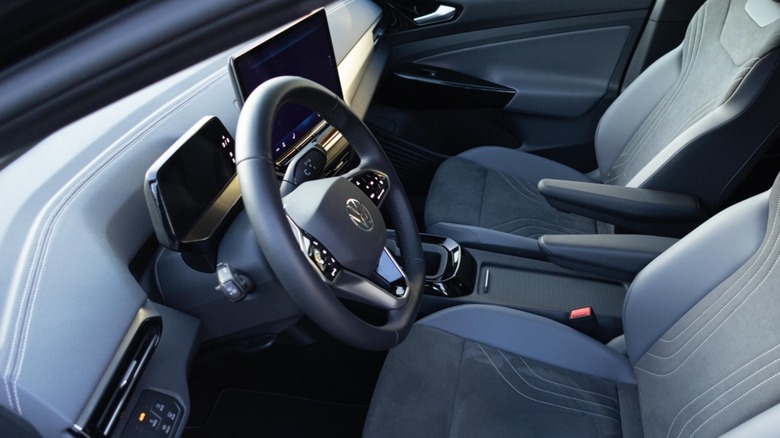
Another thing that car companies are realizing is that staring at the menu options on a touchscreen when you should be paying attention to the road might not be the best idea. However, it's not just the big screens in the middle of the dash that are causing issues. Volkswagen replaced buttons on the 2021-2023 ID.4 steering wheels with touch pads, which operate much the same way as touchscreens. The problem is that this has resulted in some drivers accidentally hitting resume on their cruise control, causing their cars to suddenly accelerate.
This allegedly happened to one driver when she was parking her vehicle. Her hand inadvertently touched the haptic cruise control slider, and before she knew it, she had $14,000 in damages to her car and a bruised hand. She and another driver have filed a class-action lawsuit against VW, while other drivers have filed complaints against the automaker with the National Highway Traffic Safety Administration. This is no doubt one of the reasons why VW is gradually discontinuing these steering wheel touchpads in newer vehicles.
Again, we don't see why automakers have had to learn this lesson the hard way, at least when it comes to the large touchscreens. Maybe we can see the steering wheel touch pad issues slipping through the cracks before production. Still, there are all kinds of laws on the books about distracted driving. Why would anyone think it's a good idea to stick all the controls on what amounts to a large smartphone?
A European safety commision is requiring some physical buttons
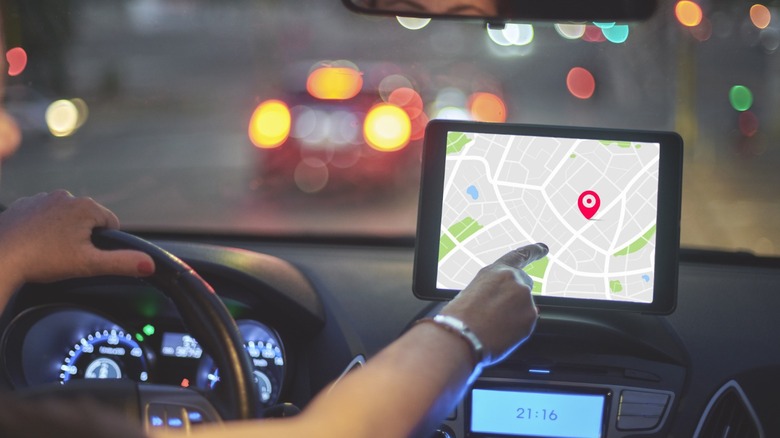
The European New Car Assessment Program (NCAP) is a non-profit organization that makes it its business to grade new cars for safety. None of their findings are legally binding in any way, but getting a high score from them is still a big deal. Volkswagen, BMW, Tesla, and Volvo all publicize their scores in their advertising. Well, starting in 2026, those brands are going to find it a little harder to have those bragging rights, especially Tesla.
The director of NCAP, Matthew Avery, told The Times that "The overuse of touchscreens is an industry-wide problem," because they encourage "drivers to take their eyes off the road and raising the risk of distraction crashes." As such, the organization has decided that no vehicle will get a 5-star rating unless it has good old knobs, buttons, or other traditional touch controls for certain functions. Those functions are turn signals, emergency flashers, horn, windshield wipers, and emergency call services.
Looking at that list, we find it crazy that anyone would think it a good idea to use digital controls for horns, of all things. However, Tesla did just that in 2021, when it changed the control for the horn in Models S and X from the tried-and-true middle button to a touch-sensitive button on the steering yoke. Why, Tesla, why? The automaker changed this back to the traditionally-located steering wheel control with the 2022 model year, though buyers had to wait until the firmware update came out to use it. Either way, that's what happens when you go around fixing things that ain't broke.
Of course, Tesla has to be different
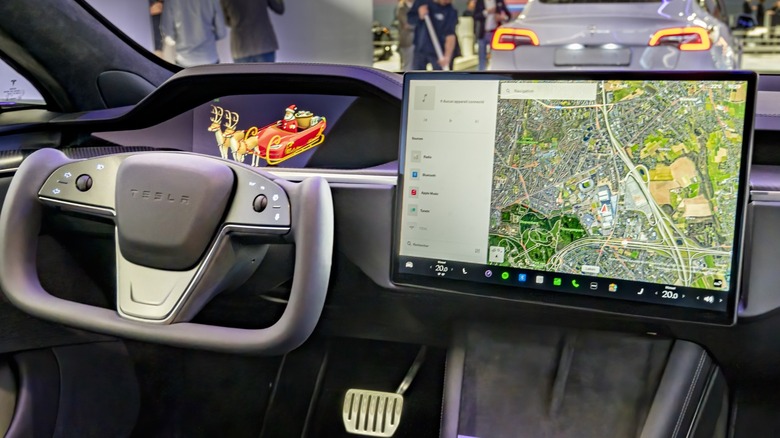
In some ways, this whole mess with touchscreens is Tesla's fault in the first place. Tesla inspired the trend, so it's no surprise that they have no plans to revert back to buttons. Elon Musk's automotive brand didn't invent touchscreens in cars, but it did pioneer the use of them when, in 2012, it released the Model S with its 17-inch touchscreen and hardly any buttons. Other carmakers, with their 7 or 8-inch touchscreens, soon developed screen envy and, before you knew it, the whole thing was out of control.
Nearly every manufacturer started replacing easy-to-use buttons with obnoxious screens and weird touch pads on the steering wheels. Soon, everyone was taking their eyes off the road to figure out how to turn on the rear defrosters. Tesla even went so far as to make some of their cars without stalks for turn signal and windshield wiper controls, though it is putting them into the 2026 Model 3 in China and making them available to be retrofitted into the Model 3 in the U.S. for a fee.
That's not to say that Tesla hasn't had its share of problems due to its touchscreens. In 2020, the National Highway Traffic Safety Administration launched an investigation after receiving numerous complaints from drivers who lost the use of their touchscreens caused by media-control unit failures. Some of these drivers couldn't access their rearview camera, warning safety features, and climate controls. In 2022, Tesla recalled 130,000 cars due to touchscreens overheating and failing. But Tesla persists with its buttonless cabins. At least we can be thankful that other car companies are coming to their senses.