

4 Companies That Insist Personal Flying Cars Are Feasible

While film classics like "Blade Runner" and "Back to the Future" gave audiences a glimpse into a fictional reality where flying cars exist, the idea didn't come from Hollywood. In fact, the first patent for a flying car was drafted in 1910, just a few years after Henry Ford introduced the Model-T. While technology has made significant strides in the automotive and aviation industries, we still don't yet have people taking to the skies in their cars.
However, there are companies such as GE still throwing money at the flying car dream and refusing to let it go. While there are a number of startups with so-called "flying car" concepts, many of them look and perform more like supersized drones, not a vehicle that can both drive on the road and fly. Fortunately, there are some options that can be both driven and piloted (in the classic sense of a flying car). However, it's not that the idea isn't a cool one; it's just that there are some inherent problems with aerial-capable automobiles that have yet to be solved.
The PAL-V Liberty
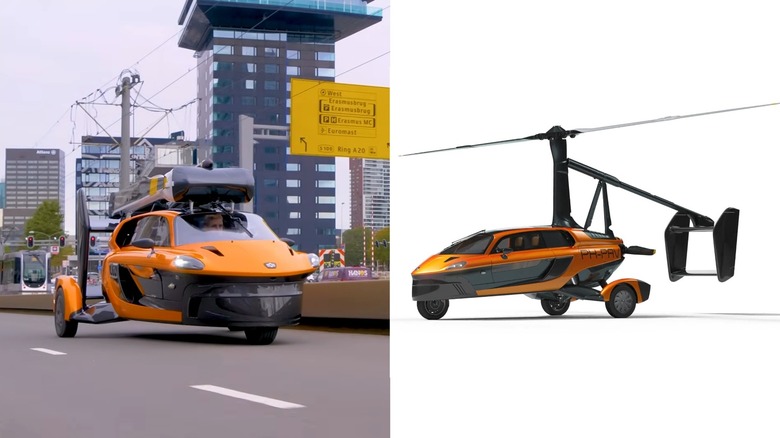
Founded in 2008, PAL-V (Personal Air and Land Vehicle) launched its three-wheeled Liberty model in 2017, becoming the first company to offer a flying car commercially. It features two Rotax 912 iS engines, which comprise its dual propulsion drive system. In road mode, despite featuring what appears to be a very thick and aggressive roof rack, it can achieve a top speed of 100 mph (160 km/h), with a range of over 800 miles. In flight mode, you can reportedly cruise up to 111 mph (180 km/h), reach 11,000 feet in altitude, and travel at least 248 miles (400 km) or beyond, depending on certain factors.
In addition, that aggressive roof rack apparatus outlined earlier is actually the gyroplane part of the vehicle (all folded up), which opens to reveal large rotary blades and a stabilization tail. The problem is, to transform from car to aerial aircraft, PAL-V explains that you need to drive to an airstrip first. Its gyroplane design doesn't deliver power to the rotor, instead using a propeller for thrust. As the propeller moves the Liberty forward, the unpowered rotor is able to create lift as it spins freely. Meaning, you need a runway to get going. The company boasts that the gyroplane designation allows a lower threshold for entering the aviation world, but one has to wonder if that's a good thing.
Aska A5
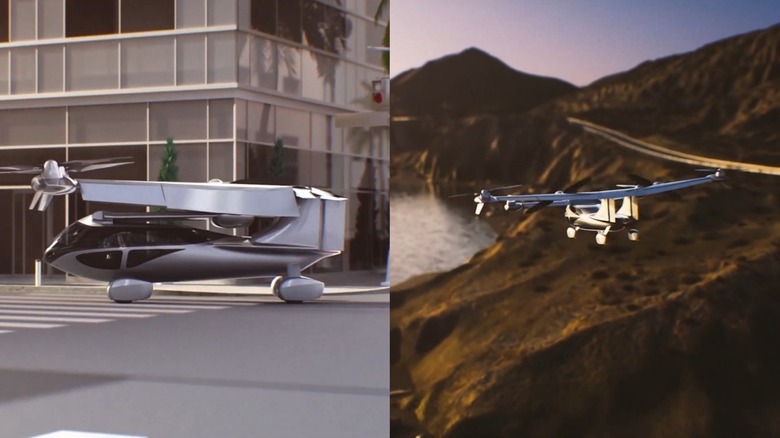
The A5 by Aska will cost $800,000 and is described as a roadable electric-hybrid VTOL (vertical take-off and landing) vehicle, but can also perform short takeoffs and landings (STOL). It features space for four people and utilizes six large propellers to facilitate lift, some of which can run both in a vertical or horizontal position. A 100 kWh battery pack provides power, along with a gas-powered engine to extend its range, which is reportedly up to 250 miles. In flight, the A5 can achieve speeds up to 150 mph, and it does include a ballistic parachute. Aska claims the A5 is around the size of an SUV when the propellers are all folded in for driving.
While Aska has been developing the A5 for over seven years and has performed some successful hovering tests, it has yet to be fully released. The company envisions the A5 as more of an air taxi than anything else, as driving would be minimal, essentially just a few minutes to an appropriate takeoff area. Downplaying the driving portion of this flying car might also have to do with it being unable to meet normal vehicle standards. Instead, the A5 will reportedly register as a neighborhood electric vehicle (NEV), which are designated for low-speed travel around 25 mph. The thing is, in terms of driving, you can already get a cheap EV in the U.S. as long as you don't want to go more than 25 mph for a fraction of the A5's price.
AeroMobil AM
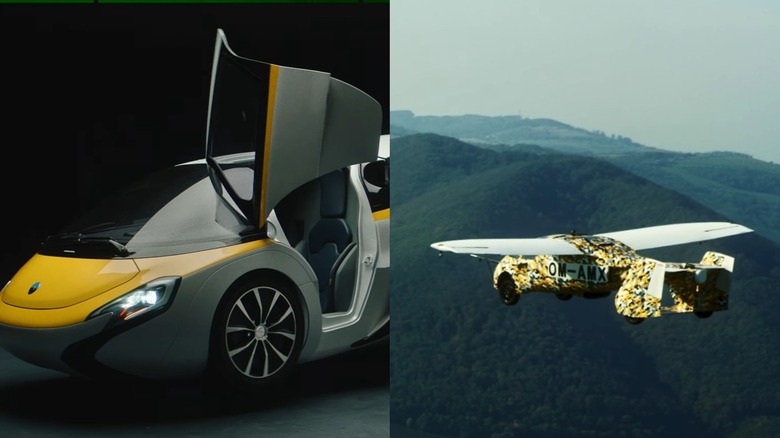
The AM from AeroMobil offers both a two- and four-seat model flying car that Motor Trend estimates will run for between $1.3 and $1.6 million. It uses a hybrid system that includes a turbocharged engine outputting around 300 bhp. When in car mode, the vehicle is 7 feet wide, but converting to flight mode unfolds wings in just 3 minutes, stretching the AM out to 30 feet in width. On the road, it can reach a top speed of 100 mph and does 0 to 62 mph in 10 seconds. In the air, you can cruise at 160 mph, and AeroMobil has also included a parachute system and an optional autonomous autopilot. The company claims the range on the ground for the AM is estimated at 600 miles and in the air is 460 miles.
But before you get too excited, there are a few things to know about the AM upfront. You will need a private pilot's license to fly it. Before every flight, you'll still need to go through the same preflight checks you would with a traditional aircraft. Another issue you'll face if flying further distances with stops in between is fuel. The AM is equipped with a car engine, so it could actually pass emissions for road driving. So, you'll need to fill up with regular gas, which will require you to drive out of the airport to find a station, before you can take off again. Also, you can find plenty of used Cessnas for under $200,000, just saying.
Alef Model A
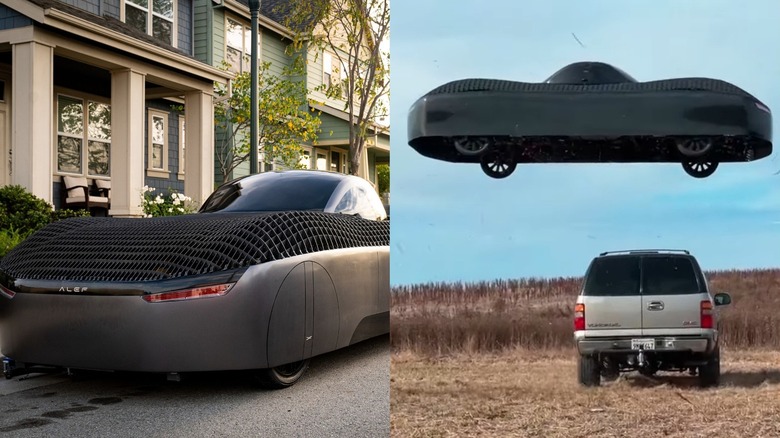
Alef is taking pre-orders for its $299,999 Model A, which is a single-seat, low-speed car with the ability to take off vertically with the use of four propellers underneath. The body is made from extremely light materials, and the wheels are smaller and thinner to further reduce its weight. Unlike other flying car models, which feature a hybrid powertrain, the Model A is completely electric. Its flight range is only 110 miles with an estimated cruising speed of 100 mph, while road travel can get you 200 miles. However, its top speed will be around 25 mph.
The Model A from Alef is undeniably an interesting take on the concept, but this so-called flying car sure seems like a miserable way to travel. If its odd look doesn't dissuade you, the noise it makes while flying might. When lifting off and slowly flying forward in some of its tests, the intense buzz of its propellers was hard to ignore. You'll also need a private pilot's license to operate the Model A, which is an investment itself, requiring 40 flight hours. Unfortunately, reality runs counter to the idea that you can fly the Model A from your garage to work and back. The truth is, there are many specific rules around flying aircraft, with weight considerations, fuel quantity, rate of speed, and more. At the time of this writing, the Model A has yet to be released, with Alef promising more details as the start of production approaches.