

Why Does The Lamborghini Huracan Need 8 Oil Drain Plugs?

It takes money and patience to change the oil in a Lamborghini Huracan, since doing so in a Lambo (or any high-strung supercar) requires specific knowledge and deep pockets. For starters, it would probably cost $500 to $800 at an independent shop or dealership. To be fair, the total charges include about 8 quarts (7.5 liters) of full synthetic lubricant, but it goes beyond choosing the right oil.
It's not unusual for sports cars to have more than one drain plug, but the Huracan's V10 has eight of them, and you need to unscrew each one to drain all the oil from the car's dry-sump lubrication system. It's not as crazy as the W16 engine in the Bugatti Veyron with 16 drain plugs (which, come to think of it, is one drain plug per cylinder), but it does have more than the V12-powered Aventador with only four.
The common denominator between the Huracan, Veyron, and Aventador is the dry-sump oiling system. It's why supercars like the Huracan have multiple oil drain plugs, since a dry sump is more complicated and routes more oil to different parts in and around the motor. Unlike a conventional wet sump that stores oil in a pan under the engine, a dry sump uses a separate reservoir (typically located around and not under the engine) for storage.
Pros and cons of dry sump lubrication
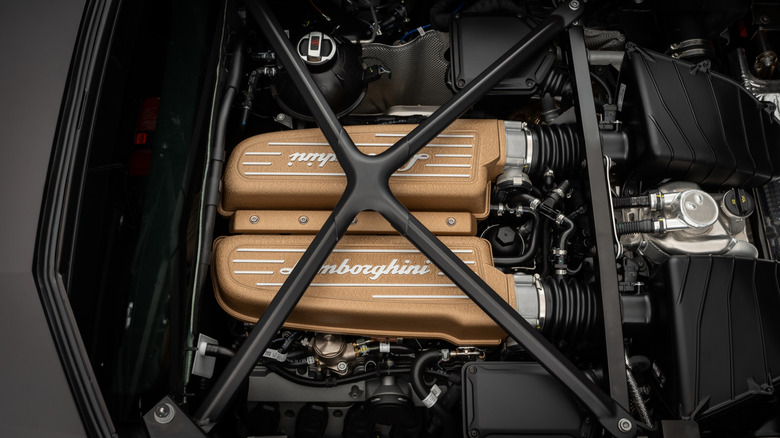
Supercars usually have dry sump lubrication to unleash more power. In a conventional wet sump, the rotating assemblies under the motor are bathed in oil, which is good for reducing friction but bad for horsepower. In a dry sump system, the crankshaft just has enough oil for lubrication, which means it doesn't need to contend with the lubricant's weight like in a wet sump. Less resistance means the crank can spin more freely, resulting in better horsepower and torque numbers across the rev range.
Meanwhile, dry sumps can hold more oil and go for more miles before needing to change it. The Lambo Huracan requires servicing and oil changes once a year or every 9,000 miles, whereas you'll need to replace the oil in a standard car every six months or 5,000 miles (whichever comes first). Moreover, dry sumps can maintain a more consistent pressure to prevent starvation, and they ensure reliable lubrication when racing around the track or holding on for dear life in a sweeping corner.
Lastly, dry sumps are more versatile and can be designed to improve weight distribution and balance. The downsides are potentially more weight, higher costs, and more complex assemblies that may require frequent servicing to prevent blockages or leaks within the many oil lines. Proof is the eight oil drain plugs in the Huracan, which are only accessible after lifting the vehicle and removing the necessary panels beneath.