

Why Boeing Is Building The F-47 Stealth Fighter Instead Of Lockheed Martin

In March of 2025, the U.S. Air Force announced that it had selected the contractor for its sixth-generation stealth fighter program: not Lockheed Martin, which made the F-22 and still makes the F-35, but Boeing. The culmination of the long-gestating Next Generation Air Dominance (NGAD) program, Boeing's first stealth aircraft has been designated the F-47. At least according to the official spec sheet, it will feature a major leap forward in range (able to fly over 1,000 nm, 50% farther than an F-35), speeds of over Mach 2, and better stealth technology than even the F-22.
However, given Boeing's recent string of (sometimes fatal) problems, you might be surprised that the company was awarded the contract. Wouldn't Lockheed, the maker of all of America's fifth-generation fighters, be a better choice? Then there's Northrop Grumman, which makes the B-2 stealth bomber. Indeed, when the NGAD program was launched, all three defense giants initially competed for the contract. In the end, however, the Air Force selected Boeing because it provided "the best overall value to the government." Which might sound like a pretty boring reason! But actually, it means Boeing did something pretty special.
The NGAD competition
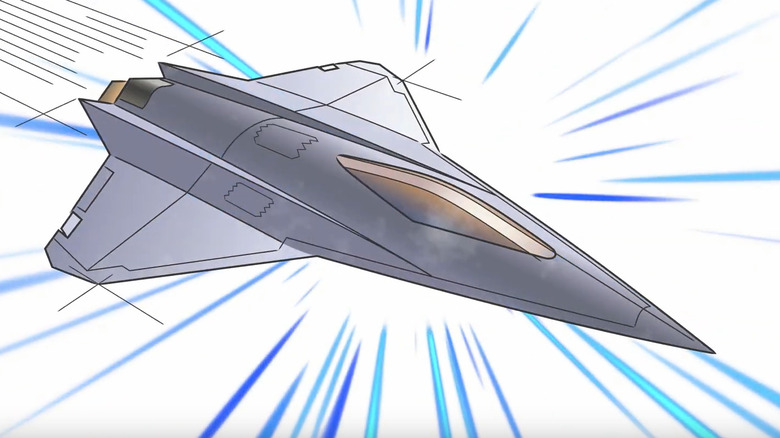
The point of the NGAD program has been to build America's replacements for the F-22 and F-35, which would make the new planes the most advanced fighter aircraft ever built. Much of this is highly classified, but the general direction seems to have been to improve range and stealth, as well as deep integration with so-called "loyal wingman" fighter drones. As sixth-generation aircraft, the new fighter would join the in-development B-21 bomber as the first such planes in the world.
While Northrop Grumman was widely expected to be one of the main competitors in the program, it surprised observers by choosing not to enter the program at all in July 2023. That left Boeing and Lockheed Martin to duke it out. Both companies built prototypes that were demonstrated for the Pentagon's selection team, which were named, respectively... well, nobody knows, actually. The experimental designations (typically an "X" or "Y") were never released to the public. This whole thing is really really classified, guys.
In fact, no complete image of either aircraft has ever been released. There have been a handful of vague renderings, however; the one pictured is from the Lockheed Martin concept. It appears to have a wider fuselage than what we're used to out of fast movers and lacks a conventional vertical tail. It also, apparently, wasn't as good as Boeing's prototype, something Lockheed itself appears to agree with.
Choosing Boeing
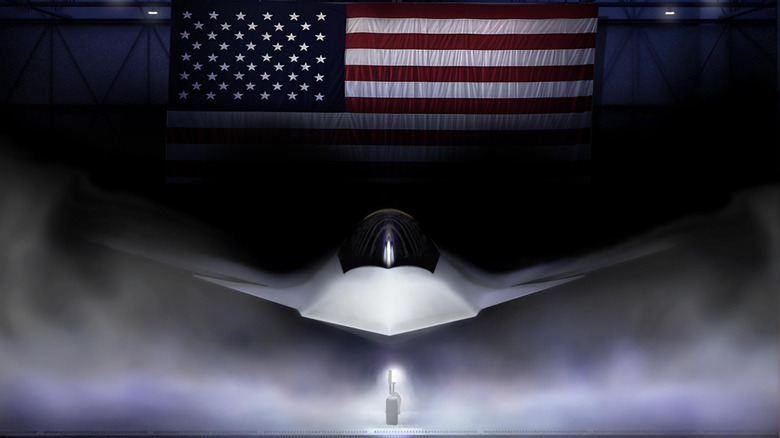
Even the winning bid from Boeing has been camera shy. The Air Force has only officially released some rather hazy renderings, with the plane mostly shrouded in fog. From what little we can see, though, its profile is similar to Lockheed's entry: wide fuselage, no tails.
Again, the Air Force's evaluation team picked Boeing's prototype for being the "best overall value," but as Air and Space Forces Magazine notes, that particular expression means more than you might think. Oftentimes, the Pentagon will pick a weapons platform by simply choosing the cheaper of similar options. This happens if several of the bids offer basically the same functionality. By contrast, "best overall value" means that the winning bid featured something that its competitors did not. In other words, the Air Force determined that the Boeing prototype did something either more or better than Lockheed.
What exactly did Boeing do that was so impressive? You guessed it: it's classified! What we do know, however, is that by law, Lockheed Martin had the right to challenge the Pentagon's selection. If it did, then the Government Accountability Office would review the entire selection process and determine if the military showed preferential treatment to Boeing. However, after receiving a briefing about why the Air Force went with the other plane, Lockheed chose not to challenge. That implies that even Lockheed was convinced that Boeing did something pretty special.
Naming the F-47
So, you're the United States Air Force, and you've just bought yourself a shiny new toy. What do you name it? Normally, the numbering simply increments upwards (like the F-16 followed the F-15), although with gaps because of prototypes or competing bids that never made it to production (there is no F-17 or F-19). That said, the F-35 broke this paradigm (for no particular reason, apparently).
The F-47, as you can tell, is also way out of sequence. According to Air Force Chief of Staff General David Allvin, this is for three reasons: "it honors the legacy of the P-47" fighter from World War II, "pays tribute to the founding year" of the USAF (1947), "while also recognizing the 47th @POTUS's pivotal support for the development of the world's FIRST sixth-generation fighter." That last one is... novel, to say the least.
Now, all Boeing has to do is complete the design, finish testing, and build them all! Never mind that Boeing is already struggling to produce a number of promised military aircraft, such as the KC-46 refueling plane and T-7 trainer jet. The goal, according to Allvin, is to get them operational by 2029. That is a very ambitious target, and I would bet good money that we actually see them somewhere in the 2030s. When they finally do, however, expect them to be the most powerful weapons platforms in the air... except, maybe, for some cheap off-the-shelf drones, that is.