

Honeycomb To High-Tech: How Mercedes Grilles Have Evolved Since 1900
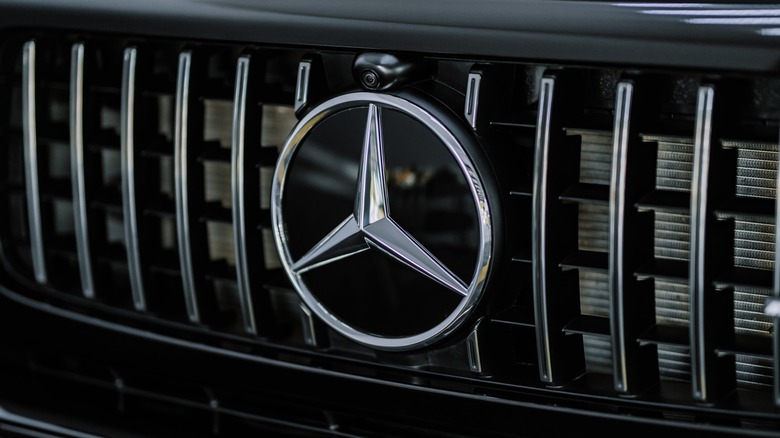
The importance of a car's grille cannot be underestimated. It's more often than not the defining feature of a car's "face," and therefore the thing that dictates the car's nature, or personality. For example, the happy face of a Frogeye Sprint, or the aggressive and purposeful face of a Shelby 'Stang — their personality is largely dictated by their grilles, along with the headlights.
So, when it comes to a storied and premium brand like Mercedes-Benz, the role of a grille is hard to underestimate. You can look at any Merc from the last, say, 60 or 70 years, and even as a non-car person it would be pretty easy to identify it as a Merc we reckon. Chrome, slatted grilles, and prominent hood ornaments — whether you're rocking a '60s SL or '90s 190E, the recipe is largely the same.
However, Mercedes-Benz didn't just wake up one day and decide to adopt the look we know and love today. That oh-so recognizable face only arrived after decades of innovation, trial, and tribulation. From fighting cooling woes, to differentiating sports and luxury models, this is the story of how Merc's grilles have evolved over the last 125 years.
1900 -- Mercedes-Benz solves its cooling issues with an innovative new honeycomb design
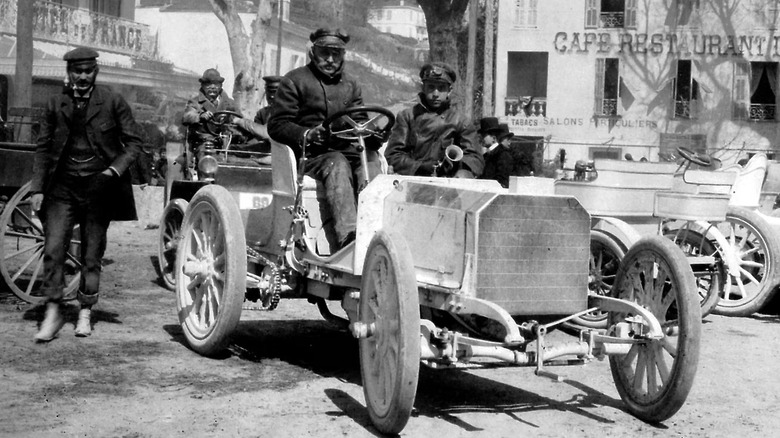
The first automobile, the 1886 Benz Patent Motor-Wagen, was monumentally important. Essentially, it rendered the horse out-dated overnight, although it wasn't perfect, and the automobiles which followed in the coming years weren't either. One of the biggest challenges with these earliest of cars was cooling.
Engineers and pioneers of automobiles of the era were immensely creative, as no rulebook for how things should be done was written — they were the ones writing it. In 1900, Mercedes-Benz managed to establish a particularly important chapter, by solving the cooling issues. The answer was the honeycomb radiator of the Mercedes-Benz 35 PS. The radiator consisted of over 8,000 small pipes, with a square cross-section of roughly 6 millimeters per side. This design allowed for increased airflow, and therefore improved cooling. A fan would be mounted just behind it, which too would allow for better cooling properties, particularly at slower speeds when the airflow was minimal.
Efficiency was the name of the game here, and the 35 PS needed just 9 liters of water to cool itself efficiently — a 100% reduction over previous models. Mercedes continued to refine the design over the coming years. Notably, in 1911, Mercedes-Benz debuted a pointed radiator on its more powerful models, such as the Knight 16. This allowed for a larger surface area, and thus, improved cooling properties. Rather than fit this to all models, Mercedes kept the flat design for lesser-powered models. After all, the pointed design was significantly more complex to produce, and unnecessary on lesser cars.
1931 -- Mercedes invents the grille
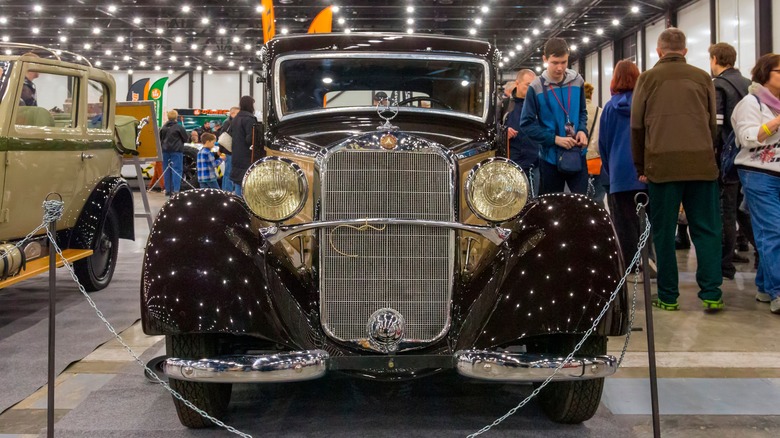
It would be decades later before Mercedes came up with another era-defining radiator improvement. In 1931, the Mercedes-Benz 170 (Type W 15) debuted, and with it came a bold new design up-front. To the untrained eye, it might not have looked all that different, but the tweaks made were significant. This was the first time in which the radiator itself would be mounted behind a protective cover, or, as you and I may call it, a grille.
The grille would be mounted by a chrome frame, a design feature which survives to this day, on many makes and models. Upon the top would be two Mercedes-Benz logos; a flat badge upon the top of the chrome frame, and that instantly recognizable hood ornament standing proud.
The honeycomb design was kept, and it served two functions. Firstly, it didn't restrict airflow, and secondly, it stopped dirt and debris from clogging up the radiator. After all, dirty radiator fins and ineffective radiator fins, and holed-radiators (courtesy of stones, and whatever else was lying about on the roads in 1931) were a reliability nightmare. The design was tweaked slightly, more than anything to appear more imposing on high-class models, but ultimately a uniform recipe was created for Mercedes-Benz models of this age. It was striking, efficient, and it just made good sense.
1954 -- the timeless sports car face debuts
Mercedes-Benz had always dabbled and impressed in motorsports throughout the decades, and in the 1950s, things were no different. This was an era in which automotive innovation really excelled, following a decade of little improvement nor excitement due to the war. New, fun designs were cropping up everywhere, and sports cars were now in, as citizens finally had something to celebrate again.
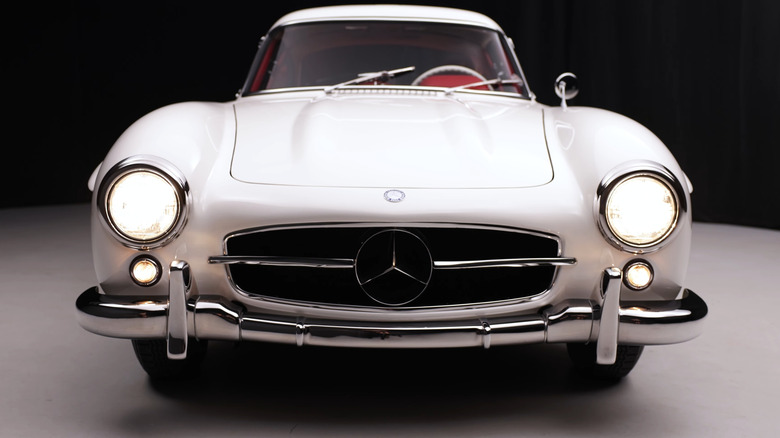
Triumphs, MGs, and Corvettes were hot new properties, and keen not to miss out on the action, Mercedes-Benz was right there with them. For the racers, the iconic 300SL Gullwing was a force to be reckoned with, and for the weekend enthusiast, Mercedes offered the sweeping 190SL — one of which we reviewed some years ago now. Rather than upright honeycomb covers, these sleek sports cars boasted wide, shallow, and slatted grilles, with a large tri-pointed star taking center stage. Internally, this design was known as the "sports car face," and has arguably gone down in history as one of the more timeless grille designs from the German automaker.
The open slats allowed for optimal cooling, yet the sleek, minimalist, chrome lines were distinctively Mercedes and effortlessly stylish too. Regardless of who was behind the wheel, Stirling Moss chasing a Mille Miglia record, or your next-door neighbor off for a Saturday evening cruise, they were going to look good doing it.
1972 -- a uniform executive look sweeps through the range
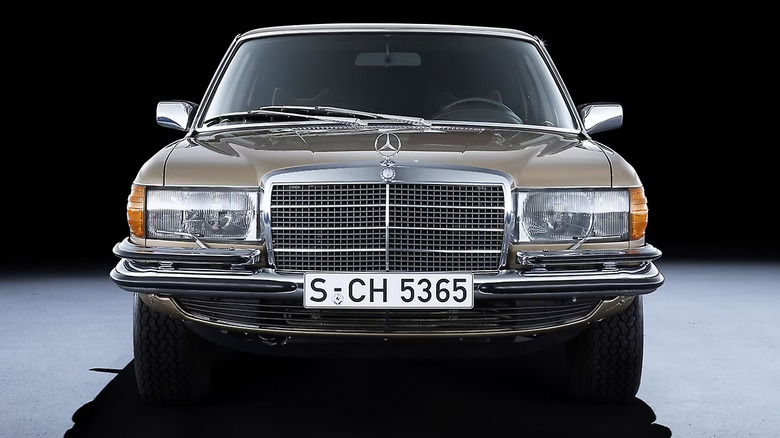
1972 saw the luxurious 450 SEL launch. This was an executive-level sedan which effectively sat as the precursor to the S-Class, a model which has been seen for decades as the benchmark in the luxury sedan sector. It was at this time, in 1972, that a newly stylized Mercedes' executive face appeared.
This new face was furnished with a wider, slatted grille, and although the grille would change in dimensions from model to model, the design would be one that would grace the front of models small and large for numerous decades. This provided a uniform face across the entire range, so whether it be a 'baby Benz' 190e, or a flagship SEL, the model in question would be immediately recognizable as a Mercedes-Benz.
As the decades progressed, the grilles became less busy, with first of all fewer upright slats featuring, and then fewer horizontal slats also, allowing for a simpler finish. This allowed newer models to differentiate themselves from older releases, all without having to reinvent the wheel, so to speak. The understated design worked well, after all, luxury models of this era were not cars which screamed and shouted with gaudy appearance packages — even throughout the '80s, most Mercedes models were fairly subdued in the looks department.
2007 -- Mercedes gives buyers a choice

The particular year marks the first in which two variants of the grille were offered by Mercedes. For traditionalists, a classic design was still available, and for those who wanted to lean more into the whole aggressive German vibe that was emerging at the time, a sporty design was offered. This theme would continue for years, to the modern day in-fact, where numerous styles are still offered. For example, the Panamericana grilles which prove popular on AMG models, in addition to the diamond-studded grilles of Merc's electric offerings.
More "firsts" followed on from this point, such as the minimalist three-bar grille of the 2008 Mercedes-Benz G-Class, and the vertically slatted face of Mercedes' Maybach models another two years later. Despite the alterations and variations, each grille was still distinctively Mercedes, yet these tweaks allowed individual models to display their own unique personalities.
Recent concepts, like the Vision V and Vision One-Eleven, suggest that in the coming years, Merc models may deviate once more from the traditional design which sported models for so many decades. Although it seems likely that core models will continue wearing the chrome, vertically slatted, wide-mouth grilles for some time yet in order to preserve that all-important brand image.