

10 Legendary Land Yachts That Weren't Built By Cadillac
A land yacht is the perfect vessel for sailing on smooth, endless rivers of asphalt. While a few foreign cars like the Maybach or the Mercedes-Benz 600 approach land yacht status, true examples of this category come from Detroit, and Cadillac has historically been the ultimate purveyor of these luxo-barges. Indeed, some of the best classic Cadillac models are land yachts. However, Caddies are far from the only cars that fit the bill.
So, what qualifies as a land yacht, exactly? Most of us probably have an "I know one when I see one" definition, but it's helpful to set out some criteria. First and foremost, a land yacht is big. Really big. While today's American trucks and SUVs have gotten as big as a World War II Sherman tank, several classic land yachts are even longer than a 232-inch-long 2025 Ford F-150 Supercrew. By the 1970s, as other cars were downsized, land yachts defiantly sailed on, offering comfy transport for six (or more) passengers.
It's a given that their rides are as soft as their plush bench seats, and handling is hardly their strong suit. Many of them had about the same lateral grip as a pat of butter in a hot skillet, with turning radii resembling those of oil tankers — which is fitting, since it took a lot of fossil fuels to power their huge V8 engines. Throw in a leather or velour interior, plus maybe some wire wheels or a vinyl roof, and you have a legendary land yacht. Here are 10 from brands other than Cadillac.
1969-1973 Imperial LeBaron
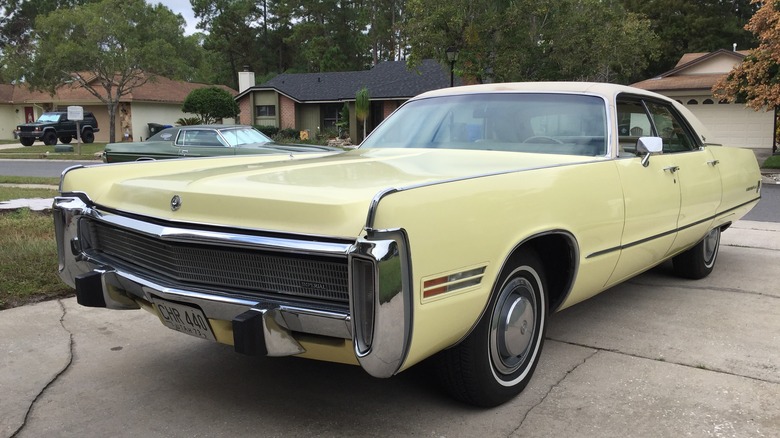
For many, the words "Imperial" and "LeBaron" may conjure memories of forgettable K-cars from the 1980s and 1990s. Yet Imperial was once a standalone luxury brand in the Chrysler stable, intended to compete with Cadillac and other high-end marques. For example, check out this 1960 Imperial Crown we found for sale on Facebook Marketplace. However, the Imperial brand wouldn't last.
At 235.3 inches, the 1973 Imperial LeBaron was one of the longest American sedans on the market. This generation of the Imperial brand actually featured two models, the LeBaron and the Crown, both sporting the Chrysler Corporation's signature Fuselage styling that integrated the body of the car with the roof, rather than having the roof set back from the body. It was considered a sleek and modern design idiom for its time, but that time would soon pass. The Imperial Crown bowed out after the 1970 model year, leaving just the Imperial LeBaron to carry the torch.
Imperial, as a brand, just never quite caught the attention of that era's equivalent of influencers. You wouldn't catch Frank Sinatra arriving at a nightclub in a chauffeured black Imperial. Neither would you have seen Elvis in a pink Imperial convertible. Imperial went the way of other half-forgotten luxury brands like Packard and Duesenberg, leaving its legacy in the age of land yachts.
1969-1972 Mercury Marquis
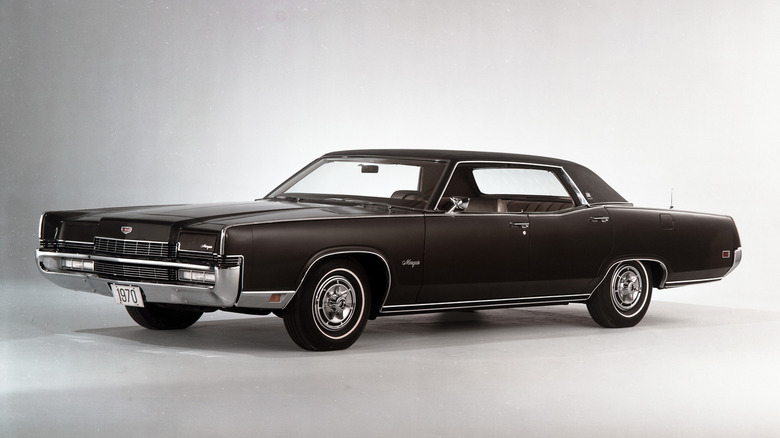
The Mercury Marquis offered full-size luxury without stepping up to a Lincoln. It certainly wasn't short on style, with knife-edge fenders, a crested hood, hidden headlights, and a muscular beltline that curved upwards at the rear windows. The showy, optionally leather-clad interior offered tons of room, thanks to a 124-inch wheelbase. It stretched out to a full 225 inches in total length. In size and appearance, it was the embodiment of the land yacht.
Up through 1971, the Marquis' 429-cubic-inch V8 pumped out 320 gross horsepower. That would drop to 208 hp for 1972 as the Feds mandated lower compression ratios, although a 460 V8 was now optional. The Marquis came very well equipped; a 1971 Mercury brochure boasts of standard features in the Marquis Brougham that included deluxe sound insulation, a Select-Shift automatic transmission, as well as power windows, steering, and disc brakes. It also touts the car's Twin Comfort Lounge Seats, with an optional reclining front passenger seat "for resting on long trips." Wink, wink.
Mercury also bragged that 50 blindfolded professional chauffeurs preferred the Marquis over a Mercedes stretch limousine — Hat tip to Mac's Motor City Garage. We'll let you ponder the "blindfolded" part for a few moments before spoiling the fun by telling you they rode in the back seat, not the driver's seat — although the latter would have made for a very lively comparison test. Still, it's a safe bet that the drivers enjoyed being pampered in the back of a luxury car, for a change.
1971-1975 Pontiac Grand Ville
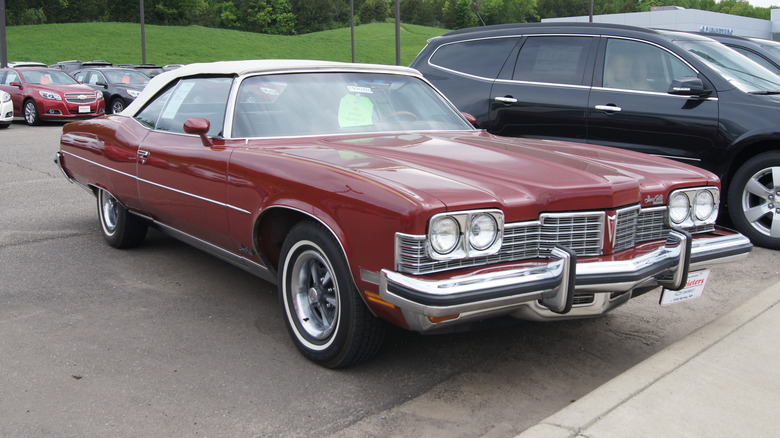
A classic Pontiac ad from the '80s declared, "We build excitement." Well, Pontiac may build excitement no more, but in its day, the late, lamented brand was well-known for producing performance cars like the 1964 GTO, the 1989 20th Anniversary Trans Am, or the 2008 to 2009 G8. With this high-performance heritage, it may be a surprise to learn that Pontiac produced a perfect example of the land yacht genre — the 1971 to 1975 Grand Ville. This model replaced the Bonneville as Pontiac's flagship for its brief five-year run before fading into obscurity.
The 1971 Grand Ville's 455-cubic-inch V8 produced 325 gross horsepower, which was enough to push this 224-inch, 4,278-pound car from 0-60 in about 10 seconds, using pre-emissions control compression ratios and regular leaded gas. By 1973, power was down to 215 hp, or 250 hp with dual exhausts. However, the 1973 model did benefit from an interior makeover that made it one of the best in its class. Luxurious velour and power everything were available.
For 1975, the word Brougham was appended to the Grand Ville's name, thus cementing its place in the land yacht pantheon. However, in 1976, the Bonneville became the top-of-the-line Pontiac again, and the Grand Ville name faded into history, never to be used by Pontiac again.
1971-1976 Chevrolet Caprice
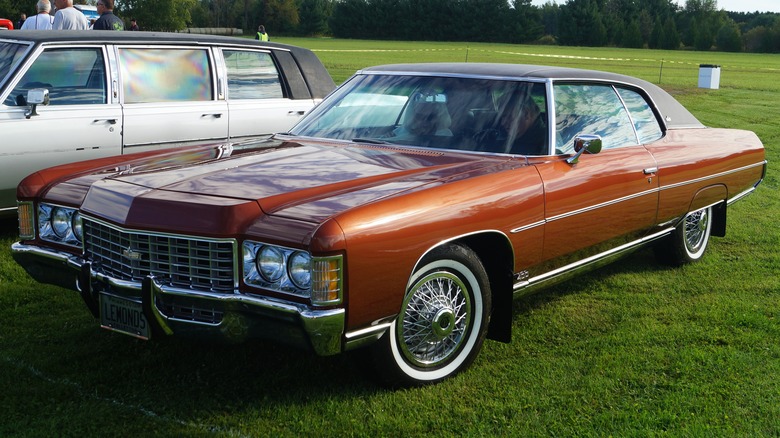
The 1971 Chevy Caprice resembled a Cadillac, which was no accident on the part of Chevy's designers. Of course, Chevy had been trying to echo Cadillac's style at a lower price since at least the 1950s. Thanks to the collection of vintage Motor Trend magazines at CurbsideClassic.com, we can see that by 1971, the base price of the Cadillac Sedan DeVille had grown to $6,533, while the Chevy Caprice held the line at just $3,740. This led Motor Trend to question whether the huge price difference was justified.
The Cadillac came with more standard equipment, although the Caprice could be gussied up with options like power everything, air conditioning (a $416 option), a positraction axle ($46), and a heavy-duty suspension (just $17.95). However, its best option was probably a big, stonking, 454-cubic-inch V8, for an extra $215.95. Fully loading the Caprice could bring its sticker over five grand, but this price was still well short of the base Cadillac.
Motor Trend's spec sheet shows that the Caprice, at 216.8 inches, was a full nine 9 inches shorter than the Sedan DeVille, and its wheelbase was shorter at 121.5 inches compared to the Caddy's 130 inches. Yet those dimensions still place the Caprice well within land yacht territory. Plus, the slightly smaller size and lighter weight helped the Caprice run from 0-60 in 8.2 seconds, compared to 10.1 seconds for its bigger cousin.
1971-1976 Buick Electra 225
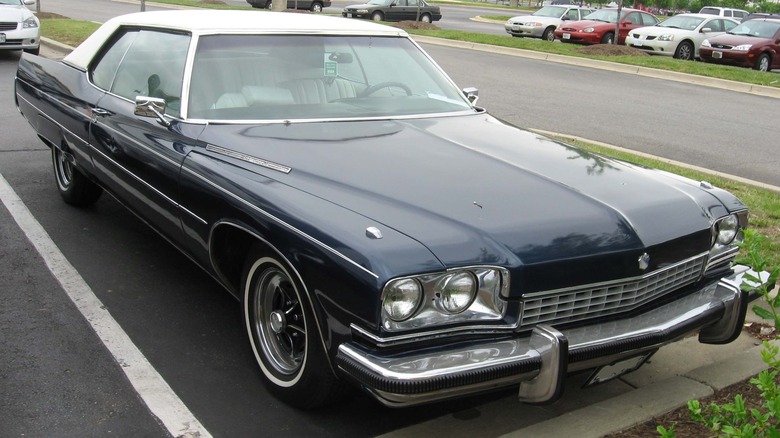
Riding a 127-inch wheelbase and stretching to 233.3 inches in total length, the Buick Electra 225 pulled its weight in the land yacht category. It was also pretty snazzy-looking for a big car. Today, Electra may become the name of a Buick EV sub-brand in China, while Buicks have long been seen as examples of a stereotypical old person's new car here in the States. Still, there was a time when the movers and shakers of the Leisure Suit Era were proud to be seen in a Buick.
GM's divisions all redesigned their full-size cars for 1971, making them longer, wider, and heavier than ever before. They featured tons of glass, and their hoods were measured in hectares. The Electra was bigger than it had ever been before, and much larger than any Buick of recent decades. Interiors featured materials like tufted leather, and Buick's designers weren't constrained by any perceived need to look restrained and tasteful, the passenger cabins were gloriously '70s.
Under the hood, the Electra featured a standard 325-hp, 455-cubic-inch V8 engine, although by 1976, thanks to Malaise-era emissions controls, it generated only 205 net horsepower. At least the Electra's Turbo-Hydramatic 400 transmission guaranteed smooth shifts while slowly powering up to freeway speeds. As an interesting historical note, mid-'70s Electras were available with GM's first-generation airbag system.
1971-1976 Oldsmobile Ninety-Eight
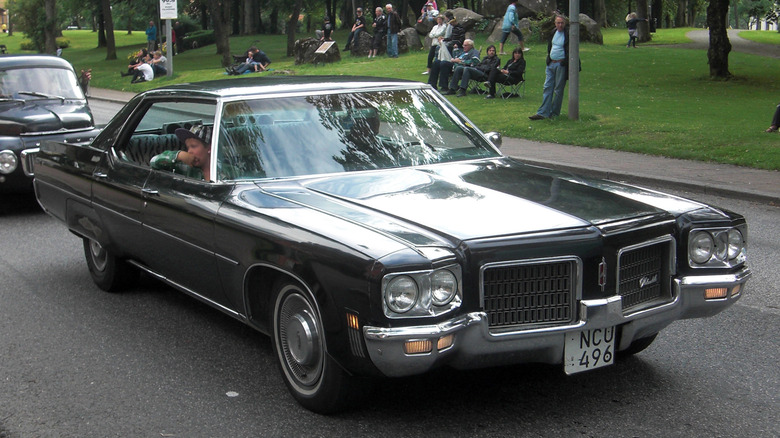
Oldsmobile's flagship, the Ninety-Eight, reached epic land yacht glory, from its 232.4-inch length to its anachronistic tailfins to the fender skirts covering its rear wheels. A car this glorious truly deserved to have its name spelled out with eleven letters instead of two digits — the appellation 98 just wouldn't have fit. Oldsmobile was particularly fond of calling its cars Brougham right up through the 1990s, but the early-to-mid '70s edition of the Ninety-Eight was practically born to wear this B-word.
By the way, in case you were wondering what the word Brougham means on cars, it generally refers to luxury or near-luxury cars dressed up with features like vinyl roofs, opera windows, and extra-plush interiors. These features do nothing to make a car go faster or handle better, but they can elevate a car to the highest reaches of land yacht-hood. The Ninety-Eight was almost the epitome of the genre, until it finally yielded to the sleek and modern Oldsmobile Aurora in the mid-'90s.
Heck, there was even a Tiffany Edition of the Ninety-Eight. Underneath its Tiffany Gold exterior was Oldsmobile's 455-cubic-inch Rocket V8, which produced 250 hp and a decent 370 pound-feet of torque, which was enough to move this nearly 4,700-pound car from 0 to 60 in about 9.5 seconds. Also noteworthy — the Tiffany Edition was produced to celebrate Oldsmobile's 75th anniversary — in 1972! It's a shame Oldsmobile is no longer around. Of course, this writer would think so: my first car was a 1982 Olds Cutlass Supreme — a Brougham edition, of course.
1972-1976 Ford Thunderbird
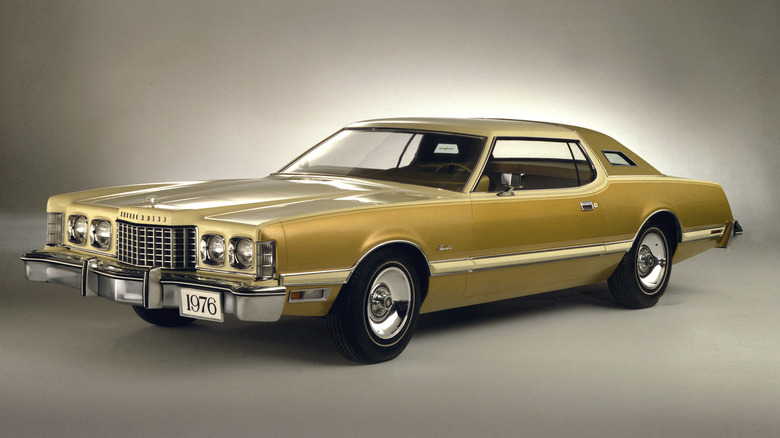
Peak Thunderbird was achieved with the sixth generation, which was a more affordable clone of the Lincoln Continental Mark IV. The Thunderbird has been many things over the years, and it's definitely one of the best cars named after a bird. Still, for pure spacious, floaty, land yacht luxury, the 1972-1976 T-bird wins the prize. By 1976, it had stretched to a whopping 225.7 inches in length and weighed in at nearly 5,000 pounds. It almost defines the term land yacht.
To move all that steel and chrome, a 212-hp, 429-cubic-inch V8 served as the base engine, with a 224-hp, 460-cubic-inch V8 being optional, and standard beginning in 1974. In the cabin, buyers would find the full range of luxury features, including power everything, plush seating, and advanced climate controls for the era. In 1973, opera windows were added in a callback to the earlier Thunderbirds.
Rising gas prices and more restrictive federal regulations slowly strangled the market for enormous, gas-guzzling luxury coupes, and in 1977, a redesigned Thunderbird debuted that was 10 inches shorter and hundreds of pounds lighter.
1974-1978 Chrysler New Yorker and New Yorker Brougham
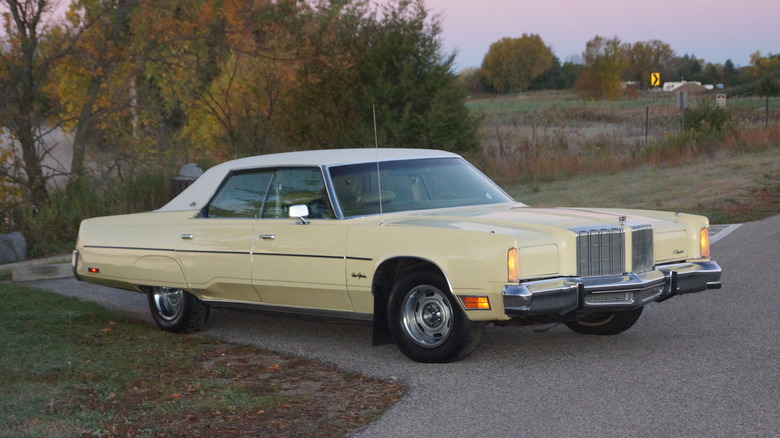
The Chrysler New Yorker grew to legendary size in total defiance of the downsizing trend in 1974, leading to one last hurrah for truly full-size Chryslers. The oil shock that occurred just as this generation of New Yorker was introduced, combined with inflation and other economic ills, meant these land yachts were sailing into headwinds from day one. The new model would sell only half as many units as its predecessor from 1973.
Yet at 231 inches in length, with an interior that was plush to the point of being pillowy, the New Yorker could stand proud as a representative of the land yacht genre, especially in its top-of-the-line Brougham version. The Brougham was available in two-door and four-door hardtop models, giving them an elegant appearance, albeit one that looked dated by 1978.
With a padded dashboard, wood door panels, power everything, air conditioning, and available modern amenities like 8-track players, the passenger cabin stayed up-to-date even as the exterior had a whiff of the 1960s about it. After the Chrysler Corporation discontinued the Imperial brand, some of Imperial's styling cues got shifted over to the New Yorker lineup, including a waterfall grille and hidden headlights. It may not have been modern, but the New Yorker was definitely a worthy flagship.
1975-1977 Plymouth Gran Fury
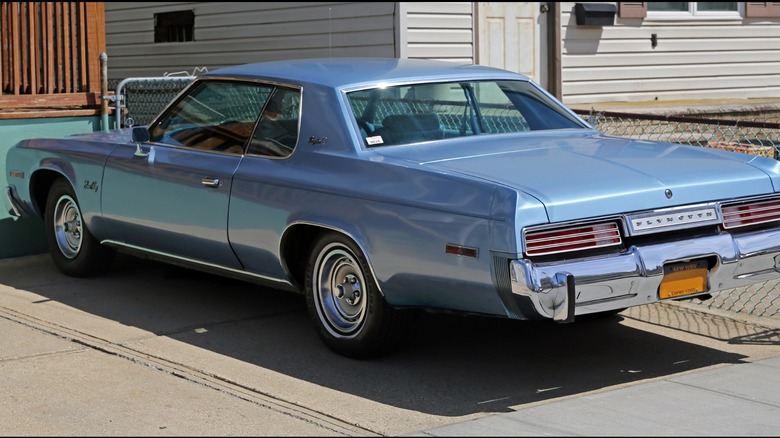
Given Plymouth's role as Chrysler's affordable, entry-level brand, the Gran Fury was a land yacht for those on a budget. Like the New Yorker, it ran smack into the twin hurricanes of rising oil prices and inflation in general. Originally introduced as the 1974 Fury, the car was renamed the Gran Fury for 1975 while the plain-vanilla Fury name was moved downmarket to grace a midsize car. For its last four model years, the Gran Fury would be the last of the giant Plymouths.
The Gran Fury's styling was sedate for a land yacht, both on the inside and the exterior. For instance, its headlights were each a single, 7-inch sealed beam on either side of a relatively modest grille. The Gran Fury didn't wear so much chrome that it would dazzle you in bright sunlight. The interior bench seats were sensible, rather than billowing with velour padding or tufted leather.
Yet its 121.5-inch wheelbase put it squarely in land yacht territory. A range of V8s was topped by a 440-cubic-inch monster that got 10 mpg in the city, but that was no problem: the Gran Fury sported a 26.5-gallon gas tank. So if you could afford the gas, perhaps after saving money by buying a Plymouth instead of a Chrysler, then your Gran Fury could get you where you needed to go in nice, floaty comfort.
1977-1979 Lincoln Continental Mark V
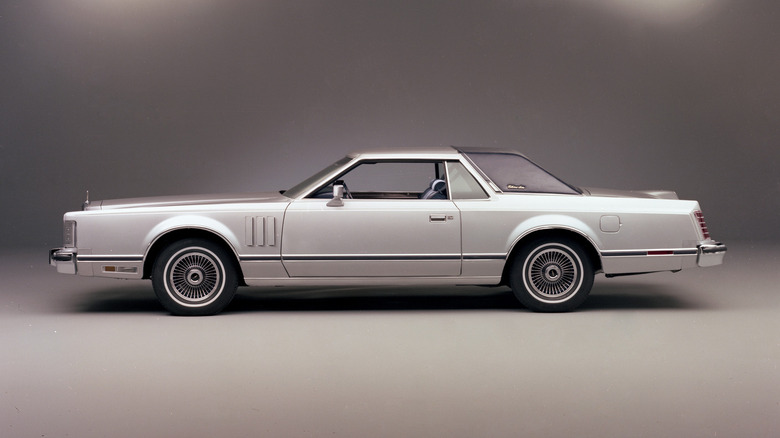
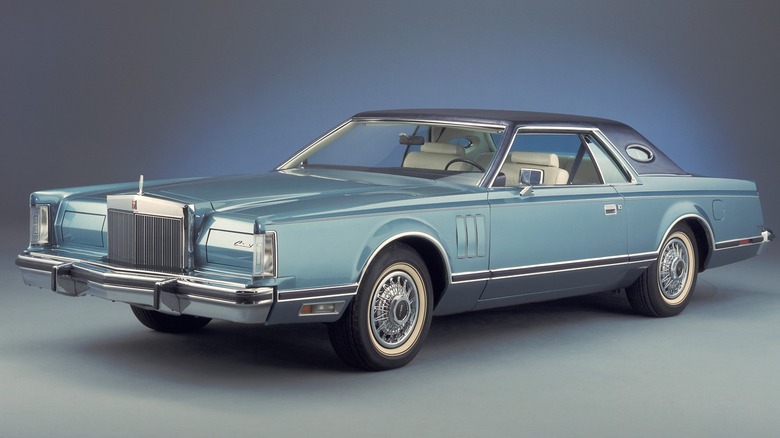
Lincoln's Continental epitomized full-size luxury coupes for decades, but the Continental Mark V was arguably the last hurrah of the Age of Land Yachts. The side profile of the Mark V seems almost comically elongated, with a crazy-long front overhang. In some model years, an oval opera window in the C-pillar seems at odds with the straight lines and sharp angles of the rest of the car. Indeed, the front end has so many sharp protuberances that it seems like it should have a warning sign; check out the top photo of this 1979 Lincoln Mark V that we found for sale on Craigslist.
This over-the-top styling makes the Mark V a worthy standard-bearer for its class, proudly waving its stylistic freak flag in defiance of the era's trend toward much smaller, plainer, boxier cars. However, the price of gas being what it was, this gigantic car was designed to be distinctly underpowered with its standard, 179-hp, 400-cubic-inch V8, requiring about 12 seconds to get from 0 to 60 mph. The optional 208-hp, 460-cubic-inch V8 only improved matters slightly.
Still, one doesn't buy a car like this to carve up twisty canyons and mountain switchbacks, so a leisurely roll up to highway speed was probably acceptable to most Mark V drivers. Isolation from the world around you is the raison d'être of a car like this, and this Continental achieved this purpose gloriously. When it was discontinued in favor of the smaller Mark VI, it was the end of an era.