

Do Automatic High Beam Systems Recognize When It's Foggy?
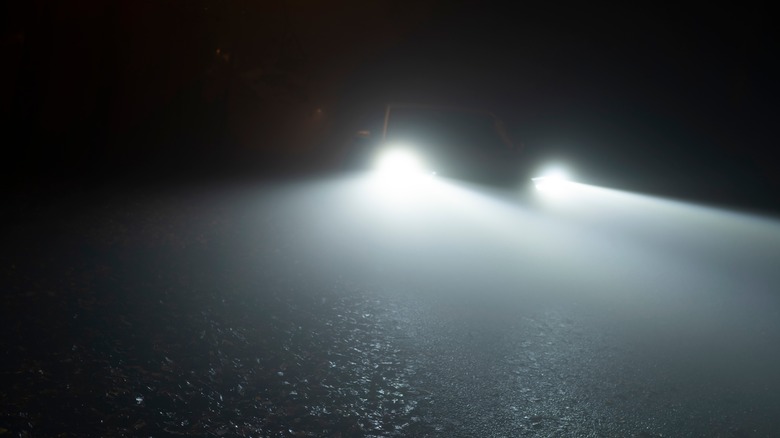
We treat our cars like people, but they aren't. You might have given your car a name, like "Vivienne the Rivian," "The Angry Banana," "Pam", or, like my dad's old Aegean blue BMW 328i, "Frau Blue Car" (yes, it's a "Young Frankenstein" reference). But they have no feelings and certainly no intelligence. It would be handy if cars were smart because then they could, like humans, recognize weather such as fog reliably to switch the high beams on and off at the right times. And "reliably" is the crux of the matter. The question is not just "Can these systems tell when it's foggy," which they sort of can, but "How will they react when it's foggy?"
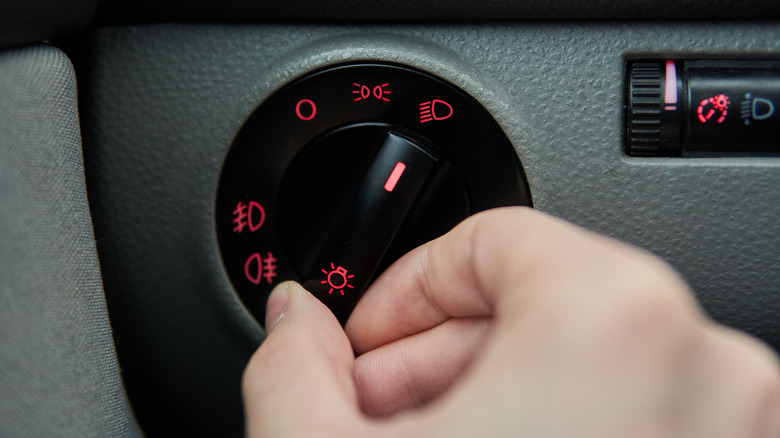
The problem is that the vast majority of automatic headlights are reacting to light, not specific conditions, which is why most safety advice is to use manual headlight settings in fog. If your car has automatic headlights, there's a photoelectric cell or photoresistor mounted on the dashboard (or a camera, we'll get into it) that senses brightness and feeds information to the car's electronic control unit. Once the light hits a certain threshold, the lights go on or off.
Fog can be confusing for sensors because the reflection from the particles looks for all the world like light. Since your car doesn't have your eyes, nor does it understand how blinding high beams are in fog, it's best to just turn on your low beams and fog lights (assuming your car has fog lights and you actually feel they help; not everyone does). Thankfully, automatic high beams are but one setting for your headlights, at least until the AI overlords don't let us control them anymore. When you shut the lights off or use the manual setting, they'll obey.
Let there be light (if the system feels like it)
Watch Hyundai's "How High Beam Assist Works" video on YouTube, but fight the urge to nap from the soothing, evenly paced voice-over. If you fell asleep, here's the relevant portion: "High Beam Assist does have limitations on operation, such as when road conditions cause reflectivity issues or lights from a vehicle ahead are not detected due to smoke, fog, or snow." So, there you go, your car can recognize when it's foggy, but the result is mostly confusion.
In the owner's manual for the 2021 Pilot, Honda says that poor visibility because of weather (rain, snow, fog, windshield frost, etc.) can prevent the high-beam system from switching off properly or the timing might be changed. It also says that the system might have problems because the "brightness of the lights from the preceding or oncoming vehicle is intense or poor," which sounds like it operates in a goofily razor-thin Goldilocks zone, but let's focus on that timing aspect for a second.
The lights aren't directly connected to the sensor because then they would constantly turn on and off with every lighting change. Go under an overpass, pass some shady trees, or drive next to a large truck and your lights could be flashing constantly. So manufacturers program a delay to make sure the lights don't become impromptu strobes. High beams are annoying enough to oncoming traffic, so there's no need to make them act erratically and tick people off. If you read different owner's manuals, you'll see that each company's "intelligent" headlight systems has its own quirks and "if, then" settings that affect whether the high beams stay on.
How different cars handle fog blindness
Adaptive headlights may help reduce the face-melting high beams we sometimes see at night, but fog can make some systems choose to continue welding with light. The manual for Chevrolet's "IntelliBeam" system states that if there's too much fog, the high beams may actually stay on. The same can happen in your Volkswagen Golf, though its system does let users change the light sensitivity with the turn signal stalk. Meanwhile, Ford's Automatic High Beam Control will, according to its manual, switch the high beams off if it detects snow or fog, which honestly sounds like safer programming.
The Ford manual also says it will turn off the high beams if the camera is blocked. Hey, 21st-century tech here, Ford uses cameras to detect fog! And so do Nissan, Honda, Toyota, BMW, Dodge, Mercedes, and Tesla. These cameras are located just above the rearview mirror at the top of the windshield rather than on the dashboard. Meanwhile, Subaru still uses sensors, so the decision between "camera" or "sensor" is up to each automaker's whims.
The likely reason some cars use cameras instead of light sensors is efficiency. Cameras are useful for pre-collision systems, adaptive cruise control, and traffic-sign detection, so why not tie in the high beams, too? Judging by the number of automakers integrating high-beam operation into the car's overall safety system via camera, it seems the traditional method of a single sensor is going the way of the dinosaur.