

The U.S. States With The Strictest Underglow Light Laws
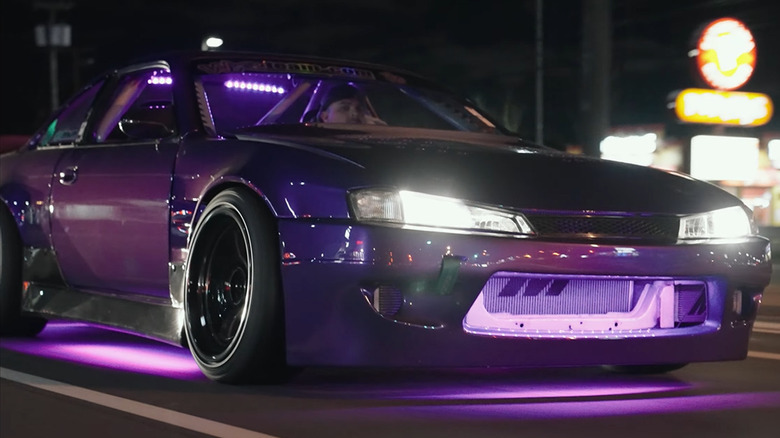
A neon glow emanating from beneath one of the best Mitsubishi Eclipses can make every drive feel like a midnight street race. It looks and feels badass. But while gearheads and enthusiasts may celebrate your style, the real world cops are less forgiving.
Underglow lights are basically decorative neon or LED tubes or strips mounted underneath a car, casting colorful halos on the pavement. Back in the '90s, the old-school kits used fragile glass neon tubes, which looked amazing but shattered easily. Today, slim LED strips do the heavy lifting. These lights are brighter and more durable and offer a rainbow of programmable color options.
Certain hues, though, have always been a problem. Blue and red are off-limits almost everywhere, because they're reserved for emergency vehicles. Green often falls into the same bucket. You don't want a slammed Integra pretending to be a fire truck or the cops.
The origins of underglow lights date back to the early days of import tuner car culture, when it was a way to make cars look futuristic under city lights. By the time "The Fast and the Furious" and "Need for Speed" hit, underglow lights exploded into mainstream car culture. Suddenly, every Pep Boys parking lot had a few Civics glowing purple. It was style, rebellion, and a little bit of theater all in one. The problem is, while the glow looked good in motion, state legislatures weren't impressed.
Many U.S. states prohibit the use of underglow lights. States like Massachusetts, Illinois, and Washington all have laws making these mods illegal, and you could receive a fine for breaking the rules. Other states allow underglow lights to an extent. Here's what you need to know.
The patchwork of state laws
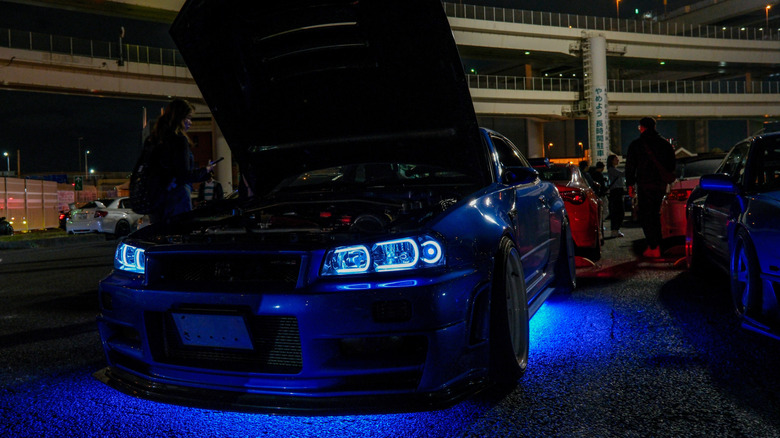
Here's the catch: The legality of underglow lights in the U.S. depends entirely on where you live –- or where you drive. For example, underglow is technically legal in California, but you can't use red on the front of the car, blue anywhere, or anything that flashes — that means your rainbow LED controller suddenly has fewer usable settings. Arkansas, Idaho, and Montana, also allow underglow lights. As long as you don't use red, blue, green, or flashing lights, you shouldn't have issues in these states.
Illinois is stricter and prohibits any additional lighting other than the default, stock lights. The same applies to Maine, Washington, Massachusetts and Virginia. Other states, like Pennsylvania, Michigan, Minnesota and Connecticut, are also members of the anti-glow revolution. Some of these states allow drivers to use underglow lights on private property while the vehicle is parked, but you should check the local laws in your area before trying it yourself.
Texas and Arizona have no laws that prohibit the use of underglow lights. They allow underglow, but only if you stick to non-restricted colors, like amber or white, and avoid any pulsing or flashing patterns. These states' laws barely touch the issue, leaving enthusiasts free to glow in peace, so long as they're not distracting other drivers. New York, on the other hand, only allows drivers to install white-colored underglow lights — the state prohibits the use of any other color when it comes to aftermarket lighting.
The glow vs. the law
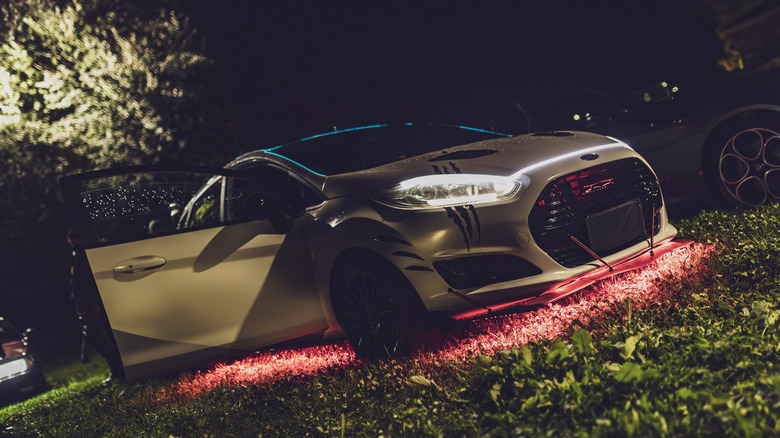
The inconsistency of underglow laws from state to state is where things get messy. You could cruise legally through Montana with a yellow halo under your Charger — but if you cross into Washington, you could earn a ticket. That patchwork of rules makes underglow one of those mods that looks simple in your driveway but becomes a legal gamble once you hit the interstate.
So, what happens if you get caught breaking the rules? Fines and penalties very from state to state. For example, if you're caught using red or blue lights in Massachusetts, you may have to pay a fine of $100 to $300. Many underglow citations are considered non-moving violations, and the officer may order you to remove the lights.
That said, the appeal of underglow hasn't gone away. Car culture thrives on style, individuality, and, sometimes, a little excess. At car meets, the glow draws eyes. During a night cruise, it transforms a basic sedan into a rolling spectacle. Fans see it as artistic expression. Haters see it as tacky — similar to those crappy sounding exhaust systems.
The real question is whether the juice is worth the squeeze. For daily drivers, it's probably not worth it. For enthusiasts who want that street-race vibe, underglow could be a great mod. Underglow lives on because car culture has always been about bending the rules. Just remember that, depending on where you live, using underglow may be one of those driving habits that seem legal but could get you pulled over.