

The Meaning Behind Lamborghini's SV Badge
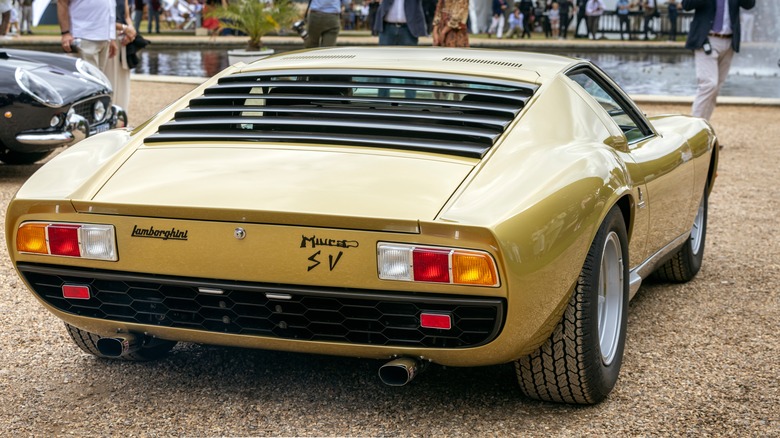
Pablo Neruda said, "Laughter is the language of the soul." This is baloney, as the true language of the soul is the 12-cylinder fury emanating from a Lamborghini Miura P400 at full tilt. The lucky few who have had the privilege to pilot a P400 to its limits are benevolent saints, for they share with us the glory of its V12 scream. Even the selfish who wall up Miuras to treat them as furniture in a living room can be forgiven, for who among us can judge someone for wanting to ogle a Miura when sipping a morning cappuccino.
But even among the lucky, there are degrees of fortune. A "standard" 350-hp Miura is desirable enough, and a 370-hp Miura S is more desirable still. Then there's the pinnacle, the zenith, the Mount Everest of Lamborghini's breakthrough mid-engined masterpiece: The 385-hp Miura SV. Those two letters, "SV", have come to signify a version of one of Lamborghini's cars pushed beyond its original scope. It's more powerful and more athletic than its non-SV brethren. Exact production numbers are hard to pin down, but it's generally accepted that just 150 Miura SVs were produced.
Then there's the question of what "SV" stands for. You've probably most often heard that it's shorthand for Super Veloce, or "super fast." Perhaps Ferruccio and the team were inspired by Ferrari's 500 Superfast, but decided to keep everything Italian?
Well, later Lambos certainly were Super Veloces, or actually SuperVeloces, but on Miuras, SV doesn't stand for that. Rather, it stands for Spinto Veloce, or "pushed fast". And here's where the history of SV can get a little confusing. While "SV" features on many of Lamborghini's special models, it doesn't always initialize the same words.
An SV can really sing
When considering the suffix on the voluptuous Miura SV, remember that direct translations generally don't do justice to the original language's meaning. Spinto is more than a vehicle "pushed" closer to its ideal, and the word carries more connotation than the car being "tuned," a translation of "spinto" you won't find in any dictionary, but is oft-repeated when discussing the apex Miura. Rather, "spinto" indicates a compulsion from an inner place, as the Cambridge Dictionary's demonstration sentence indicates: "Si sentì spinto a perdonarlo," or "He felt compelled to forgive him." In more colloquial, figurative use, "spinto" translates to meaning racy or risqué.
However, the reason Lamborghini chose "spinto" (prounounced SPEEN-toe) may have been for its musical association. In opera, a form of theater somewhat popular in Italy, a spinto soprano or spinto tenor is a voice that can force itself over a large orchestra with little effort. It's heavier than the lyric soprano/tenor, yet lighter than the dramatic soprano/tenor. In Lamborghini terms, an SV can push past lesser vehicles but isn't so bold and intense as an all-out race car.
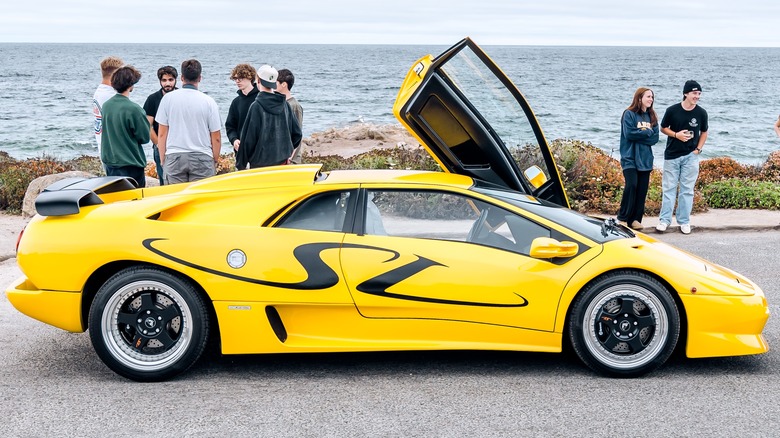
While the Countach never got an "SV" version, the Diablo certainly did. The first Diablo SV appeared at the 1995 Geneva Motor Show, and represents a rare good decision by Lamborghini's then-owner, MegaTech. Horsepower was up to 510 from its original 492, and it also received larger front brakes, more ducts to cool those brakes, and an adjustable rear wing. Also, it had apparently been lightened slightly, as the OG Diablo weighed 3,620 pounds and the SV weighed 3,534 pounds. This time, SV stood for Sport Veloce. Thankfully, "sport" in Italian is the same as it is in English, so it's simply translated to "sport fast."
The SV is certainly is super, and the J is no joke
The Murciélago was one heck of an introduction for Lambo's Audi/Volkswagen Group era. This time, the SV had no time for spaces, with SV standing for SuperVeloce. The original Murciélago made do with 571 hp, and the subsequent LP 640 jumped to 632 hp, but the top dog SV required more. So the final iteration of Giotto Bizzarini's original V12 was genetically modified into a beast delivering 661 roided-up horses in 2009's Murciélago LP 670-4 SuperVeloce.
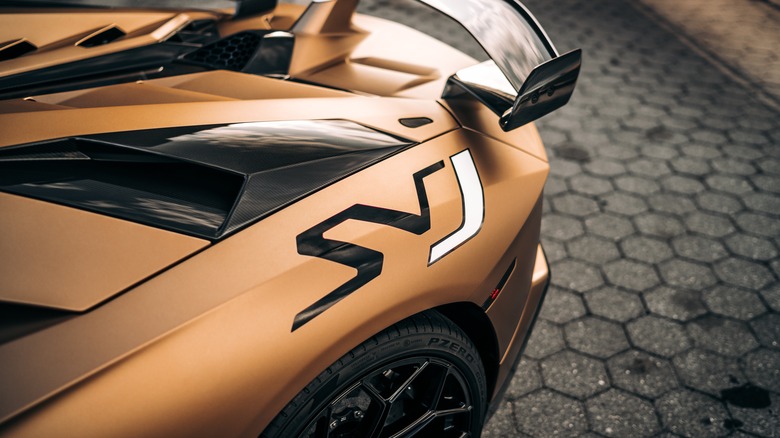
Excess is never enough, however, so naturally the successor had to make previous SVs look like Fiat Topolinos in comparison. For 2016, Lamborghini released its 740-hp Aventador LP 750-4 SuperVeloce, a more extreme version of the extreme 691-hp Aventador LP 700-4. By this point, 0-60 mph times had fallen well below three seconds, but why stop improving? The Aventador became cartoonishly consummate with the release of the 759-hp SVJ, this time so fast that the designers didn't even have time to slap "LP" and a number onto the name. This was rectified for the 769-hp Aventador LP 780-4 Ultimae.
As for the "J" in SVJ, that stands for Jota (pronounced HO-tuh). It comes from Lamborghini's test driver, Bob Wallace, who wanted the most intense Miura possible. So he turned to Appendix J of the international auto-racing rules and nabbed that letter to make his "J-car," a serious racing version of the Miura that, well, never raced. At least the world got the stupendous Miura P400 SV.
By the way, the "P" in P400 stands for the Italian word for "rear": posteriore. Maybe "spinto" was supposed to mean "risqué" after all.