

Why Don't Most Gas Stations Have The Extra Long Hoses Like Costco?
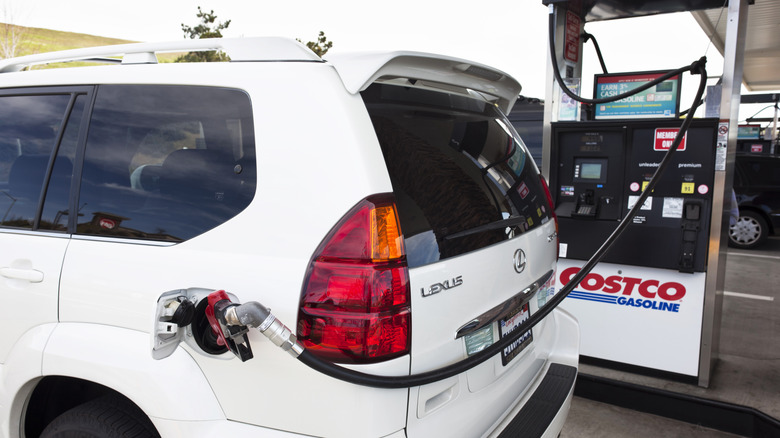
Read online comments about Costco's extra-long hoses, and you'll find two primary sentiments. The first, in wondering why such hoses aren't more prevalent, comes on Reddit's r/explainlikeimfive: "I'm sure we've come far enough as a society to where pumping a liquid a few extra feet isn't an impossible task." The second, on r/lifehacks, is, "Pull up to the pump with your tank on the correct side so you don't have to do this and look like an idiot." Such critics can make great points, even if they're buried under eye rolling and "ppphhhtttt" noises, so let's address the anaconda-length gas hose in the room.
Costco didn't accidentally order a bunch of double-length gas hoses and decide to just roll with it. By using pumps that allow customers to fill their cars from either side, Costco can channel them into the lanes like metal cattle. The traffic only flows one way, so there's no sitting and waiting as someone backs up and pulls in for the fifth time to align the filler door. It's fast and efficient, and if you pulled in with your gas cap on the far side, no worries. Plus, it encourages people to not stay parked at the pump and head into the store for snacks.
As for why giraffe-neck-length hoses are so rare, it's hard to get specific reasons because no gas station boasts about its short hoses. Most likely either lack the amount of vehicle traffic for it to matter or have enough pumps that it doesn't come up. Buc-ee's brags about having a station on I-40 in Tennessee with 120 pumps, not a station with the longest hoses. Also, regulations can make extra reach a liability.
Red tape is sometimes kind of helpful
Let's say you pull up to one of those gas stations that's little more than a shed with two pumps on a plot of land the size of an average driveway. Well, those pumps may be as close to the front door as legally possible. International Fire Code Section 2203.1 states that "the nozzle, when the hose is fully extended, will not reach within 5 feet (1524mm) of building openings." Also, Section 2306.7.5 says that "Dispenser hoses shall be not more than 18 feet (5486 mm) in length unless otherwise approved." Imagine if someone could just stretch the hose into the station's front door and let the clerk know what he really thinks of the store's candy selection by spritzing some 87 octane on the register. Limiting hose length seems reasonable.
Remember also, Costco didn't just make its pumps bidirectional-filling-friendly to make customers' lives better, the company did it to sell more gas. For Costco, the expense of installing such pumps was financially beneficial, since the stations funnel so many people and get so busy, they often have wait times. Refining the process is continual, and the wait times during peak hours went from as much as 12 minutes in 2022 to as little as six minutes in 2025. Costco is obsessed with efficiency and flow, encouraging you to make your purchase and get moving.
For other stations to begin adopting longer hoses, there would need to be a financial incentive. If people aren't clamoring for such hoses, your average gas station will stick with what works. That's cheaper.
A case for the short hose
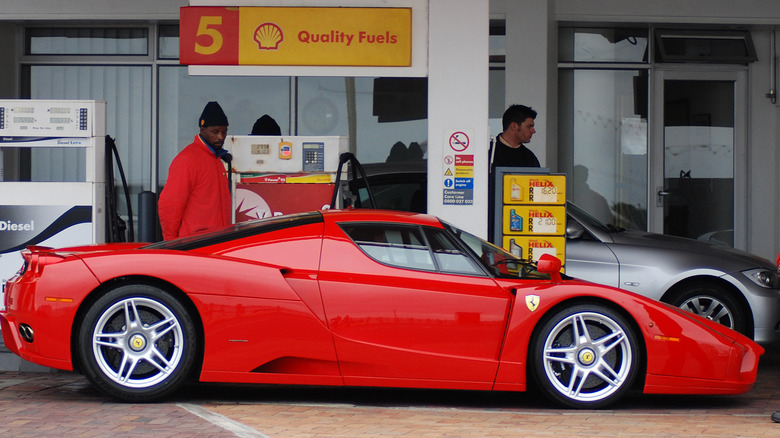
To give the long and winding hoses' detractors their due, stretching the nozzle around a car isn't always desirable. Though the hoses are designed to clear car roofs thanks to a retracting mechanism that also keeps them from resting on the ground, they'll still drape across a taller car, SUV, or van. If you just washed and waxed, you probably won't want a gas station hose sliding over your vehicle's paint. And if you drive an older car with an honest-to-goodness antenna, sweeping that hose willy-nilly (or going through a car wash, or leaning on it wrong) could result in not getting your favorite radio station anymore. Owners of exotics will be even more cautious.
Granted, these reasons mean you simply wouldn't use the longer hose, rather than complain about its existence. You can always plan ahead and pull into the proper lane if you must have the filler on the same side as the pump. Besides, Costco has had such success with its long pump hoses that other big-box membership stores such as BJ's and Sam's Club are using them, too.
But what if the side you pulled in on didn't matter? While modern cars should totally have the filler on the passenger side, a few classics such as the Lamborghini Espada have fuel doors on both sides. Then there are cars that had filler doors in the middle, whether embedded in the bodywork or hidden under the license plate, something that disappeared with the 1996 Chevy Caprice/Impala SS. So if you're looking for a classic that you can fuel up at Costco and not worry about scratching the paint, consider an Espada or an Impala SS.