

When VW Beetle Owners Turned To Swamp Coolers To Survive The Summer
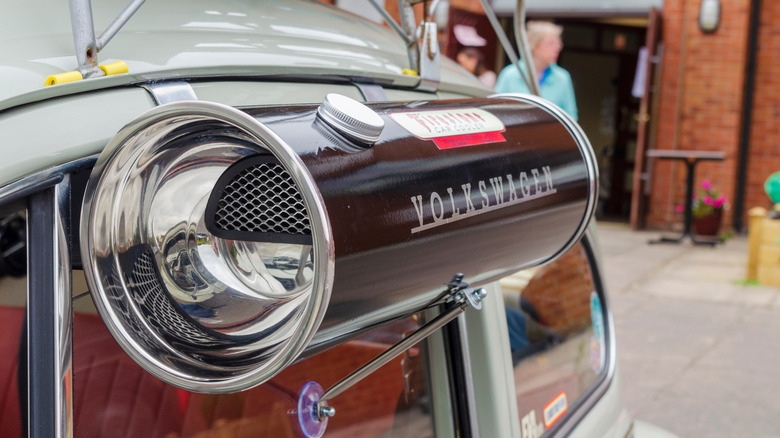
There's never been a car quite like the Volkswagen Beetle. It's the most mass-produced car sold before the Toyota Corolla, with over 21 million made over its 65-year lifespan (even with a pause in production during World War II). It's still seen on roads in nations around the globe, so it's no shocker that "the people's car" has gone down in history as a worldwide cultural icon.
With a car having such a broad reach, it's unsurprising the Beetle has had lots of unique customizations, from a $1,500 homebuilt hot rod to Baja Bugs and restomodded bougie builds with wheel spats and a dash-mounted coffee maker. But there's one simple addition that's stood out — and stood the test of time.
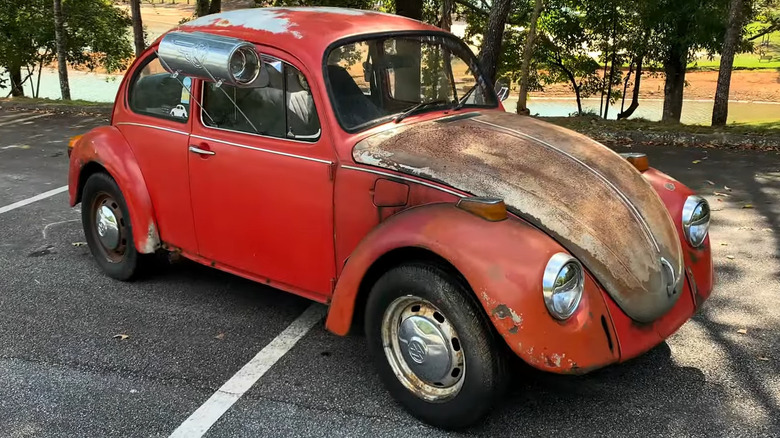
If you've seen Bugs during the summer, there's a solid chance you've seen what might seem like a mailbox strapped to the window. As bizarre as it may look today, it was vital in hot months of yesteryear, helping to keep drivers cool in the cabin. These are swamp coolers, and while they were once a necessity to help Bug owners beat the heat, they've evolved into a part of vintage Volkswagen culture.
Why swamp coolers?
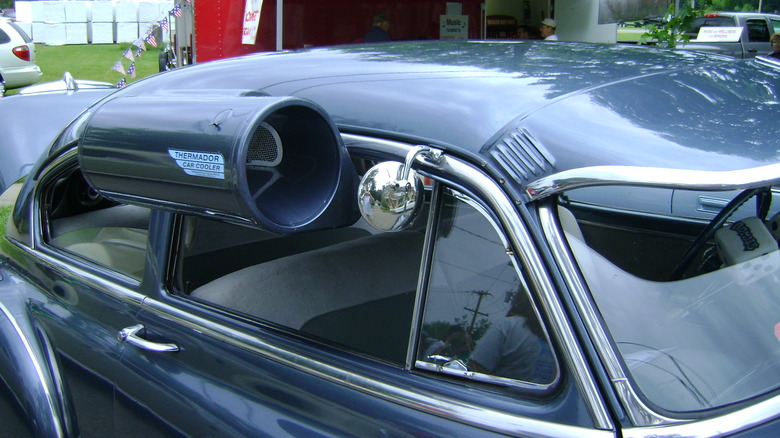
As soon as the open-air cars like the Ford Model T gave way to the closed-cabin models of the '30s and '40s, things started to heat up inside. By 1930, however, Thermador had figured out a solution with its signature "car cooler".
Mounted to the passenger side window, these car coolers relied on what's called evaporative cooling. The technology dates all the way back to ancient Egypt, but was modernized for home cooling in the 20th century. All that's needed for these coolers to work is that their wood fiber or cellulose pads would be dipped in water. As the car drives and air moves through the cooler, water evaporates from the filter and absorbs the heat. As a result, the air is cooled before blowing through the window and into the cabin. Popular Mechanics promised that these cabin coolers could reduce the temperature behind the wheel by up to 15 to 20 degrees.
The main catch was that the cooler air blowing into the cabin is more humid after absorbing the water, which means the stickier the climate, the less effective the unit. Bummer for those in the Deep South, but for those in America's arid deserts, it was a major hit. Another issue came from those who waited a tad too long to change their fiber pads, leading to algae and bacteria growing inside the canister. That smell would earn the accessory the nickname "swamp cooler."
Still swampin' today
By the 1950s, car air conditioning and climate control systems started to hit their stride. Many automakers made the switch to internal, refrigerated systems. While modders and VW dealers would find ways to cram these units into Bugs, it wasn't until the debut of the New Beetle in 1998 that Bugs would come from the factory with air conditioning.
We can list a handful of reasons why VW stayed away from air conditioners for so long. The big one is that air-cooled flat four engine working overtime. Aftermarket AC units could take a big chunk out of the boxer's power, and some owners reported having to switch it off so the car could have enough beans to clear a hill. Not a shocker, considering the Beetle was never a performance vehicle, and it also was far from a luxury car, with keeping costs low a major priority for VW. Part of what made the Bug so iconic was that the car was almost unchanged between 1938 and 2003. Its minimalist approach kept prices down and maintenance simple.
That let swamp coolers stay in service decades beyond what was expected, with Bug owners rocking them deep into the second half of the 20th century. Even today, die-hard Volkswagen fans and fabricators restore vintage models and even build brand-new coolers from scratch. Embraced now as an aesthetic choice as well as a tool, swamp coolers don't just keep drivers feeling cool, but looking cool, too.