

Every Formula 1 Team Runs Brembo Brakes, But Not All Are Alike
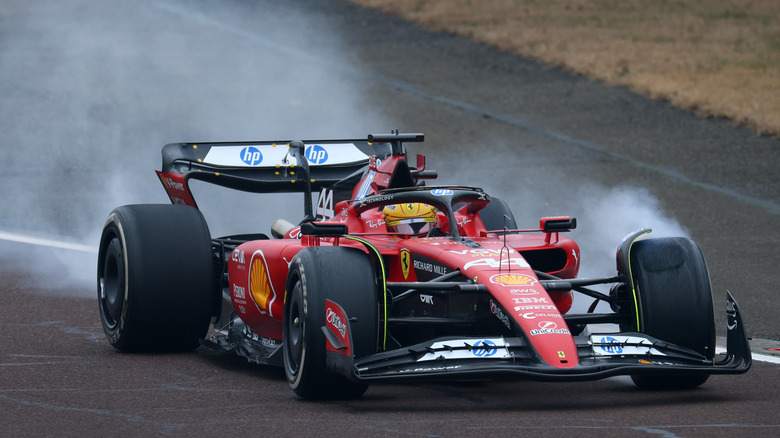
Formula 1 is known for its quirky methods when it comes to aerodynamics and engineering. In that mix, brakes become a vital component for the teams because stopping power is just as important as raw horsepower in Formula 1. No matter how fast the latest Red Bull, Mercedes, or Ferrari goes, it has to slow down just as effectively, often from over 200 mph to a crawl in a second and pulling 5Gs in the process. That's where Brembo comes in. The Italian brake giant has been a fixture in F1 since 1975, and today, all the cars on the grid run Brembo braking technology in one form or another. However, no two teams run exactly the same system.
Each team's brakes are custom-tailored to their setup, their drivers, and the circuits they're racing on a given weekend. That means one team's Brembo setup might look very different from another's, even if they share the same basic DNA. And when you realize how critical brakes are in F1 — they can decide a position change or even influence races that can be won or lost under braking — you start to understand why this behind-the-scenes engineering war matters just as much as engine performance.
The science of carbon-carbon rotors
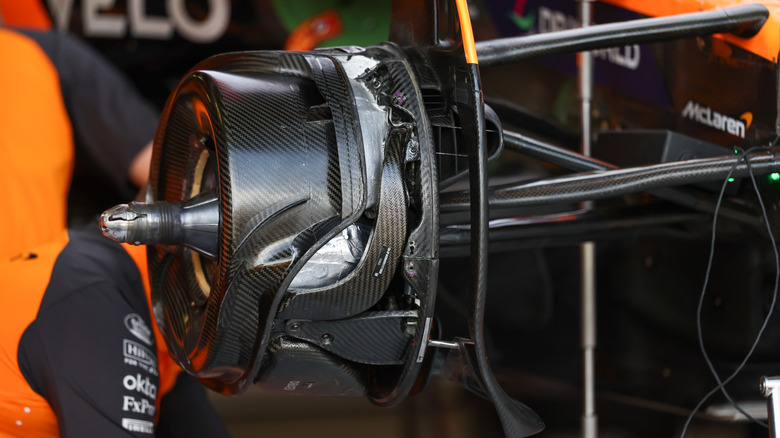
To delve deeper into Brembo's braking tech in F1, we'll have to look at the components that make up the system. At the heart of every F1 brake system are the rotors, and things start to get exotic right about here. Forget the steel or cast iron discs you see on road cars. F1 uses carbon-carbon composite rotors which are ultra-light, heat-resistant discs that can handle temperatures soaring above 1,832 Fahrenheit without warping or fading. This material isn't carbon-ceramic, like you'd find on high-performance cars, where a carbon fiber reinforces a ceramic core while the friction surfaces are also coated with a ceramic layer. It's F1, after all, so the material is even more specialized.
At Brembo, the carbon-carbon discs for F1 is a pure form of carbon that's featherlight, at around 50% lighter than standard materials. At racing temperatures it offers nearly double the grip, with a friction coefficient peaking at 0.6 compared to 0.3 for iron. Making these discs, however, is a painstaking four-month-long process that involves weaving sheets of carbon fiber into layers that are then stitched by a needler machine. The raw carbon disc then goes through multiple carbonization baking cycles at up to 4,532 degrees Fahrenheit. Once hardened, the rotors are precision-drilled to add hundreds of cooling holes.
Performance comes at a price, though. Carbon brakes only bite properly once above 752 degrees Fahrenheit and peak beyond 1,202 degrees Fahrenheit, but at those temperatures, they face aggressive oxidation. This effectively burns away the surface, especially as braking temps spike to 2,192 degrees Fahrenheit. Even the air cooling them paradoxically accelerates that wear by feeding oxygen right into the discs.
Calipers are bespoke engineered for every team
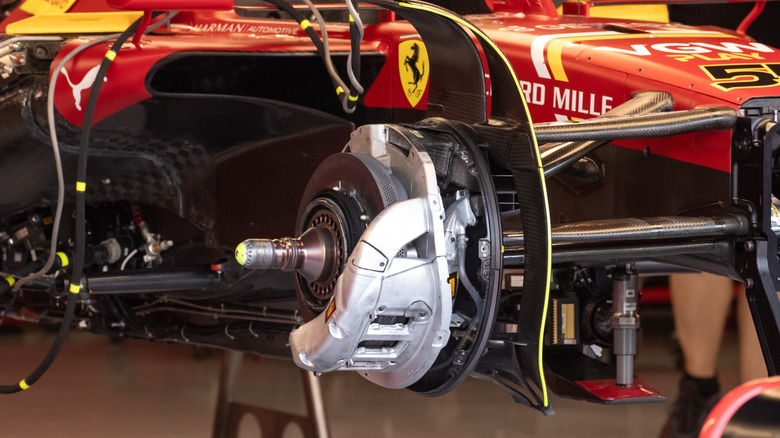
The rotor tech is pretty consistent across the teams. Brembo supplies the brake calipers too, but things diverge here on. The calipers are machined from solid billet aluminum for maximum strength and minimal weight of around five to 6 pounds. While the raw materials and manufacturing techniques are consistent, each team gets a custom solution for the caliper design according to their requirements of stiffness and weight.
Brembo works with the teams individually, since calipers must integrate seamlessly with each chassis and suspension design. Some squads opt for calipers that sacrifice rigidity in favor of weight savings, while others prioritize strength. Even the mounting points vary, which means a caliper designed for one team is useless to another. Regulations cap calipers at six pistons, but not every team uses the maximum everywhere.
The front axle almost always runs six pistons for maximum stopping force, while some teams run just four pistons on the rear to save weight and simplify packaging. Cost-saving rules also limit each team to a single-spec front and rear caliper design per season. That means the same components must handle the heavy braking zones of Monza as well as the stop-start nature of Monaco, forcing teams to optimize their overall balance rather than tailor calipers race by race.
The hidden aero trickery that are brake ducts
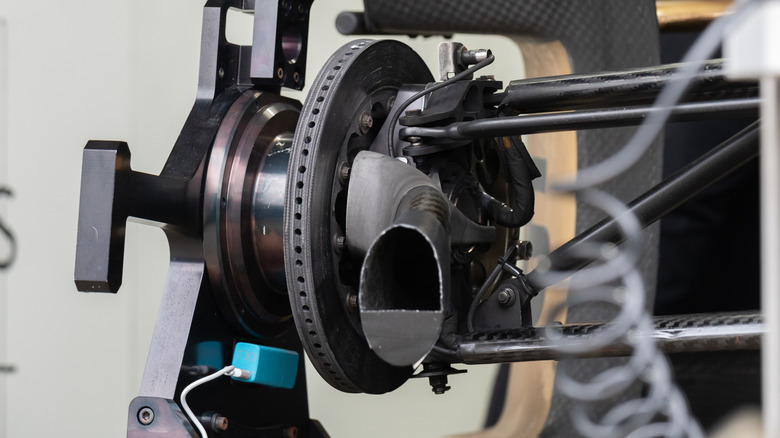
If calipers are the muscle of the braking system, imagine brake ducts as the lungs. They channel cooling air directly onto the discs and calipers, preventing overheating; but in F1, nothing is ever simple. Brake ducts don't just cool the brakes, they're also playing a double-role as a key piece of aerodynamic strategy. Every team designs its own ducts to balance brake cooling with downforce generation, and ultimately affecting tire performance, too. The FIA tightly regulates their size and placement, but within those limits, ducts can double as aerodynamic devices, shaping airflow around the wheels and into the diffuser. A poorly designed brake duct can cause drag and overheating. A well-designed one gives the car stable brakes and a cleaner aero profile.
Brakes work by converting kinetic energy into heat through friction, but they're only happy in a narrow temperature window: too hot and oxidation chews them away, too cold, and they simply don't bite. Cooling management is everything, and teams do it with ducting around the calipers, and directly into the discs and pads. The size of those ducts varies wildly depending on the braking requirements.
Teams run larger air ducts for tracks that need heavy braking, sacrificing around 1.5% aerodynamic efficiency. Brembo has pushed design further with discs drilled with up to 1,000 tiny ventilation holes, modeled via CFD to maximize airflow and thermal discharge without compromising strength. Brake cooling is important enough a subject to warrant, considering drilled and slotted rotors for your regular road car as well.
Brake pad materials are the secret sauce
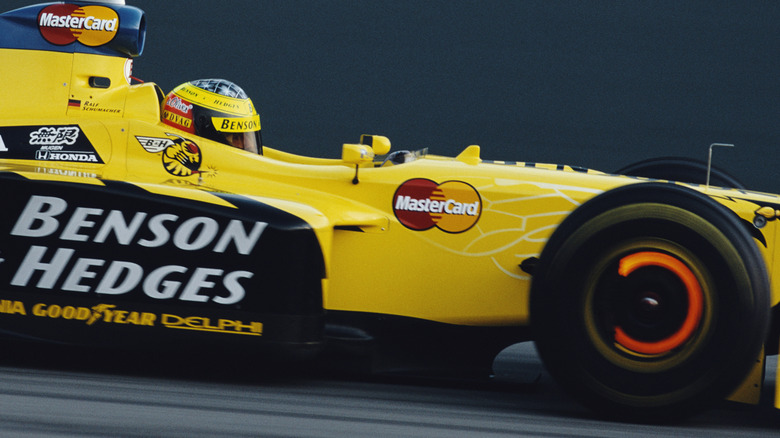
Unlike the ceramic, semi-metallic or organic brake pads you'd find on a road car, F1 pads use a carbon-based friction material called CER, developed to handle the kind of punishment only an F1 race can deliver. We're talking about peak operating temperatures brushing 1,832 degrees Fahrenheit, with the ability to warm up rapidly and reach peak efficiency within moments of use.
That quick warm-up is critical as drivers need immediate confidence in braking from the very first corner, not a lap later. What makes these pads truly special is their ability to combine extreme heat tolerance with low wear and predictable response. That means the brake pedal feels rock-solid from lights out to the checkered flag, giving drivers precise modulation through every braking zone.
Thermal conductivity is another secret weapon, allowing pads to spread and shed heat more effectively while resisting the dreaded fade. However, these pads aren't invincible, as heat-soak during long pit stops can push temps over 2,192 degrees Fahrenheit, sometimes setting brakes alight. And while they're tough, they don't last long, just 550 miles before they're toast. Over a season, Brembo supplies each two-car team with up to 480 pads, proving just how consumable this element of the braking system really is.
The eye-watering cost of F1 brakes
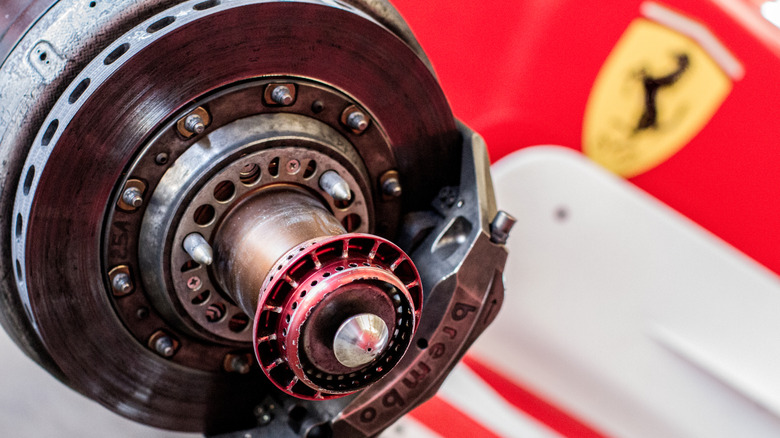
Brembo upgrades for regular cars can be considered exotic, which is also another way to assume that they're expensive; and they are. So it's only natural for F1 tech to be on an astronomically high cost level in comparison. A single carbon-carbon rotor for an F1 car can cost up to $3,000, and each car needs four of them plus spares, and one set lasts two race weekends at best. Add in calipers at $5,600 each, master cylinders at $5,400 each, and the pads costing cheaper at $780 each. But that's just the main elements of the braking system. The ducts, the supporting hardware and electronics, all demand high manufacturing costs, so you're looking at a grand total of $66,000 and then some. With two cars, a full season's worth of brake components alone, can run a team well into the millions.
This level of expense is one reason F1 brakes remain off-limits to consumer cars. Even supercars with carbon-ceramic brakes operate in a totally different universe of performance and cost, despite coming a long way from the first car with disc brakes and the tech used back then. Brembo does supply some of that tech to road cars, but the carbon-carbon rotors in F1 remain racing-exclusive. For a team like Mercedes or Ferrari, brake costs are just another line item in the nine-figure budget. For us mortals, it's a reminder of how far removed F1 tech really is from what's on our driveways.
In the end, the Brembo monopoly is purely about trust in a manufacturer that guarantees unsurpassable stopping power and safety, rather than just uniform technology support for the teams. Teams know that they can't risk their race, cars, or their driver's safety; there is no question of choice here. That's why, from the front of the pack to the backmarkers, you'll find Brembo logos stamped on every brake caliper in Formula 1.